



Five Drupal Advisories Span Access Bypass and SSRF Risks

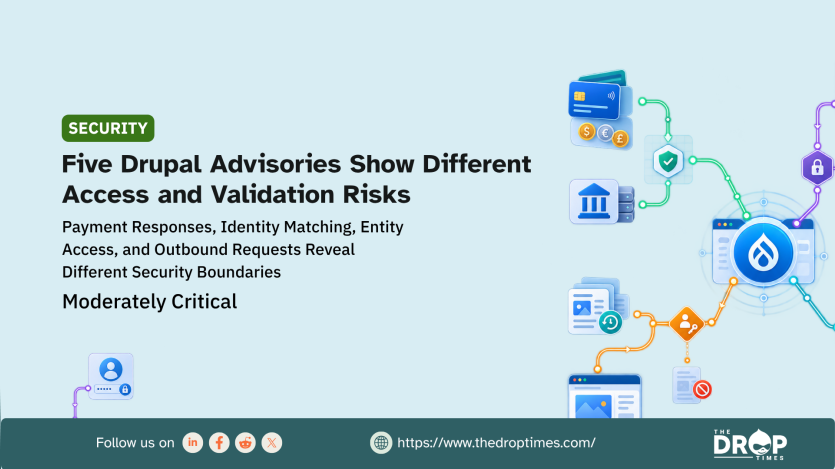
The Drupal Security Team published five Moderately Critical contributed-project advisories on 12 August 2026. Four concern access bypass vulnerabilities, while one concerns server-side request forgery. Commerce PayPal, Diff, Entity Share Websub, External Authentication, and Quick Tabs all have advisory-listed security releases, and all five carry an exploit-availability rating of theoretical.
The shared severity range does not indicate a shared technical failure. The vulnerabilities occur in payment-result validation, revision access, external identity matching, content rendering, and server-initiated network requests. Earlier Drupal advisories provide close precedents for some of those boundaries, particularly payment validation, database collation, and externally influenced requests, while the Diff and Quick Tabs issues are better treated as distinct access-control failures in the current batch.
Four Access Bypass Labels, Four Different Failures
SA-CONTRIB-2026-095 says Commerce PayPal does not sufficiently validate a transaction result under certain circumstances. A malicious user could cause a transaction to be treated as placed without payment. The vulnerability affects only sites using the Payflow Link payment gateway, and the Security Team recommends Commerce PayPal 2.1.3 or 8.x-1.12.
SA-CONTRIB-2026-096 concerns revision access in Diff. The module does not sufficiently restrict access to revision differences for non-node entities. Exploitation is mitigated because an attacker must already have a role permitted to view the underlying entity. The fixed releases are Diff 2.0.1 and 2.1.1.
The other two access-bypass advisories operate at different layers. SA-CONTRIB-2026-098 concerns exact matching of external authentication identities under certain database collations, while SA-CONTRIB-2026-099 concerns access decisions made while Quick Tabs renders nodes and blocks. Grouping all four solely as access bypass would therefore obscure where each affected decision is actually made.
Payment and Identity Checks Show the Strongest Historical Repetition
The Commerce PayPal issue has close precedents in other Drupal Commerce payment integrations. SA-CONTRIB-2026-058, published on 24 June 2026, found that Commerce Realex / Global Payments did not sufficiently verify the authenticity of a payment response when configured to use its redirect method. The security release added cryptographic verification against the merchant shared secret, while the lightbox method was not affected.
A related integrity problem appeared in Commerce Eurobank Redirect SA-CONTRIB-2025-066 on 21 May 2025. That advisory said the module did not sufficiently verify payment status on cancelled orders, allowing a specially crafted request to change an order to completed. The three advisories do not describe identical implementation defects, but each concerns a Commerce integration accepting externally mediated payment state without sufficient validation.
The recurring point is therefore narrower than a general claim about payment modules. Redirect or externally mediated payment flows create a boundary where Drupal receives information about an event performed through another system. Each integration must validate that returned state according to its payment protocol before treating the transaction or order as successfully paid.
External Authentication shows a separate recurring condition. Its advisory says externally supplied identity values were not always matched exactly when authentication mappings were stored and retrieved under affected MySQL or MariaDB collation settings. A database collation defines rules for comparing and ordering text, which can affect whether identity strings are treated as equivalent.
Drupal has encountered related collation-dependent identity problems before. SA-CORE-2024-004, published on 20 November 2024, addressed inconsistent uniqueness checking for certain Drupal user fields depending on the database engine and collation. OpenID Connect / OAuth client SA-CONTRIB-2026-027, published on 4 March 2026, later addressed another collation-dependent uniqueness problem involving externally authenticated users.

The External Authentication flaw is not the same vulnerability as either earlier advisory. It concerns exact matching of authentication mappings rather than Drupal's general user-field uniqueness checks. Together, however, the advisories demonstrate why an application's identity rules must remain consistent with the database rules used to compare stored values.
Entity Access Must Survive Reuse and Rendering
Quick Tabs provides the clearest Drupal-specific access-decision example in the batch. Its advisory says the module treated a neutral access result as a grant for node tabs and block plugins and performed no access check for reusable custom blocks. That could expose an unpublished node or reusable custom block to a user without permission to view it.
Drupal's AccessResult API explicitly distinguishes neutral from allowed. Its documentation warns that a result that is not forbidden may still be neutral and therefore not permitted, and directs developers to use isAllowed() when converting an access result into a yes-or-no decision. The Quick Tabs vulnerability turns that API distinction into a concrete content-exposure risk.
The advisory also limits the exposure scenario. A user with the administer quicktabs permission must select the affected content when configuring the tab, so an attacker cannot arbitrarily choose which item is exposed. Quick Tabs 4.3.1 corrects the affected access handling.
Diff presents an adjacent but distinct access-control problem. It provides another interface through which existing entities and their revisions can be inspected, and that interface must preserve the relevant access restrictions. The evidence supports comparing Diff and Quick Tabs as cases where existing content appears through another interface, but it does not establish a common underlying defect.
SSRF Reappears Where Drupal Makes Outbound Requests
SA-CONTRIB-2026-097 is the only advisory in the current set classified as server-side request forgery, or SSRF. The Entity Share Websub module supports content sharing through a hub-subscriber model, and its advisory says certain inputs were not sufficiently validated. SSRF occurs when insufficiently controlled input causes a server to make a network request to an unintended destination.
The vulnerability follows other Drupal SSRF disclosures from 2026. Drupal core SA-CORE-2026-008 addressed oEmbed URL discovery that could be used to make server-side requests to arbitrary URLs. OpenAI Provider SA-CONTRIB-2026-053 concerned insufficient sanitisation of user-supplied URLs.
Those projects serve different purposes and do not establish a common implementation flaw. The recurring boundary is created when user-controlled or externally supplied information can influence the destination of a request made by Drupal's server. That makes destination validation part of the security decision rather than merely an input-handling detail.
Site Teams Need Configuration Checks, Not Just Module Names
The security releases are direct, but exposure is not uniform. Sites using affected Commerce PayPal branches should update to 2.1.3 or 8.x-1.12; Diff should move to 2.0.1 or 2.1.1; Entity Share Websub should move to 1.1.2; External Authentication should move to 2.0.13; and Quick Tabs should move to 4.3.1. Applying the security releases removes the need to depend on the advisory mitigations as permanent controls.
Configuration review still helps teams determine where the vulnerable path existed. Commerce PayPal is limited to Payflow Link, External Authentication depends on affected MySQL or MariaDB collation settings, Diff requires permission to view the underlying entity, and Quick Tabs depends on affected content having been selected by an administrator. Entity Share Websub carries a target-distribution rating indicating that all module configurations are affected.
The theoretical exploit rating should also be read narrowly. Drupal's security-risk definition uses that rating when no public exploit code or documentation for developing an exploit is available. It does not make an affected version safe, and the availability of patched releases remains the primary response.
The five advisories identify several points where contributed modules must validate information or preserve access decisions as data moves between payment systems, identity providers, Drupal entities, presentation layers, and remote services. Earlier advisories make the payment, identity, and outbound-request patterns visible over time. Diff and Quick Tabs separately show why a shared access-bypass label still requires vulnerability-specific analysis.
References
-
Diff - Moderately critical - Access bypass - SA-CONTRIB-2026-096 (12 August 2026)

ASK: Drupal Community Needs Your Support
View all →
Disclosure: This content is produced with the assistance of AI.
Note: The vision of this web portal is to help promote news and stories around the Drupal community and promote and celebrate the people and organizations in the community. We strive to create and distribute our content based on these content policy. If you see any omission/variation on this please reach out to us at #thedroptimes channel on Drupal Slack and we will try to address the issue as best we can.

You may also like