




Drupal Tooling Digest Explores Single-Binary Setup, Agent Workflows and Live Updates

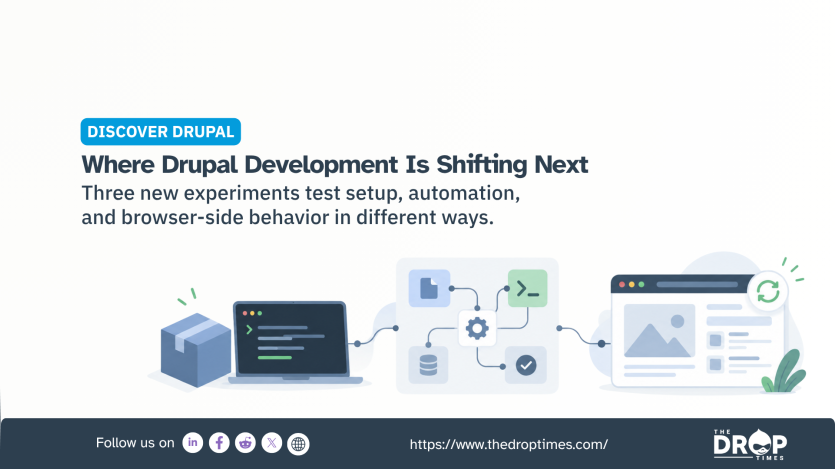
Three early-stage Drupal projects published releases or documentation between 22 and 23 September 2026 that test different parts of the development stack: how a local site starts, how automation exposes executable tools, and how browser interfaces receive updates. Drupack, ECA Tool and Drupal Live Update target separate layers rather than solving one shared problem. Their current maturity makes them projects to evaluate rather than defaults for production architecture.
Across the three projects, responsibilities that often sit around Drupal are being pulled closer to the application. Drupack packages more of the local runtime, ECA Tool connects Drupal automation with a general tool interface, and Drupal Live Update introduces a reusable channel-based mechanism for browser updates. The practical significance lies in the architecture each project is testing, not in treating the three as equally mature or supported.
Drupack Tests a Single-Executable Local Environment
Drupack takes the most immediately visible approach. In a blog post published 22 September 2026, Théodore Biadala, the project's creator, described a downloadable executable containing what is needed to start a local Drupal CMS site without separately installing Docker, PHP or Apache. The package uses FrankenPHP to serve the application and currently installs the Drupal CMS Mercury Demo in the directory from which it is run.
The experiment uses SQLite by default and can instead point to MySQL. Biadala published binaries for Linux, Windows and macOS, although he noted that he had not personally tested the Windows and macOS builds. He describes Drupack as an experiment and, for now, as another low-friction way to try Drupal.
Drupack therefore tests a narrower proposition than replacing established Drupal development environments. Its current question is how much of the path from downloading a file to running a local Drupal CMS instance can be collapsed into one executable. The published post does not present the project as a production replacement for established local-development tooling.
ECA Tool Connects Automation With Tool API
ECA Tool approaches a different boundary by connecting ECA with the Tool API in both directions. Version 1.0.0-beta1, released 22 September 2026 for Drupal 11.3 and 12, makes tools registered with Tool API available as ECA actions. An ECA model containing an event of type Tool can in turn become a tool that an AI agent or another Tool API consumer can call.
The module also defines access controls for both directions of that bridge. Executing a tool exposed from an ECA model requires the restricted execute eca tools permission unless the model specifies another permission, while Tool API tools invoked from ECA still run their own access checks. The tagged beta also defines typed inputs and outputs, operation metadata and a destructive flag that callers can use when deciding whether confirmation is needed.
ECA Tool remains a beta release and requires ECA 3.x together with a beta release of Tool API. That makes the integration substantial enough to evaluate while keeping its interfaces in a pre-stable phase.
Drupal Live Update Introduces a Shared Update Layer
Drupal Live Update extends the experimentation to browser-facing behaviour. Version 1.0.0-alpha1, released 23 September 2026 for Drupal 11 and 12, introduces generic live-update channels with Drupal-side access checks. Its first release includes a JavaScript polling transport, lets site builders enable live updates for placed blocks, and allows the browser client to receive either direct HTML payloads or refresh paths.
The alpha also provides a public API for publishing events and implementing channel access, together with a Chatroom integration provider. Its concrete delivery mechanism in the first release is polling, so the alpha is best read as an initial reusable update layer rather than a complete real-time transport stack.
Different Experiments, Different Maturity
The three projects should not be collapsed into a single maturity label. Drupack is explicitly presented by its creator as an experiment, ECA Tool has reached beta, and Drupal Live Update is at its first alpha. Those distinctions matter when deciding whether to test an architectural idea or depend on it in routine production work.
Taken together, the releases put experimentation at three points in the Drupal development stack: the local runtime, the automation interface and the connection between application events and browser state. Drupack reduces setup dependencies, ECA Tool makes executable capabilities portable between automation and tool consumers, and Drupal Live Update provides a common starting point for browser updates. Further testing and later releases will show whether any of these approaches move from useful experiments into routine Drupal development practice.
References
-
-
eca_tool 1.0.0-beta1 | Drupal.org (22 September 2026)
-
eca_tool 1.0.0-beta1 source | GitLab (22 September 2026)


ASK: Drupal Community Needs Your Support
View all →
Disclosure: This content is produced with the assistance of AI.
Note: The vision of this web portal is to help promote news and stories around the Drupal community and promote and celebrate the people and organizations in the community. We strive to create and distribute our content based on these content policy. If you see any omission/variation on this please reach out to us at #thedroptimes channel on Drupal Slack and we will try to address the issue as best we can.

Related People


You may also like