



Drupal GovCon 2026: From Site Building to AI Orchestration

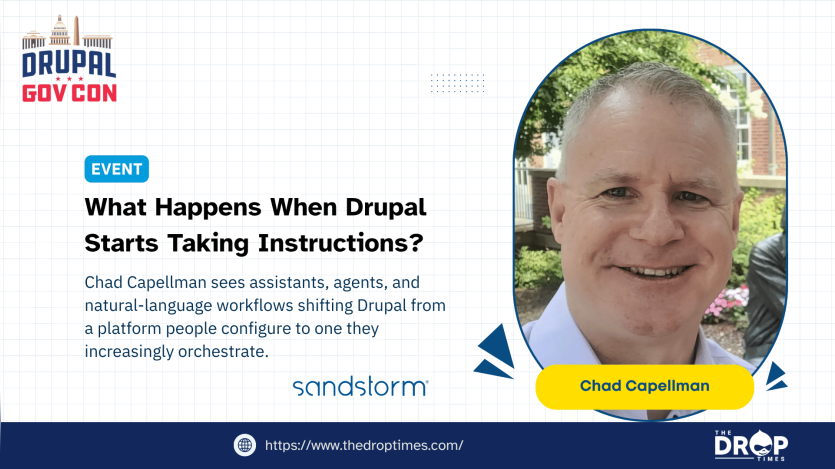
Editor’s Note: The DropTimes invited Chad Capellman to contribute this reflection following Drupal GovCon 2026. The views and interpretations expressed are his own.
I went into this year's Drupal GovCon telling myself to show up with a fresh mind and not assume I already knew what Drupal was, even though I have been architecting and articulating Drupal-based solutions for more than a decade.
I left realizing that the major shift wasn't really in Drupal itself, but how the world around it has amplified what it is uniquely positioned to support.
Drupal has always been one of the most robust platforms out there. The person who introduced it to me, in 2009, told me that Drupal isn’t a content management system. Rather, it’s a framework that lets you build anything, including a CMS.
That's never been more evident than right now, as AI reshapes what a "website" even means, regardless of what’s being used to build it.
There's an image that started surfacing in my mind. The early 1900s, when horses and early automobiles shared the same roads. Grainy film from that era showed what looked like chaos.
The day after a full day of hands-on Drupal AI training, I sat at lunch with someone from a federal agency who mentioned in passing that their entire intranet is still built out of hand-coded HTML pages, without a CMS, and no one can really search well for anything.
This was all the more jolting because less than 24 hours earlier, I managed to:
- Connect Drupal to specific LLMs
- Install modules and configure them to automatically modify the tone of content in addition to auto-generate alt tags
- Use AI to change the tone of content, even down to the paragraph level, and went with Samuel L. Jackson
The same internet is currently hosting both types of content, from technologies that feel worlds apart and at entirely different speeds.
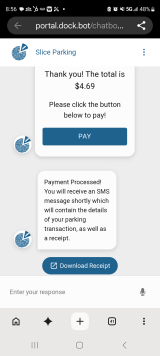
A parking transaction completed inside the Slice Parking chat interface, including payment confirmation and access to a receipt. Capellman encountered the experience the day after Drupal GovCon's AI training.
A parking transaction completed inside the Slice Parking chat interface, including payment confirmation and access to a receipt. Capellman encountered the experience the day after Drupal GovCon's AI training.
A day after the training, I paid for a parking space. To do so, I scanned a QR code. A chat window opened. I had a short conversation with it. I paid, and never left the chat. That was the entire interface and experience. Just a conversation and a couple of buttons inside it.
This encounter reminded me of the training portion that covered chatbots, built directly in Drupal.
Drupal's AI Assistants API lets you configure assistants for different jobs. Pairing an assistant with the AI Agents framework can turn that chat interface into something you can build with.
One of our trainers, Rod Martin, typed a single line into one, live, in the room. "Create a taxonomy vocabulary called tone, and add the following terms: happy, sad, angry, and mine." The taxonomy appeared, terms and all, before he finished talking.
That same conversational interface can support much more than building one list.
With the appropriate agents and tools, you can ask it for a longer list, a new type of page, or a set of fields using plain English. Configured differently, an AI assistant can also work with site content and provide a conversational interface for people looking for information. The underlying idea is similar even though the audience and configuration differ: the conversation can sit behind the scenes for site builders or become part of the experience presented to visitors.
We've been chewing on a version of this same question at Sandstorm. Earlier this year, we presented research at DrupalCon on how users actually choose between typing a search term and asking a chatbot a question, and the split isn't as clean as most teams assume.
“Site builders are going to start orchestrating Drupal instead of building it. This is the first step,” Rod Martin said.
As I stepped away from the training, this notion of orchestrating with Drupal followed me home and back to campus. When I crossed paths with the other trainer from that day, amazee.io AI Ambassador Matthew Saunders, he extended the idea of orchestration beyond Drupal itself to AI. (See the slides.)
“I believe that Drupal is becoming the number one open source AI harness, and I think we need to stop thinking about it as a CMS,” Saunders said. “I think we need to think about it as an operator for artificial intelligence. And it may do a lot of CMS-y things, which is great and cool [but] I think the actual strength of it is gonna end up being an orchestrator of artificial intelligence agents and so on.”
That idea isn't hypothetical for me. At Sandstorm, we’re building this kind of orchestration for a national healthcare advocacy organization, a Drupal platform that combines AI-assisted taxonomy generation, hybrid semantic and keyword search, and natural language querying across more than 10,000 regulatory and policy documents.
I’m a big believer in the idea of frameworks over rigid structures, especially when dealing with varying amounts of complexity and uncertainty.
This feels like one of those times, and with it lies tremendous opportunity within the obfuscation.
Whatever the ultimate solutions are or tools we use to adapt, it’s looking to me like Drupal has the potential to hit the right notes, when the instruments are in the right hands.
 Chad CapellmanMaking the internet better, 1-3 websites at a time.
Image Attribution Disclaimer: At The Drop Times (TDT), we are committed to properly crediting photographers whose images appear in our content. Many of the images we use come from event organizers, interviewees, or publicly shared galleries under CC BY-SA licenses. However, some images may come from personal collections where metadata is lost, making proper attribution challenging.
Our purpose in using these images is to highlight Drupal, its events, and its contributors—not for commercial gain. If you recognize an image on our platform that is uncredited or incorrectly attributed, we encourage you to reach out to us at #thedroptimes channel on Drupal Slack.
We value the work of visual storytellers and appreciate your help in ensuring fair attribution. Thank you for supporting open-source collaboration!
ASK: Drupal Community Needs Your Support
View all →
Note: The vision of this web portal is to help promote news and stories around the Drupal community and promote and celebrate the people and organizations in the community. We strive to create and distribute our content based on these content policy. If you see any omission/variation on this please reach out to us at #thedroptimes channel on Drupal Slack and we will try to address the issue as best we can.

Related Events


Related Organizations


Related People


You may also like