



NNEDV Seeks Drupal Vendors for $275,000 WomensLaw Project

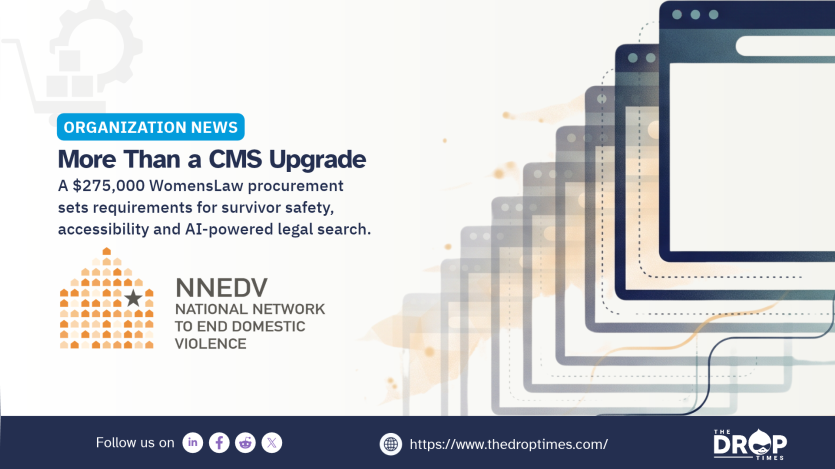
The National Network to End Domestic Violence (NNEDV) is accepting proposals from U.S.-incorporated businesses to migrate WomensLaw.org from Drupal 7 to Drupal 11. The request for proposals (RFP), issued on 5 November 2026, specifies a maximum budget of $275,000 covering website migration, enhancements and AI-powered search. Proposals are due by 8 January 2027.
The procurement seeks more than a replacement content management system. NNEDV wants the upgraded website to improve access to legal information while protecting visitors who may be using shared or monitored devices. For Drupal agencies, the requirements present implementation and testing challenges, particularly where website functionality cannot guarantee the removal of browsing traces or prevent device-level monitoring.
WomensLaw.org provides legal information and support resources for people experiencing domestic violence, sexual assault and stalking. According to the RFP, the website contains thousands of pages of legal information covering 55 U.S. states and territories and receives more than 3.9 million users annually. Its Drupal 7 platform reached the end of community security support on 5 January 2025. NNEDV plans to use Drupal 11 to improve accessibility, editorial administration and the site's capacity to support new technologies.
The first deliverable covers migration and website enhancement. Vendors must assess the existing content architecture, review custom and contributed module functionality, improve administrative workflows and preserve search visibility. The RFP calls for programmatically mapped data transfers using Drupal's core migration APIs, with AI assistance where appropriate. The upgraded website must support multilingual content, role-based permissions, version control and an editorial interface that non-technical staff can manage.
Survivor safety is a specific requirement within the migration scope. NNEDV specifies a quick-exit button, a disguised browser-tab option and what it describes as "no-content history behaviors". The website must use HTTPS, avoid browser fingerprinting, collect no personal data outside contact forms and include routine backups and a documented recovery plan. The solicitation also calls for privacy-preserving analytics and fonts that avoid third-party tracking, with Plausible suggested as an analytics provider.
These requirements must be evaluated against the limitations of web browsers and shared devices. A quick-exit button can redirect a visitor to a neutral website, but it cannot guarantee that the original visit disappears from browser history. NNEDV's Safety Net Project guidance explains that such controls can help visitors quickly switch websites when someone enters a room. They do not prevent another person from reviewing browser history or monitoring internet activity remotely.
Browser APIs impose similar limitations. The History API's replaceState() method can modify the current history entry but cannot erase all records of earlier visits. Likewise, the HTTP Cache-Control: no-store directive addresses response storage rather than providing a general browser-history deletion mechanism. A disguised tab title or favicon may reduce immediate visibility without hiding the website's address or preventing device-level monitoring.
For prospective vendors, acceptance testing could examine quick-exit behaviour across desktop and mobile browsers, accessible operation of safety controls, browser navigation after an exit and the visibility of sensitive search terms in URLs. Privacy testing could include reviews of network requests, analytics configuration, browser storage and server-side data retention. These are possible methods of evaluating the stated requirements, not tests that NNEDV has already conducted. The RFP also refers to zero-knowledge encryption without specifying which information it would cover or who would control the encryption keys.
Accessibility forms another substantial part of the procurement. NNEDV specifies conformance with the Web Content Accessibility Guidelines (WCAG) 2.2 and 2.1 at Level AA. Vendors must conduct initial assessments, prepare improvement plans, manually test accessibility, reassess the website and document their findings. The RFP also requires user testing of prototypes, mobile-first design and support for low-bandwidth connections.
Acceptance testing could include keyboard navigation, screen-reader access to state-specific legal information and content readability at increased zoom levels. NNEDV also requires visitors to be able to print pages or sections and download information as PDFs. These functions need to be accessible, although files saved or printed on shared devices may leave traces that the website cannot subsequently remove.
The second deliverable covers an AI-powered search tool intended to help visitors find relevant legal information. NNEDV requests two implementation options, one using Drupal 11 AI integrations and another using an external tool. The proposed system must use retrieval-augmented generation (RAG), draw from WomensLaw.org content and other intentionally supplied sources, and provide links to the underlying website pages. The RFP requests a "hallucination-free" tool and expresses a preference for directing visitors to legal information instead of generating interpretations of legal questions.
That requirement describes the intended outcome rather than a demonstrated capability. Retrieval-augmented generation does not guarantee accurate answers, even when the underlying sources are authoritative. Acceptance testing could examine whether the system identifies the appropriate jurisdiction, handles ambiguous questions and avoids presenting unsupported information as legal advice. NNEDV also requests attorney-curated language, automatic purging of searches and conversations, safeguards against malicious prompts and an option to avoid AI search.
The handling of sensitive disclosures would need to be established across Drupal and any external AI services involved in processing requests. Deleting a conversation from the website interface does not necessarily establish that associated information has been removed from other systems. The RFP also specifies supply chain security and web application security practices as part of the AI search implementation.
The solicitation requires human review of AI-assisted administrative work. Staff must be able to verify and approve generated content, taxonomy tags and alternative-text suggestions before publication. Separately, the website enhancement scope includes measures to improve discoverability through AI-powered search systems, manage automated crawling and encourage citations to WomensLaw.org.
The third deliverable covers administrative tools to identify amendments to cited statutes, report broken and potentially malicious external links, and manage information updates submitted by outside organisations. NNEDV requests separate fixed-price quotations for all three deliverables and an overall project quotation. Its stated maximum budget of $275,000 must cover Deliverables I and II, while no separate funding allocation for Deliverable III is specified.
Vendors must demonstrate Drupal development expertise, accessibility and user-experience capabilities, relevant experience with nonprofit, legal or mission-driven organisations, and the ability to provide post-launch maintenance. NNEDV expresses a strong preference for companies that have developed applications for populations at heightened risk of surveillance or targeting. Collaboration with external companies requires NNEDV's approval. The evaluation criteria also consider how proposals reduce long-term dependence on vendors and support sustainable website operations.
The official procurement notice provides access to the solicitation. Applicants must submit a single PDF containing the required company information, personnel details, a phased implementation plan, itemised fixed-price quotations, insurance documentation and references from at least two similar projects. The proposal section is limited to 12 pages, with a minimum font size of 12 points. Submissions must be emailed to [email protected].
The deadline for bidder questions was 20 November 2026, with responses expected by 1 December 2026. NNEDV anticipates awarding the contract by 22 January 2027, subject to changes in its schedule. The selected company is expected to begin discovery by February 2027, provide a finalised phased work plan by March 2027 and complete delivery by June 2028.
References
-
Request for Proposal: Drupal Website Migration and Enhancement, National Network to End Domestic Violence (NNEDV) (5 November 2026)
-
RFP: Website Migration and Enhancement (13 November 2026)
ASK: Drupal Community Needs Your Support
View all →
Disclosure: This content is produced with the assistance of AI.
Note: The vision of this web portal is to help promote news and stories around the Drupal community and promote and celebrate the people and organizations in the community. We strive to create and distribute our content based on these content policy. If you see any omission/variation on this please reach out to us at #thedroptimes channel on Drupal Slack and we will try to address the issue as best we can.