



Acquia Tells Cloud IDE Users to Delete Workspaces and Rotate Credentials

Developers using Cloud IDE must save their work before deleting their existing development environments and replacing associated credentials, according to Acquia. The company details these requirements in its customer-action documentation, published on 24 November 2026 and updated on 26 November at 14:40 UTC.
The instructions have consequences beyond individual development environments. Drupal application administrators, infrastructure teams and repository maintainers may need to coordinate credential replacement. Acquia reported that Cloud IDE was operational at 08:00 UTC on 26 November, but customers still need to complete the prescribed security actions.
Scope of the Security Incident
Acquia detected unusual activity within a limited number of its platforms and systems on 21 November 2026. The company activated its incident response plan and engaged independent digital forensic experts. Its first public service interruption notice appeared on 22 November at 15:41 UTC.
According to Acquia's preliminary findings, unauthorised individuals may have copied configuration data from customer environments. The information potentially included credentials stored as environment variables. Acquia temporarily took Cloud API administration offline on 22 November to replace credentials, although the company says customer websites remained operational during that maintenance.
An updated incident summary and customer Q&A, published on 26 November at 18:57 UTC, clarifies that the risk extends beyond environment variables. Acquia advises customers to treat credentials stored in its environments or accessible to application code running there as potentially exposed. This includes credentials associated with user accounts used with Acquia services.
Cloud IDE and Drupal Credentials
Acquia instructs Cloud IDE users to commit any work they wish to retain to a Git repository before deleting their IDEs. Customers must also remove the associated SSH keys from Acquia Cloud Platform and any repositories where those keys were authorised. Credentials previously used or stored within the IDE, including those entered through its terminal, require replacement.
The instructions specifically address production keys managed through Drupal's contributed Key module, which provides mechanisms for managing sensitive application keys. Acquia calls for replacing the production keys and then rotating the secrets they protect. Where applications rely on these keys to encrypt stored information, remediation requires coordination with the administrators responsible for that data.
The guidance also covers database passwords and Drupal's hash_salt value stored in IDE configuration files. Acquia warns that changing the salt will log users out and invalidate previously issued password-reset links. These consequences make credential replacement an application maintenance concern rather than an isolated development task.
Customer Actions by Service
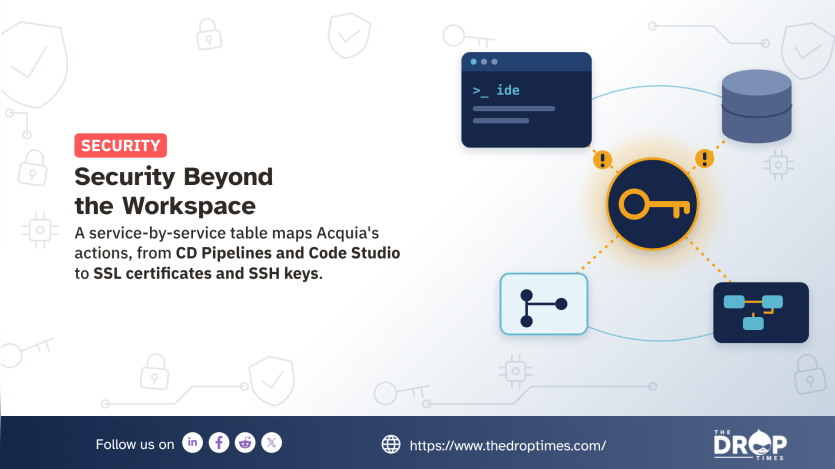
Acquia's consolidated guidance covers multiple products and customer configurations. The following table identifies the principal actions by service. Customers must consult the complete official instructions for the procedures and exceptions that apply to their infrastructure.
| Service or Customer Group | Principal Customer Actions |
|---|---|
| All customers | Replace at-risk credentials, review logs and block the identified malicious addresses where Acquia has not already done so. |
| Cloud IDE | Preserve work before deleting IDEs and replacing associated credentials. |
| Cloud Platform API | Replace invalidated tokens created before 9 May 2025. Newer credentials remain subject to the general rotation guidance where applicable. |
| Cloud CD Pipelines | Reactivate pipelines, reconnect external repositories and rotate encrypted secrets. |
| Code Studio | Replace access tokens and keys, rotate deployment secrets and renew third-party authorisations. |
| Connected services | Replace applicable credentials for Acquia DAM, log forwarding, Web Governance, Content Governance and Conversion Optimization. |
| Acquia Search powered by SearchStax | Replace read and write tokens. Acquia's consolidated guidance exempts Acquia Source customers from this specific action. |
| Customer-managed SSL/TLS certificates | Obtain replacement certificates with new private keys and revoke the old certificates through the certificate authority. |
| SSH users | Review authorised keys and replace private keys stored in Acquia services. Cloud Next and Multi-Experience Operations customers must also account for Acquia's infrastructure host-key changes. |
Acquia distinguishes removing a credential from an application from permanently invalidating it at the issuing service. The company instructs customers to delete and reissue third-party credentials rather than merely disable them. It also recommends limiting the permissions and lifetimes of replacement credentials where possible.
The incident response establishes two separate log review periods. Customers should examine credential-provider access records from 19 November 2026 at 09:59 UTC and network traffic associated with the identified malicious addresses from 16 November at 00:00 UTC. Acquia says it has already implemented the address-blocking measures for Platform CDN and Acquia Edge with Edge Managed Service.
Operational Consequences
A functioning Drupal website does not necessarily mean that its supporting services are fully operational. Deployments, backups and environment management tasks that rely on invalidated Cloud API credentials may fail until administrators update the corresponding integrations. Acquia also warns that log forwarding will remain interrupted until customers update the authentication details for their logging destinations.
Customers using single sign-on (SSO) with Web Governance face a separate configuration requirement. Acquia began rotating the login service's secrets on 26 November. Customers experiencing authentication failures may need to update their identity-provider configuration or contact Acquia Support.
Recovery and Investigation
Acquia's incident summary of 26 November states that its security engineering and forensic teams have found no evidence of ongoing unauthorised activity within the company's environment, based on the information available at the time. Acquia anticipates completing service restoration during the week beginning 30 November 2026. The estimate concerns operational recovery, not the conclusion of the forensic investigation.
The company acknowledges that it cannot guarantee the safety of newly introduced credentials while the investigation continues. However, it advises customers not to postpone credential replacement. Acquia says it will notify individual customers if investigators determine that their systems or data have been affected.
Acquia's service interruption update at 02:01 UTC on 27 November reports that restoration and security response activities remain underway. The company has committed to publishing a root cause analysis after the investigation concludes but has not provided a date. Customers should monitor Acquia Status, whose latest instructions take precedence over the consolidated customer-action documentation if the two differ.
References


ASK: Drupal Community Needs Your Support
View all →
Disclosure: This content is produced with the assistance of AI.
Note: The vision of this web portal is to help promote news and stories around the Drupal community and promote and celebrate the people and organizations in the community. We strive to create and distribute our content based on these content policy. If you see any omission/variation on this please reach out to us at #thedroptimes channel on Drupal Slack and we will try to address the issue as best we can.

Related Organizations


You may also like