

How the State Bar of California Rebuilt Two Public Websites on Drupal

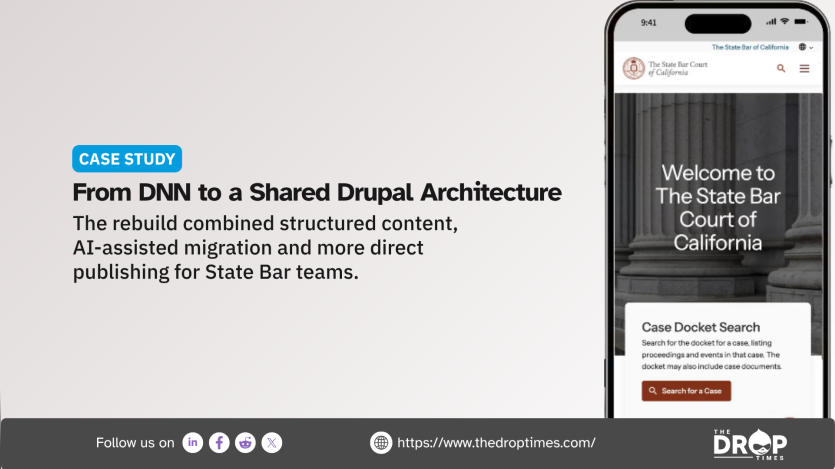
California's legal regulator, the State Bar of California, launched redesigned Drupal websites for itself and the State Bar Court in December 2025. The State Bar's 2025 annual report records the launch, while Kalamuna says the two sites share a common architecture but retain separate content and branding. Kalamuna developed the sites after the State Bar had already selected Drupal.
The State Bar's main website alone contained more than 2,700 pages and 2,200 documents and drew nearly four million visitors annually before the rebuild, according to its March 2024 redesign RFP. The same procurement record described more than 20 integrations across the DNN-based websites. That mix of regulatory information, external systems and public traffic made content fidelity, accessibility, search and maintainability central to the migration.
Drupal was not predetermined in the early procurement record. The March 2024 RFP called for a side-by-side CMS evaluation, and an October 2024 development RFI said the platform selection was still in progress. In written responses to The DropTimes, Kalamuna said it was not part of the initial redesign phase and joined only after the State Bar had selected Drupal. Its explanation of why Drupal fit the project is therefore retrospective rather than firsthand evidence of the comparative CMS decision.
Kalamuna said Drupal's open-source model avoided per-seat CMS licensing fees and reduced dependence on a proprietary vendor, while the State Bar's previous DNN setup carried licensing and support costs through another vendor. It also cited Drupal's accessibility considerations, structured content and multisite capabilities, along with fine-grained editorial workflows and permissions. Kalamuna pointed to the open-source community and long support horizon as useful for a regulator publishing complex, authoritative content over many years. Those points explain Drupal's fit from the implementation partner's perspective, but they do not reveal how the State Bar scored Drupal against other platforms.
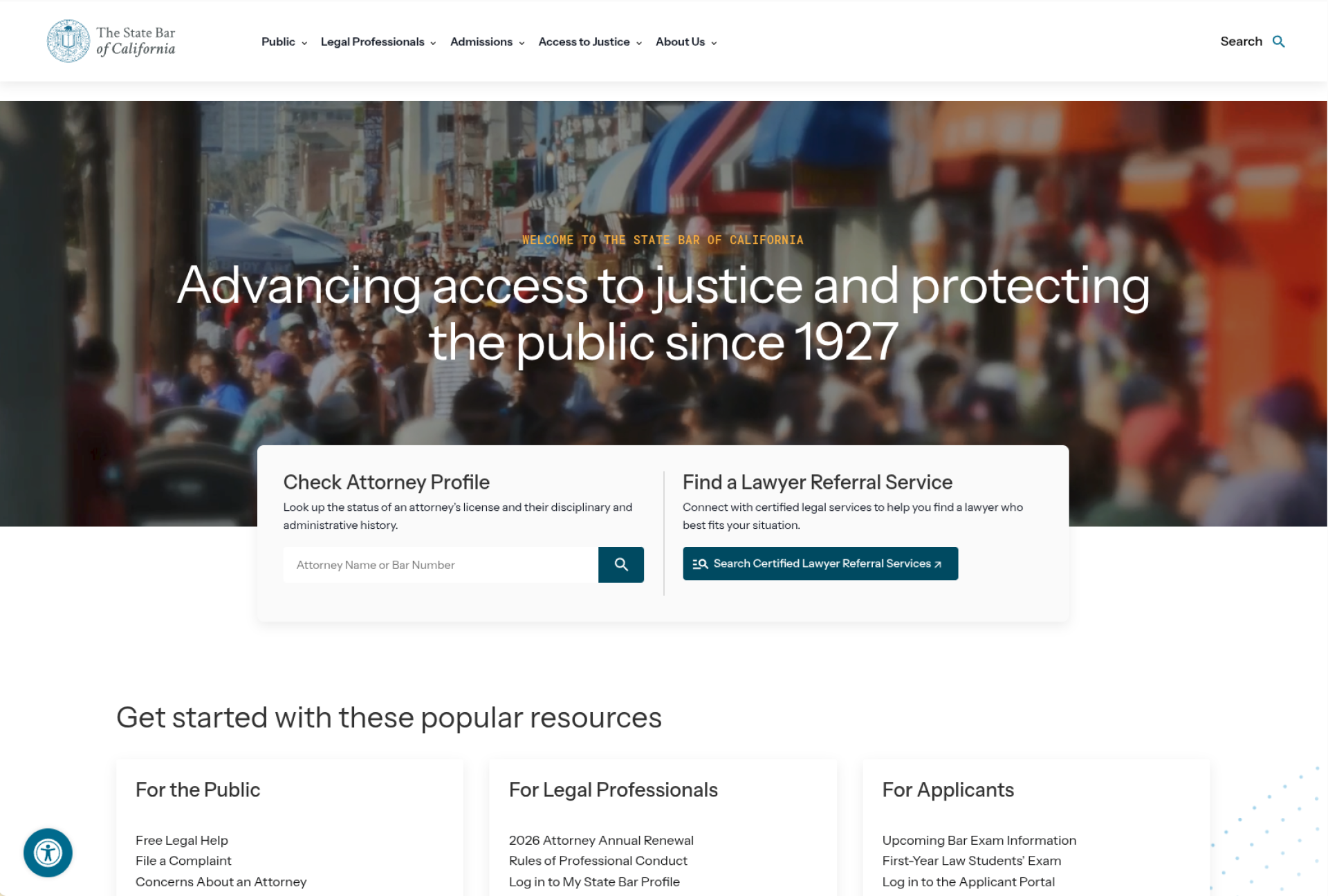
The finished sites share design components and governance while maintaining separate branding and content, according to Kalamuna. Kalamuna developed a component library for Drupal Layout Builder, templates for recurring content types, consistent styling patterns, documentation and workflows, and trained State Bar teams to use them. It also implemented faceted search across both sites, with filters including content type and date, plus search-driven landing pages for news, reports and data. A help centre aggregates frequently asked questions, while the component-based editing model gives content teams more control over landing pages.
The legacy estate also depended on more than 20 integrations. The redesign RFP listed systems including customer relationship management, Salesforce, My State Bar Profile, Agency Billing, Attorney Search, Power BI, Google Tag Manager and Google Analytics. Kalamuna says it re-coded several high-use external web applications as part of the Drupal migration. Its case study does not identify which applications were rewritten or disclose the technology behind the new faceted search.
Kalamuna says the State Bar maintained more than 5,000 PDFs covering rulings, rules, FAQs and related material. Working with the Justice Management Institute, Kalamuna developed a content governance approach and converted thousands of State Bar Rules PDFs into dynamic web pages. The case study does not establish that all 5,000-plus PDFs were converted, so the total source estate and the converted subset remain separate figures. Kalamuna also says it addressed display and organisation problems affecting current and historical board agendas and meeting materials.
Kalamuna's published case study labels the migration an "AI-powered scraped migration," but its written response to The DropTimes describes a more specific role for AI. The company said developers built AI-assisted processes to read poorly structured DNN content, identify meaningful parts and map them into Drupal's structured content model. Kalamuna said this pattern-recognition and reformatting work would have taken a team months by hand and was susceptible to subtle errors at scale.
Kalamuna said in its written response that "nothing the AI produced went live without oversight." A person reviewed migrated content before publication, with additional care for legally significant material, and Kalamuna said its team and the State Bar communications team checked completeness, structure and fidelity to the source. In that workflow, AI handled extraction and structuring while people remained responsible for what was published.
Accessibility and measurable site quality were part of the State Bar's procurement requirements before implementation. The March 2024 RFP preferred WCAG 2.2 at Level AA, while the October development RFI required at least WCAG 2.1 and called for accessibility, performance, usability and security testing reports. The State Bar's 2025 annual report says the redesigned sites adhere to accessibility guidelines, but the public sources reviewed by The DropTimes do not provide the project-specific test results. Kalamuna likewise said it could not yet point to a quantitative headline metric for post-launch improvement.
The clearest outcome Kalamuna identified is operational. On the DNN sites, it said routine content changes often required IT involvement, creating a technical bottleneck for ordinary editorial work. On Drupal, Kalamuna said the content team can make the great majority of those updates itself, replacing many ticket-and-wait workflows with direct publishing. Kalamuna described that shift as the outcome the State Bar raises most often and as part of building longer-term content capability.
Jorge Descaire, Director of Strategic Communications and Stakeholder Engagement at the State Bar of California, said in comments supplied with Kalamuna's written responses that the implementation team presented multiple technical options and helped the State Bar assess them against the needs of different audiences. Descaire also emphasised the team's user focus, communication, proactive advice, transparency and technical support during the project. Those comments describe the State Bar's experience of the implementation process rather than independent measures of site performance or accessibility.
Several technical details remain outside the public record reviewed for this case study. Kalamuna says it upgraded the platform to the "latest Drupal versions," but neither its case study nor the State Bar records examined here identify the Drupal core version, hosting arrangement, search backend or exact number of converted documents. The available evidence is stronger on migration method and editorial workflow than on quantitative post-launch performance. For Drupal practitioners, the documented value lies in the combination of structured content, shared architecture, human-reviewed automation and reduced routine dependence on IT rather than a claim of measured platform superiority.
 Allen JasonAllen without organs
Image Attribution Disclaimer: At The Drop Times (TDT), we are committed to properly crediting photographers whose images appear in our content. Many of the images we use come from event organizers, interviewees, or publicly shared galleries under CC BY-SA licenses. However, some images may come from personal collections where metadata is lost, making proper attribution challenging.
Our purpose in using these images is to highlight Drupal, its events, and its contributors—not for commercial gain. If you recognize an image on our platform that is uncredited or incorrectly attributed, we encourage you to reach out to us at #thedroptimes channel on Drupal Slack.
We value the work of visual storytellers and appreciate your help in ensuring fair attribution. Thank you for supporting open-source collaboration!
ASK: Drupal Community Needs Your Support
View all →
Disclosure: This content is produced with the assistance of AI.
Note: The vision of this web portal is to help promote news and stories around the Drupal community and promote and celebrate the people and organizations in the community. We strive to create and distribute our content based on these content policy. If you see any omission/variation on this please reach out to us at #thedroptimes channel on Drupal Slack and we will try to address the issue as best we can.

Related Organizations

You may also like