



Scott Falconer Makes Drupal Growth Focus of Board Candidacy

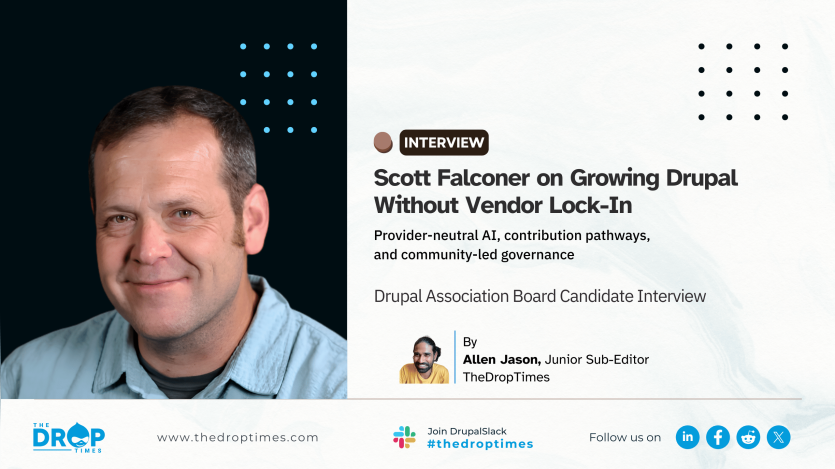
Longtime Drupal contributor Scott Falconer says his candidacy for the Drupal Association Board is shaped by an ambitious concern: how Drupal can grow while keeping AI-assisted development provider-neutral, portable, and accountable to the community.
In written answers to The DropTimes’ Allen Jason, Falconer connects AI-assisted contribution, digital sovereignty, enterprise support, conflict-of-interest safeguards, and community-led product direction through a common question: how the Association can expand Drupal adoption without allowing any single company, vendor, or model to become irreplaceable.
Falconer has been active on Drupal.org for about 20 years and currently serves as Senior Director, Drupal, Applied AI, & Agent Success at Acquia. His Drupal.org profile lists him as a maintainer of the Drupal AI Initiative, AI Best Practices for Drupal, and the Drupal AI Learners Club.
Drawing on that experience, he argues for open standards, data portability, transparent funding, distributed leadership, stronger contribution pathways, and direct investment in documentation, onboarding, mentorship, and the first-site experience. His stated measure of success is deliberately ambitious: twice as many active Drupal sites in production at the end of a board term as at the start.
This interview is part of The DropTimes’ series with candidates for the at-large seat on the Drupal Association Board. The DropTimes sent each candidate five common questions and two candidate-specific questions to help readers compare their priorities, experience, and approach to the Association’s role.
Interviews in this series are being published as candidates return their completed responses.
TDT [1]: As AI-assisted and agentic site-building grows, what role should the Drupal Association play in protecting Drupal’s open-source values, data privacy, maintainer well-being, and freedom from vendor lock-in?
Scott Falconer: To me, Drupal is best understood not just as software, but as an accumulation of hard-fought decisions by many dedicated individuals over many years. These individuals, coming together as a community, make Drupal something bigger and incredibly special to many of us. As a result, protecting our values and ensuring that anyone from anywhere in the world can personally benefit from Drupal—as a user, as a maintainer, or as a member of the community—is a critical obligation of the Drupal Association.
That obligation extends to data privacy as well—site owners should always know and control what data leaves their site for any provider, with consent and portability treated as defaults rather than afterthoughts.
In practice, this means supporting open standards that protect user sovereignty and access, including things like MCP, contributing upstream to shared tooling such as the official PHP SDK for MCP, and continuing to support open APIs and standards within Drupal core and contrib. At the same time, the Drupal Association should not dictate a specific AI implementation, but it should use the levers it does have, including funding, partnerships, infrastructure, and convening power, to ensure that the work it supports remains provider-neutral and portable without creating a dependency on any single vendor.
The DA should also continue working to ensure that AI-assisted contribution does not transfer additional review and maintenance work onto already stretched maintainers.
The person or organization contributing AI-assisted work must remain accountable for its quality and security and be willing to stand by the contribution.
TDT [2]: Drupal benefits from enterprise users, agencies, and public institutions, but contributions are still uneven. What should the Drupal Association do to turn more of that use into visible support through developer time, code, documentation, infrastructure, or funding?
Scott Falconer: The number one thing that can be done to increase contributions is to increase adoption of Drupal. The foundation of Drupal contributions is that people use the product, and some of them choose to give back. These types of contributions are critical, as the natural pressure often aligns well with real-world problems and opportunities. Beyond increasing adoption, the Drupal Association should continue to guide the contributor experience, ensuring that anyone interested in contributing can do so in a safe, effective, and fulfilling way that aligns with Drupal’s values.
Adoption creates the opportunity for contribution, but it does not automatically convert use into support. The Drupal Association can make that conversion easier by giving organizations concrete, correctly sized ways to contribute developer time, documentation, infrastructure, maintainer funding, or direct financial support, and by making those contributions visible and meaningful.
As for specific initiatives, the Drupal AI Initiative is a great example of how the Drupal Association can enable enterprises and other contributors to come together in a way that helps everyone. Enterprises and their employees often have a desire to contribute, but without structure and a bit of convincing, those programs have difficulty taking off. The little extra push from the Drupal Association can be the difference between “we’d like to” and “we did it.”
TDT [3]: How should the Drupal Association balance investment in enterprise tooling with simpler entry points for junior developers, hobbyists, and new site builders?
Scott Falconer: I don’t think it’s an either-or. Things like the Outside AI track of the Drupal AI Initiative are providing functionality that is increasing adoption among large-scale enterprises while also making it easier for those new to Drupal to try out and experiment with Drupal.
The kind of investment I prefer is shared capabilities that lower the barrier to entry while also supporting Drupal at scale. We should also protect direct investment in documentation, onboarding, mentorship, and a successful first-hour/first-site experience.
In the rare case where it really comes down to “should we support the enterprise or should we support the individual,” I think it should be evaluated based on which opportunity creates the most sustainable growth for Drupal usage and the community without narrowing who can participate.
TDT [4]: If digital sovereignty is increasingly defined through national ownership, where does that leave a global open-source project like Drupal? How should the Drupal Association argue that distributed international stewardship can offer a credible form of sovereignty?
Scott Falconer: We prove it by doing. A recent example is the temporary global suspension of Fable 5 following a U.S. export-control order. Although access was restored, my assumption is that we will see more regulatory limitations like it. Access to frontier models is also increasingly unevenly distributed due to economic considerations, and my assumption is that this will also increase.
Open source offers a different kind of sovereignty: the ability to inspect, operate, modify, self-host, and move your system and data without needing permission from anyone else.
Distributing this via international stewardship also means there is no single switch that can turn Drupal off for everyone.
Those of us who have access to frontier models should use that access to create improvements for the commons wherever possible. At the same time, we should advocate for, build for, and protect the ability of users to control their own destiny as to what tools, data, compute, or access they personally feel is right for them.
The Drupal Association should reinforce this through open standards, data portability, transparent governance, and meaningful participation across regions and languages.
TDT [5]: How would you handle board decisions where your role at Acquia could be perceived as overlapping with Drupal Association responsibilities?
Scott Falconer: As a member of the Drupal community for a decade-plus prior to joining Acquia, the independence of the Drupal Association is critical to me. I’m a relatively transparent person, and those who have worked with me via the Drupal AI Initiative know that I will openly talk about what Acquia’s strategy is and where it informs my decisions. But even as a longtime employee of Acquia, if it’s a Drupal vs. Acquia decision, Drupal comes first.
Trust from the community that their best interests are being upheld is critical, so for clear-cut cases of conflict, or decisions directly related to Acquia where my independence could reasonably be questioned, I would disclose the conflict early and recuse myself from the discussion and vote. I would expect the same standard from anyone representing any other organization.
TDT [6]: As Drupal’s AI and product direction develops, what safeguards would help ensure that strategic decisions remain community-led rather than shaped too heavily by any single company?
Scott Falconer: The Drupal AI Initiative is a great example of this already in practice. All 32 partner organizations, alongside individual contributors, have a direct say in the decisions and direction of the initiative. The competing values and goals of these organizations have helped drive and frame the focus of what’s being done. This also includes ensuring that the values and goals of community members who are hesitant about or concerned by AI use are addressed and considered as first-class views.
Broad participation is an important safeguard, but it is not the only one. We should also have public roadmaps and backlogs, clear decision rights, transparent funding and organizational affiliations, distributed leadership, public reviews, and architectural principles that prevent any single model or vendor from becoming irreplaceable.
Community-led does not mean companies have no voice. It means no single company has the deciding voice, and important decisions can be challenged in the open.
TDT [7]: If elected to represent the community on the board, what is the single most important, measurable outcome you intend to deliver by the end of your term, and what specific metrics do you want the community to use to evaluate your success?
Scott Falconer: Growth of Drupal. Most of us are here because we love Drupal and we love the community. Many of us are fortunate to have been able to build a career on Drupal. Continued growth of Drupal is key for us to keep doing what we love alongside a community that is incredibly important to us.
As for a specific metric, I would like there to be twice as many active Drupal sites in production at the end of my term as there were at the start. That is deliberately ambitious, and I may fail, but it is the scale of growth I believe we should be working toward.
 Allen JasonAllen without organs


ASK: Drupal Community Needs Your Support
View all →

Disclaimer: The information provided about the interviewee has been gathered from publicly available resources. The responsibility for the responses shared in the interview solely rests with the featured individual.
Note: The vision of this web portal is to help promote news and stories around the Drupal community and promote and celebrate the people and organizations in the community. We strive to create and distribute our content based on these content policy. If you see any omission/variation on this please reach out to us at #thedroptimes channel on Drupal Slack and we will try to address the issue as best we can.
Related Organizations