



Dan Frost on Drupal’s AI-Ready Architecture, Controlled AI, and AI-Mode SEO


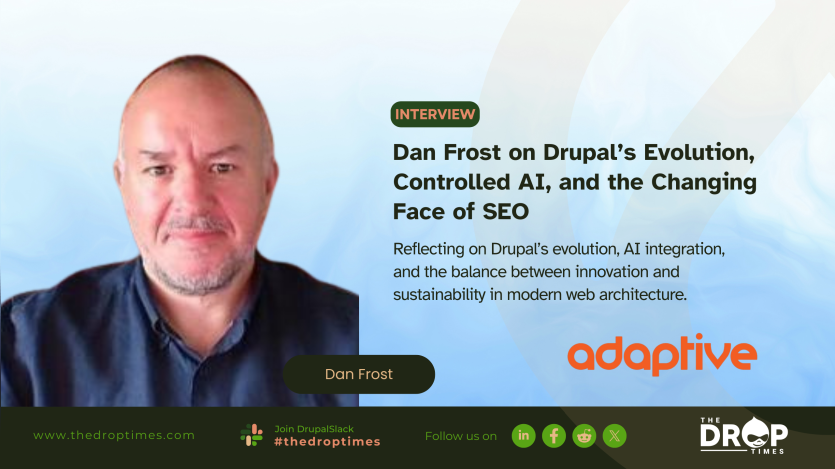
Resilience, controlled AI, and structural sustainability are becoming central to how organisations evaluate Drupal builds and digital strategy in 2026. In this interview, Dan Frost discusses Drupal’s architectural evolution, the practical limits of AI integration in enterprise environments, and the shifting relationship between SEO, PPC, and AI-driven search.
Dan Frost’s career spans more than two decades across software development, IT infrastructure, cybersecurity, digital publishing, and performance marketing. A decade with the Daily Mail Group shaped his understanding of large-scale digital operations, while subsequent agency work refined his focus on long-term platform sustainability. Today, he serves as Managing Director of Adaptive, a Drupal agency specialising in AI, development, hosting, security, and support, and as Chief Technical Officer at The Digital Marketing Partners (TDMP), where search strategy and performance marketing intersect with technical architecture.
Across 25 years in the field, Dan has worked through multiple technology cycles—from early content management systems to modern AI-assisted development environments. His perspective is shaped less by novelty and more by maintenance: what holds up over time, what scales under pressure, and what becomes fragile as organisations grow. That lens informs Adaptive’s work with Drupal, particularly around conversational interfaces, controlled AI implementations, and the long-term implications of headless architecture.
In this interview, prepared by Kazima Abbas, Sub Editor at The Drop Times, and conducted via video by Alka Elizabeth, Sub Editor, Dan discusses the evolution of Drupal, the structural impact of Drupal 8, the realities of AI integration in enterprise environments, and the shifting relationship between SEO, PPC, and AI-driven search. The full video conversation will be published soon.
Highlights
|
TDT[1]: You have 25 years of experience in the digital world. Your career spans software development, IT, cybersecurity, and earlier, you were associated with the Daily Mail Group. What did those early roles teach you about how digital systems fail or succeed in large organisations?
Dan Frost: I started my career in a small software agency, working with really talented people. We punched above our weight and delivered a lot of good work, but we operated at the end of the market that was difficult to serve—SMEs with very high expectations.
I was 17 when I started, so I learned an enormous amount very quickly. Moving from that small, fast-moving, very dynamic, slightly chaotic environment into corporate life was extremely valuable. It allowed me to see how things could and should be done properly, and corporate environments had the budgets and facilities to follow through on ideas.
I adapted well to corporate life initially, but as I moved further up the organisation, change became slower. It became harder to effect change at the speed I wanted. The role gradually became more about politics than technology, and that wasn’t for me. That’s ultimately why I moved on.
However, having worked in both small and large environments was incredibly valuable. You get the benefits of agility from smaller organisations and the structural discipline of larger ones. That’s something I’ve tried to carry through into Adaptive, maintaining agility while also thinking seriously about maintainability, security, and long-term sustainability.
It was a very valuable experience overall.
TDT[2]: At what point did you encounter Drupal?
Dan Frost: When I left the Daily Mail, I initially took one other developer with me. We intended to build platforms that the Daily Mail wasn’t building at the time. We built portals for jobs, cars, and homes, which were essentially the newspaper’s core classified areas, and we also built some additional technical tools.
Those projects were progressing reasonably well. However, the Daily Mail came back to us and asked whether we could build several websites for them.
Matt Burke, who is now co-founder at Adaptive, found Drupal and suggested we use it. I initially said we should stick with our own content management system and use that instead. He ignored me and built the new website in about three days.
That’s how we came across Drupal. Once Matt showed me what it was capable of, it was a no-brainer. Even back then, it was extremely powerful. It could do things that very few other platforms could do at the time. The structure lent itself to flexibility, and it was data-driven, which aligned well with our background.
From there, we started building websites for the Daily Mail using Drupal and gradually left the other platform projects behind. Eventually, we decided to create an agency focused on Drupal.
TDT[3]: How has Adaptive’s journey with Drupal evolved over the years, especially through Drupal 7 to Drupal 8, Drupal CMS 2.0, and recent AI developments?
Dan Frost: It’s been really good overall because Drupal has moved with the times. There have been difficult periods. The move from Drupal 7 to Drupal 8 was particularly challenging. At the time, it was painful.
…But in hindsight, it was an absolute masterstroke. Drupal 8 and everything above it play very nicely with AI. The architecture lends itself to AI integration.
We’ve also avoided many of the problems other platforms have faced, such as security issues, open-source licensing challenges, and structural limitations. Drupal has been a very good choice for us.
Increasingly now, especially with AI-assisted development, the real skill isn’t just in writing code. It’s in knowing how to put systems together—securely, in a scalable way, and in a maintainable way. Whether you know PHP or another language still matters, but it matters less than it used to. Architecture and systems thinking are more important.
Looking ahead, I genuinely think Drupal’s future is headless.
In the past, I wasn’t a big fan of headless because it effectively meant maintaining two systems, Drupal on the backend and a separate frontend. That often introduced unnecessary complexity, and in many cases, there wasn’ta strong justification for it.
However, now things are changing. If you build Drupal correctly and expose content in the right way, you can bring a lot of frontend development closer to the customer. There’s a journey toward that; it’s not a binary shift, but I do see Drupal moving increasingly in that direction. So overall, it’s been an excellent platform for us, and I think the coming years are going to be very interesting.
TDT[4]: Over those 25 years, you’ve witnessed how teams managed upgrades, infrastructure, and security. What convinced you that digital platforms needed a more sustainable, long-term approach than most organisations were taking?
Dan Frost: Because I had to maintain them. I worked in support, I worked in IT, and I knew what good looked like.
One of the mantras in my time at the Daily Mail was always, “Get the newspaper out.” That was the number one priority. That mindset has stayed with me. I’m someone who builds a backup plan on top of a backup plan.
Working with other agencies and departments, I often saw too much reliance on hope that things would go well, rather than engineering for resilience. We work from a position of resilience and scalability first, and then expand from there.
Because I’ve had to look after systems long-term, my starting point is always: what is this going to look like in three, four, five, or six years? That’s probably one of the reasons we’ve enjoyed such long relationships with clients. When we build something, we think about how it could evolve. What will they want next? How might this feature logically expand?
Sometimes that means we potentially over-engineer. But nine times out of ten, that pays dividends. Clients often return and ask for enhancements, and we can say, “That’s fine—here’s how we extend it,” because we already anticipated it.
We don’t just deliver to a specification. We try to deliver a solution, and think about what it should do next and how it might be reused elsewhere. Long-term maintainability and making considered choices on platforms and technology stacks are critical.
It’s baked into how we work because I’ve lived through maintaining these systems.
TDT[5]: Was that mindset what motivated the foundation of Adaptive? What gap were you trying to address in the market?
Dan Frost: When we first set out, we were building classified-style platforms, similar to what later became Rightmove or AutoTrader. That was the original intention when I left the Daily Mail.
We then had a decision to make: do we pursue those relatively high-risk platform ventures, or do we become an agency?
The honest answer is that it came down to risk. We had a great platform in Drupal. We had a strong customer relationship with the Daily Mail. It was the obvious and lower-risk route to apply our skills to building websites for them.
That decision then grew organically. We started with Daily Mail, got introduced to other organisations, and expanded quickly, from two people to eight, to twelve, and at one point, nearly thirty.
So it wasn’t a grand strategic plan. It was the right place, right time, and a good choice with Drupal.
We were very technical in those early days and less focused on marketing. Some of the things we built were ahead of their time. Over time, I learned SEO because I had to, and that knowledge paid dividends. But fundamentally, becoming a Drupal agency evolved naturally from the circumstances.
TDT[6]: Adaptive spans Drupal development, hosting, security, UX, integrations, and AI. What principles guide your decisions about which technologies to introduce into your stack and which to avoid?
Dan Frost: It comes down to balance. One of the first things we consider is the fit with the team. We do not bring in completely random technology stacks. We are fundamentally a PHP and Linux-focused team. That is our background and our strength.
We try to avoid introducing completely new concepts unless there is a strong justification. Sometimes you do need something different. For example, there may be a particular task where using Go or another language makes sense. But when we do that, we work very hard to spread that knowledge across the team.
We do not want a single point of failure, one person being the only expert in something. That again comes from my IT background. You cannot afford to have knowledge locked into one individual. If that person leaves or is unavailable, the system becomes vulnerable.
So there is a cultural and operational element to technology choice. We ask whether the stack fits with what we already use. Is it a logical progression from our existing tools? Does it integrate naturally? Or are we introducing unnecessary complexity? Then we look at support. What is the support ecosystem like? Is it well-maintained? Is it secure? Is it actively developed?
We like SaaS products where possible. Software as a service removes a layer of maintenance overhead. If we are not using SaaS and we are building something on our own infrastructure, we design maintenance into it from day one. That includes keeping software up to date, ensuring patches are applied, and planning for lifecycle management.
We obviously use cloud computing, but even there, maintenance is part of the architecture, not something bolted on later. So it is not one single principle. It is a combination of team fit, knowledge distribution, support, security, maintainability, and long-term sustainability.
We do not tend to build hugely disparate stacks internally. When using SaaS, the underlying technology matters less; for example, whatever powers GitHub is irrelevant to us because we are consuming it as a service. But for systems we are responsible for directly, we stay within technology stacks we understand deeply. That discipline is intentional.
TDT[7]: You’ve led technical teams for more than 20 years. How do you create an environment where deep engineering, rapid delivery, and long-term platform support can coexist?
Dan Frost: With difficulty. It is challenging. You have to create the right culture. That starts with having the right people in the right roles, square pegs in square holes. That can evolve over time because people change. We have had a team that has been together for a long time, and individuals’ interests and strengths shift. We try to accommodate that.
It is about making sure people feel heard. These are experts in their areas. They need a voice. Not every idea will be a winning idea, none of us gets it right all the time, but how you respond matters. Particularly in DevOps and in the current AI era, new ideas emerge constantly. I want the team to innovate. I want them to explore solutions. We want to talk about new approaches. But we do not adopt everything.
If someone proposes something new, it is not enough to simply say yes or no. It is about explaining the reasoning. If we decide something is not right for us at that moment, we explain why, whether it is due to timing, risk, resource allocation, or alignment with our direction. You take people with you in that decision.
Because I am technical and have become more involved again due to AI developments, I can engage in those conversations. When it gets into deep detail, they are far better than I am in their respective areas. But at the strategic level—overall direction, architecture, and positioning—I can contribute meaningfully. That leadership perspective helps.
A practical example was during COVID. Before that, we had built and maintained our own complex infrastructure within AWS. It was sophisticated and worked well. But COVID forced us to reassess. We were dedicating three or four people to maintaining the infrastructure. That maintenance load was becoming disproportionate. It was almost the tail wagging the dog, too much focus on infrastructure management, not enough on broader business and client value.
So we made the decision to move to Pantheon. Pantheon started as a Drupal-specific platform and expanded into supporting other CMSs. It is a SaaS product. Financially, it was more expensive in direct cost terms. But from an overall business perspective, culture, time allocation, and focus, it was absolutely the right move.
Instead of maintaining infrastructure ourselves, we shifted that responsibility to a platform built for it. That freed our team to focus on delivering value elsewhere.
We also tend to invest in enterprise versions of tools, GitHub Enterprise, and Atlassian Enterprise. That likely comes from my corporate background. It is not about saving small amounts of money at the expense of efficiency. Time, capability, and results matter more. So balancing engineering depth, delivery speed, and long-term support is not simple. It requires conscious trade-offs, cultural alignment, and strategic platform choices.
TDT[8]: 'Interact' was developed in response to Google’s AI mode and conversational search. Why did you feel Drupal needed a controlled, transparent approach rather than relying on third-party AI?
Dan Frost: It really comes down to guardrails and observability. We work with a number of charities, and when we began developing Interact, we launched with four of them in what was effectively a pilot scheme. We listened carefully to their concerns. A major concern, and this is becoming more significant, is uncontrolled AI. AI running without clear boundaries or oversight creates risk.
With Interact, we use AI in a very specific way. It works on a defined corpus of content that we control. In most cases, that means the content on the website itself. That content is structured and managed, so when responses are generated, they are grounded in that defined dataset rather than the wider web.
It depends on the configuration, but for many of our implementations, the AI only uses the content that exists on that site. That ensures accuracy and relevance. It also means behaviours can be controlled.
Observability is equally important. Our customers can see the chats. They can see what questions are being asked and how the system is responding. We have built reporting around it so they can analyse conversation types, areas of interest, and usage patterns.
Simply sending queries to a general AI system and hoping for the best is not a responsible approach. I am a strong advocate of AI, but I advocate controlled AI.
Context is critical. It is about giving AI the right context and the right boundaries so the output is appropriate.
If AI is left too broad, you will see problems. There have already been examples of AI systems producing inaccurate or inappropriate outputs. That will continue if systems are not managed properly.
The broader the question, the broader the answer. So what we try to do is steer AI down specific routes, within defined content, with visibility into how it is operating. That approach has worked very well. Clients are seeing strong results, and they are comfortable because they understand how the system is behaving.
TDT[9]: Which sectors are showing the strongest interest in conversational UX and AI-assisted journeys?
Dan Frost: It is slightly a self-fulfilling situation because the majority of our clients are in the charity sector.
Charities are very receptive to it, particularly because of the impact it is having. I will explain that in a moment. Education has shown interest. I have spoken to a couple of universities, and we have ongoing conversations. However, budgets are tight in UK education at the moment, and there is also some hesitation around AI. There is still an education piece to do there.
In the public sector, there is also caution. I think in some cases it is driven by concern about risk. Larger organisations tend to be more cautious. With charities, especially the larger ones we work with, we have long-standing relationships with their digital teams. There is trust. They understand what we are doing and how it works, which makes adoption easier. We are currently doubling down on the charity sector because of the measurable impact it can have there.
There are strong use cases in education. Conversational search would work very well in that environment. Fundamentally, what conversational interfaces bring is the ability for users to speak in their own terms.
A traditional website is prescriptive. It has to cater to many different audience types, use different vocabularies, and structure content in a particular way. A user might be one of fifty personas trying to use the same website for very different purposes.
With a conversational interface, the user simply asks the question they want answered. That is why we have seen such rapid adoption of systems like ChatGPT and similar tools. Users are no longer piecing together answers from multiple pages. They are asking directly for what they want to know. That behavioural shift is significant, and I believe it is here to stay.
We have seen this reflected in data. For one client that works to educate farmers in less developed regions, sharing best practices to improve agricultural yields across Africa, India, and South America, we implemented AI mode. After implementation, we saw a fourfold increase in returning visitors among users who engaged with the AI mode. Those users also visited significantly more pages, often up to ten times more pages, because they were being guided more effectively around the site.
We also observed a threefold increase in downloads. So the engagement impact is measurable. It demonstrates that conversational interfaces help users find relevant content more efficiently and engage more deeply. It is still relatively new for some users. Some people land on a site and do not immediately understand what the AI interface is for. But those who do use it tend to see strong benefits.
For us, the charity sector is currently leading adoption, but the potential extends well beyond that.
TDT[10]: You wrote that AI mode could become the default search experience by 2026. How does this affect organisations relying on SEO and PPC?
Dan Frost: There are two parts to this. One is AI mode on websites, which we have already discussed in terms of conversational interfaces. The other is AI mode within search engines, particularly Google, and what that means for SEO and PPC.
What Google is currently navigating is how to innovate with AI while protecting what has historically been its main revenue driver, which is PPC. PPC still represents a significant proportion of its revenue. YouTube is also strong, but search advertising remains critical. So Google is trying to balance user experience improvements with monetisation.
Over the last twelve months, there has been more flux in how search results are presented than in the previous ten years. AI overviews appear at the top. Ads are increasingly blended into results. Organic listings are often pushed further down the page. The presentation layer is shifting rapidly.
I believe Google will do well financially from this shift. Ads are increasingly becoming part of conversational experiences. Google has already indicated that advertising will be integrated into AI-driven results. That effectively expands their inventory.
In terms of SEO, the traditional idea of ranking number one is changing. In many searches, the top organic result now appears below AI overviews and advertisements.
However, with good SEO, you can appear within AI overviews. You can be cited within AI-generated summaries. That is the challenge now.
It is not just about ranking first. It is about being part of the conversation within AI-generated responses.
Some people refer to this evolution as AEO or AIO rather than SEO. Ultimately, it is about visibility. Organic visibility across AI-driven surfaces.
There is also diversification happening. We are seeing increased use of systems like ChatGPT and other AI interfaces. So visibility strategies must account for more than just traditional Google results. I would not say SEO is disappearing. But it is changing significantly.
Google has to balance user satisfaction with ad revenue. They cannot undermine their own business model, but they also cannot ignore user behaviour. It is a moving landscape. Organisations that rely on organic traffic or PPC need to understand that search presentation is evolving. Strategy must evolve with it.
TDT[11]: How do you judge whether a new idea deserves investment rather than being industry noise?
Dan Frost: We now have evidence. That is important. From the moment we first used ChatGPT, it was clear that this type of interface had real utility. You could see immediately how powerful it was. That is what prompted us to begin developing Interact.
We actually developed Interact before the term AI mode became widely used. We now refer to it as AI mode because that terminology is becoming more familiar. It is not simply a chatbot. That is not what we are building. It is a conversational interface designed around structured content and controlled responses.
When you look at the adoption curve of tools like ChatGPT, the growth was extraordinary. It became one of the fastest-growing web applications ever, even faster than Gmail at launch. That kind of shift in user behaviour is significant.
When you see that scale of adoption, you can reasonably conclude that the underlying interaction model is not a fad. It reflects a real change in how people want to access information. So for us, it was not about hype. It was about observing user behaviour and responding to it.
Now we also have our own data from implementations. When we see increased engagement, return visits, and downloads tied directly to conversational interfaces, that reinforces the decision. It was not a difficult decision. Once we saw both user behaviour globally and measurable outcomes locally, it was clear this was not temporary. For us, it felt like an obvious direction.
TDT[12]: You have often spoken about the difference between genuine progress and noise in the industry. What criteria do you use to judge whether a new idea deserves investment?
Dan Frost: It comes back to balance and long-term thinking. Earlier, I mentioned headless Drupal. Headless can be an attractive concept. It is often an easy sell. You can tell a client that they can keep Drupal and put a modern front end on it, that they are not tied in, and so on. It sounds compelling.
But the reality is more complex. Maintaining two systems can introduce additional overhead. In the past, I did not see strong justification for headless in many cases. So we always evaluate whether something is genuinely beneficial or simply appealing in theory.
Because we focus on long-term client relationships rather than one-off projects, we have to be careful. Any technology choice must hold up over time. It cannot be a passing trend.
There have been many approaches over the years that looked impressive initially but turned out to be fads. Certain web design patterns, certain UX ideas, certain SEO tactics. Sometimes you can sense when something is more about being fashionable than about delivering real improvement.
We weigh ideas on their actual benefits and long-term viability. Sometimes we experiment and test. That is part of learning. But we are cautious.
A good example is SEO techniques that attempt to game the system. You might get short-term gains. But if you think about what Google is trying to achieve, those approaches are unlikely to last. Eventually, you will be caught out. So instead of trying to exploit loopholes, we ask how the platform intends to function. What are its goals? How does it reward behaviour? If you align with that, you are more likely to build something sustainable.
Experience helps. After being in the industry for a long time, you begin to recognise patterns. You develop a sense for what is durable and what is noise. The decision to invest is rarely based on novelty. It is based on long-term value and alignment.
TDT[13]: Interact brings conversational UX to Drupal, while AX Plus focuses on streamlining the editor experience. How do you decide which problems require a product-level solution rather than an internal improvement on a per-project basis?
Dan Frost: We have product leads for each. I lead Interact. Steve Allen leads AX Plus. Steve originally worked with me at the Daily Mail and comes from an editorial background. He has done the job that many of our customers are doing. He understands what it is like to manage websites and digital platforms from the inside. He also has the technical capability to design and build systems that improve that experience.
Because of that background, he is in a strong position to identify pain points and translate them into product features.
More broadly, we maintain strong relationships with our clients. We talk to them regularly about their challenges and what they are trying to achieve. That feedback helps us understand which issues are recurring across multiple clients.
In terms of deciding what becomes reusable, it is often a case-by-case basis. However, we try to build solutions with abstraction in mind. Without going too deep technically, that means designing features in a way that they are flexible and not overly rigid. For example, if a client wants something specific, we might design it so that it is not limited to that one exact configuration. Instead of building something that only works for three images in a row, we build it in a way that can adapt and expand.
That approach means we can reuse the underlying logic in other contexts.
It comes back to the philosophy I mentioned earlier. We do not simply deliver exactly what the client asks for in a narrow sense. We consider how that feature might evolve, how it could be extended, and whether it solves a broader problem. There is also a prioritisation process. Both Interact and AX Plus have backlogs of enhancements. We evaluate changes based on impact versus effort. We want to keep moving forward. You cannot stand still in this space.
Interact, in particular, has expanded into different areas as new use cases emerge. For example, one of our clients operates in multiple languages, including low-resource languages. Some of these languages are spoken by relatively small populations in specific regions, such as parts of Kenya. Because they have limited digital presence, AI models do not have a large corpus from which to learn those languages.
In that case, the client had built their own translations. We had to work carefully with that structured content to ensure the AI could operate effectively within those constraints. These types of challenges are complex but interesting. Solving them often requires extending the product itself rather than handling them as isolated project fixes.
So the decision comes down to whether the problem is recurring, whether it can be abstracted, and whether building it at the product level creates long-term value.
TDT[14]: You’ve been active in the Drupal community for almost two decades now. Which current shifts in Drupal feel most significant for long-term platform planning?
Dan Frost: To be honest, the most significant shift was when Drupal moved to Drupal 8.
At the time, it was a very difficult pill to swallow. The transition was painful for many people. But in hindsight, it was a masterstroke. That architectural change positioned Drupal extremely well for what is happening now, especially with AI.
Drupal is benefiting from that shift today. In terms of current shifts, I think Drupal is finding its place in the market. When I attended DrupalCon, there was a discussion about adoption rates dropping. But that issue is multifaceted.
There are many more choices now than there were when Drupal originally gained traction. Back then, Drupal solved problems that other platforms simply did not address. Today, there are many more tools available that might suit different needs.
That does not mean Drupal has become worse. It just means the ecosystem is more competitive.
Where organisations need a flexible, secure, scalable platform that integrates with many other systems, Drupal remains a strong choice. We do evaluate other platforms, but I do not see anything close in terms of the flexibility Drupal offers.
I agree with Dries Buytaert’s idea of Drupal being part of a toolchain. I see it very much as a strong content hub. As a true content management system, it provides a stable foundation.
Drupal CMS is interesting. When that initiative began, it felt perfectly timed. The idea of packaging Drupal’s power into something more accessible made sense.
However, even since that initiative started, the market has shifted again. AI-driven website builders and low-code platforms now allow non-technical users to create simple sites quickly. That has expanded the lower end of the market dramatically.
So, Drupal CMS may face more competition than it would have previously. That does not mean it will fail. I still think it can succeed. But the environment is more crowded.
I believe Drupal’s AI initiatives are moving in the right direction. It is important that Drupal builds on what it already does well rather than trying to become something else.
Looking ahead, I do see more headless implementations. With the right control and structure, users can extract more value from Drupal at lower cost. AI-enabled frameworks are making that more achievable. Overall, I think Drupal is on the right path. But the wider CMS market is in flux. It is an interesting time.
TDT[15]: How is your interaction with the Drupal community? Have you been attending any Drupal events lately? Are you going to DrupalCon North America 2026? How do you see the Drupal community right now?
Dan Frost: It is difficult, to be honest, to balance everything. We really enjoyed DrupalCon Vienna. I, Steve Allen, who is Head of UX, and Matt Burke, Head of Development, attended. It was very well run and a very good experience. We learned a lot from it.
The challenge is balancing commercial reality with community contribution. We are a relatively small agency, around twenty-two or twenty-three people. Taking senior leadership out to conferences is a significant investment of time and money. We do contribute where we can. We have released modules, and we have several more that we plan to publish in the near future.
The community has some very strong people involved. There are dedicated contributors and solid leadership. We respect the work the Drupal Association does.
In terms of events this year, there is a Drupal conference in the UK coming up, and a couple of our team members are likely to attend. I am not certain whether we will make it to Boston this year. It depends on balancing priorities.
We want to contribute more. But we also do not want to start something and then fail to support it properly. If we release a module, we want to maintain it responsibly. That sometimes means holding back until we are confident we can commit. So our engagement is genuine, but it has to be balanced with the practical realities of running a business.
TDT[16]: Do you think there is any particular aspect of Drupal or its community that is keeping it backwards? Is there a limitation that you are particularly aware of within Drupal?
Dan Frost: Not really. At DrupalCon Vienna, there was a discussion about the age profile of people involved in Drupal. A significant proportion were in their thirties and above. Some people see that as a concern.
I see it slightly differently. There is maturity there. The people using Drupal tend to understand its strengths. They often choose it deliberately rather than casually.
That said, of course, we need younger developers coming into the ecosystem. That is natural. But it is also natural that younger developers explore many technologies. When I started, there were different systems like Novell NetWare, Unix, and Windows. I looked at all of them because I wanted to understand what they offered.
As developers gain experience, they begin to see which tools are appropriate for which contexts. So I do not think the demographic discussion is necessarily negative. It just needs to be understood in context.
The market today is very different from ten or fifteen years ago. There are far more choices. There are many more platforms. Competition is stronger. Drupal needs to be comfortable owning its position in that ecosystem. It should focus on what it does well rather than trying to become something else.
When I was at DrupalCon, there was significant discussion about AI. I think Drupal is well-positioned in that regard. Under the hood, it is very AI-friendly. The architecture allows structured content, relationships, and flexibility in ways that some other CMS platforms do not.
For example, WordPress does not have the same structural depth under the surface to support complex AI use cases in the same way. It simply was not built for that. I see Drupal as a strong foundation within a broader toolchain. You can build AI-enabled applications on top of it without reinventing the core content management layer.
Right now, there are many disparate platforms and technologies emerging. Over time, these things tend to consolidate. It is difficult to predict exactly how that will happen. But having something like Drupal at the core of a technology stack, particularly for organisations that need flexibility and integration, makes sense.
It is an interesting period for content management systems generally. All of them are facing pressure from different directions. But fundamentally, Drupal has strong foundations. The question is how it continues to position itself in this evolving landscape.
Follow The Drop Times for the full video interview and more conversations with Drupal leaders and practitioners.
 Kazima AbbasKazima Abbas is a sub-editor at The Drop Times
 Alka ElizabethMy puns are intended.


ASK: Drupal Community Needs Your Support
View all →

Disclaimer: The information provided about the interviewee has been gathered from publicly available resources. The responsibility for the responses shared in the interview solely rests with the featured individual.
Note: The vision of this web portal is to help promote news and stories around the Drupal community and promote and celebrate the people and organizations in the community. We strive to create and distribute our content based on these content policy. If you see any omission/variation on this please reach out to us at #thedroptimes channel on Drupal Slack and we will try to address the issue as best we can.
Related Organizations

Related People


You may also like