



What Accessibility Audits Reveal About Drupal Websites

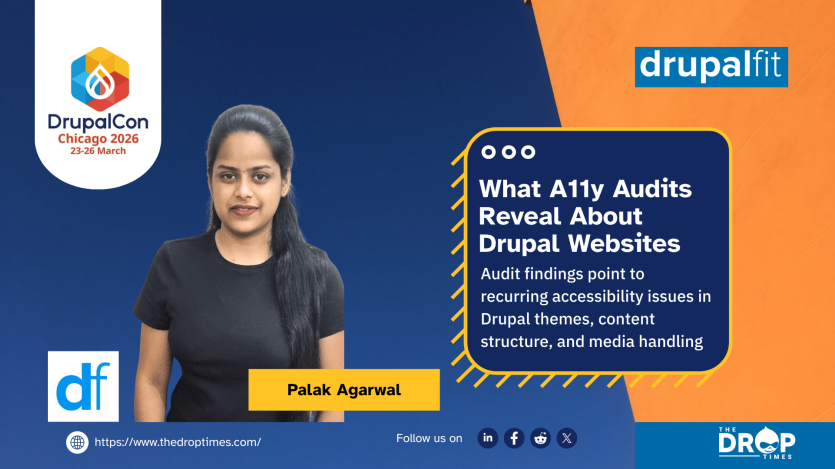
Accessibility has become an increasingly urgent concern for organisations running Drupal websites, as both regulatory requirements and user expectations continue to evolve. According to accessibility advocate Mike Gifford, Open Standards & Practices Lead at CivicActions, accessibility should not be treated as a compliance checkbox but as a core part of designing usable digital experiences. Drupal itself has long promoted accessibility as a core principle, with accessibility support embedded in its development practices and community standards. The Drupal community maintains an active accessibility effort aligned with W3C accessibility guidelines to ensure that Drupal core and contributed projects remain accessible by default. Within Drupal’s development process, accessibility barriers are often treated as bugs rather than feature requests, reflecting the community’s long-standing commitment to inclusive design.
More than 1.3 billion people worldwide live with disabilities that affect how they interact with the web. Yet accessibility gaps remain widespread. According to 2025 WebAIM Million report, studies of the wider web suggest that around 94.8% of top websites still contain detectable accessibility failures against WCAG standards, highlighting how common accessibility barriers remain across digital platforms. Because automated testing identifies only a portion of possible accessibility barriers, the absence of detected errors does not necessarily indicate full compliance with WCAG guidelines.
Insights from accessibility audits conducted during the DrupalFit Challenge Vienna Edition suggest that Drupal websites face many of the same issues. In that initiative, approximately 148 Drupal websites were audited, and 84.5% showed at least one detectable accessibility issue, revealing recurring accessibility gaps that development teams still need to address across Drupal projects.
What Accessibility Means in Practice
Website accessibility involves designing and developing digital experiences that remain usable for people with visual, auditory, cognitive, or motor impairments. Accessibility improvements also benefit users facing temporary limitations such as injuries, device constraints, or difficult viewing conditions.
Legal requirements around accessibility are also expanding. ADA-related web accessibility lawsuits in the United States continue to increase, while the European Accessibility Act, which came into force in June 2025, introduces binding accessibility requirements across EU member states. For Drupal teams working in sectors such as government, healthcare, education, and enterprise, accessibility compliance is becoming an increasingly important operational concern.
What Accessibility Audits Reveal About Drupal Websites
Insights from the DrupalFit Challenge Vienna Edition offer a practical snapshot of accessibility issues across Drupal sites. The audits revealed recurring accessibility problems across many of the evaluated websites.
1. Insufficient colour contrast
Many sites failed to maintain the minimum contrast ratios required between text and background colours, making content difficult to read for users with visual impairments.
2. Missing alt text on images
Images without descriptive alternative text prevented screen reader users from understanding visual content.
3. Improper heading hierarchy
Heading levels were often chosen for visual styling rather than document structure, disrupting how assistive technologies interpret page layout.
4. Vague link text
Generic phrases such as “click here” or “read more” appeared frequently, providing little context for screen reader users before activating a link.
These findings highlight recurring accessibility gaps that appear even on professionally built Drupal websites. Understanding where Drupal sites most often fall short provides a useful starting point for accessibility reviews and helps development teams focus their audits and improvements more effectively.
Practical Accessibility Checks for Drupal Sites
Understanding common accessibility failures helps development teams focus their attention during audits or site builds. Several checks consistently prove valuable when evaluating Drupal websites.
1. Heading structure
Heading levels from H1 to H6 should follow a logical hierarchy that reflects document structure rather than visual styling preferences.
2. Keyboard navigation
Interactive elements such as menus, forms, and modal dialogs should remain fully usable through keyboard navigation alone. Focus indicators should remain visible throughout the navigation process.
3. Form accessibility
All form fields should include properly associated labels, and error messages should clearly communicate issues while remaining programmatically linked to relevant inputs.
4. Accessible media and documents
Videos should include captions, audio content should provide transcripts where possible, and downloadable documents such as PDFs should remain compatible with assistive technologies.
5. ARIA implementation
Templates and module output should be reviewed for unnecessary or incorrect ARIA roles, ensuring landmarks such as main, nav, and aside are applied consistently.

Approaches to Accessibility Auditing
Accessibility testing typically combines both manual and automated evaluation methods.
1. Manual testing
Manual testing involves navigating websites using assistive techniques such as keyboard-only interaction or screen readers like NVDA and VoiceOver. This process helps identify usability barriers that automated scans may miss.
2. Automated testing
Automated tools such as Axe, Lighthouse, and WAVE scan site code to identify common accessibility violations.
During the DrupalFit Challenge audits, DrupalFit was used to evaluate Drupal websites across accessibility, performance, security, and SEO. Its accessibility analysis examines websites against WCAG A, AA, and AAA standards while highlighting areas that require attention.
Community Initiatives Promoting Accessibility
Efforts to improve accessibility increasingly involve community-driven initiatives that encourage organisations to evaluate and improve their websites. One such effort is the DrupalFit Challenge, which audits Drupal websites across accessibility, performance, and security to provide insights into how sites measure against recognised best practices.
The DrupalFit Challenge—Chicago Edition is planned in connection with DrupalCon North America 2026. Organisations interested in assessing their Drupal websites can submit their projects through the DrupalFit Challenge submission form, where participating sites are evaluated across accessibility, security, and performance dimensions.
By examining real-world Drupal implementations, initiatives like these aim to encourage greater awareness of accessibility standards and highlight areas where improvements are still needed across the ecosystem.
Accessibility as an Ongoing Responsibility
Accessibility improvements rarely happen through compliance alone. They require continuous attention during design, development, and content creation.
For Drupal teams, accessibility reviews and community initiatives can serve as valuable reminders that inclusive design is not a one-time task but an ongoing responsibility.
As Drupal projects continue to power government, education, and enterprise platforms worldwide, strengthening accessibility practices remains essential to maintaining trust in the open web—and in the Drupal ecosystem itself.
 Palak AgarwalLoves turning the ‘wait, what does that even mean?’ kind of tech talk into ‘oh, that makes sense!’ moments.
Image Attribution Disclaimer: At The Drop Times (TDT), we are committed to properly crediting photographers whose images appear in our content. Many of the images we use come from event organizers, interviewees, or publicly shared galleries under CC BY-SA licenses. However, some images may come from personal collections where metadata is lost, making proper attribution challenging.
Our purpose in using these images is to highlight Drupal, its events, and its contributors—not for commercial gain. If you recognize an image on our platform that is uncredited or incorrectly attributed, we encourage you to reach out to us at #thedroptimes channel on Drupal Slack.
We value the work of visual storytellers and appreciate your help in ensuring fair attribution. Thank you for supporting open-source collaboration!
ASK: Drupal Community Needs Your Support
View all →
Note: The vision of this web portal is to help promote news and stories around the Drupal community and promote and celebrate the people and organizations in the community. We strive to create and distribute our content based on these content policy. If you see any omission/variation on this please reach out to us at #thedroptimes channel on Drupal Slack and we will try to address the issue as best we can.

Related Drupal Initiatives

Related Organizations


You may also like