



Ten Technical Areas Shaping Enterprise Drupal Workflows in 2026

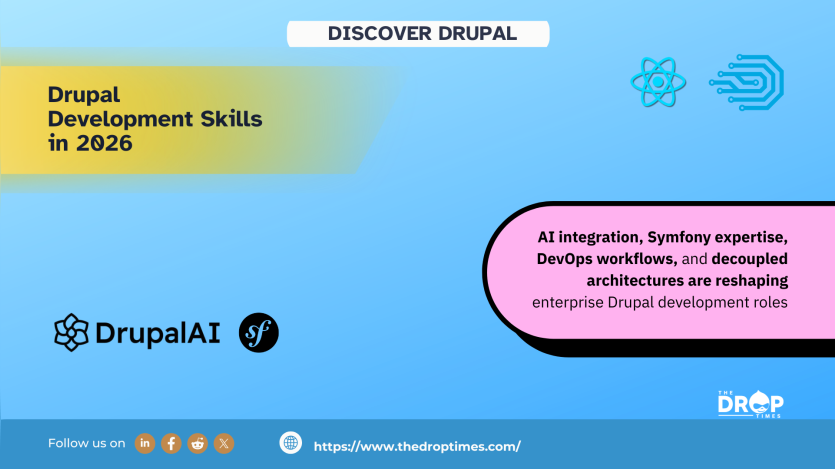
The introduction of Drupal 11, alongside continuous updates within the community-led Drupal CMS initiative, continues to evolve the technical framework used for large-scale web platforms. Many enterprise deployments now use Drupal as an integrated content node within broader digital experience platforms (DXPs), moving away from using it solely as a standalone content management system.
For engineering teams managing high-concurrency environments in the public sector, media, and corporate spaces, the technical baseline regularly emphasises automation, platform alignment, and configuration synchronisation. Active core updates and community development roadmaps highlight ten technical areas frequently associated with modern enterprise Drupal workflows.
1. Modern PHP and Symfony Framework Dependencies
Enterprise Drupal development increasingly mirrors broader ecosystem transitions toward modern PHP standards. Drupal 11 requires a minimum of PHP 8.3 and updates its foundational framework components to Symfony 7. This moves backend workflows toward strongly typed object-oriented code, dependency injection, and native PHP attributes.
Operationally, legacy procedural hooks are often replaced by custom Event Subscribers to isolate application logic cleanly. Managing these environments also relies on dependency orchestration via Composer to maintain codebase stability and manage upstream core patches across distributed environments.
- Technical Focus: Utilising Symfony 7 components, object-oriented plugins, and service containers.
- Operational Pattern: Managing multi-package dependencies and version pinning using Composer.
2. Decoupled and Hybrid Architecture
Many digital platforms separate content storage from presentation layers, using Drupal primarily as a structured content engine. Building and maintaining these platforms involves working with web services capable of transferring nested data structures efficiently across independent frontend applications.
This workflow frequently relies on the core JSON:API Module and the contributed GraphQL ecosystem to deliver secure content payloads. Backend teams regularly coordinate with frontend developers working in JavaScript frameworks such as React, Vue, and Next.js, often utilising modules like the Decoupled Router to handle path aliasing and redirect logic.
- Technical Focus: Customising and optimising endpoints using core JSON:API or GraphQL serialisation layers.
- Operational Pattern: Exposing schema-conforming data to modern JavaScript frameworks while maintaining backend routing logic.
3. AI Framework Integration and Workflows
Following the publication of the official Drupal AI Roadmap, automation and large language model integrations are moving from standalone custom scripts to structured ecosystem implementations. Enterprise projects frequently focus on integrating these tools safely into existing editorial moderation systems.
Development in this area utilises the unified framework developed by the Drupal AI Initiative, allowing systems to interface with external LLM APIs, manage context rules, and handle asynchronous background queues. The primary task for developers is to build automated steps for tasks such as auto-categorisation while enforcing validation via core Workflows.
- Technical Focus: Connecting Drupal sites to external language models and processing pipelines via core-aligned APIs.
- Operational Pattern: Automating content operations while maintaining editorial oversight and state permissions.
4. Core Subsystem and Custom Module Engineering
While contributed modules address broad functional requirements, enterprise environments often require custom business logic that aligns with specific organisational rules. Writing sustainable custom code requires developers to work directly with Drupal's low-level structural APIs to ensure compatibility with future core upgrades.
Engineers frequently use the Entity API for custom data modelling, the Form API for secure data ingestion, and the Render API for output markup. Alignment with core caching principles—such as cache tags, contexts, and max-age properties—is necessary to avoid rendering bottlenecks in high-traffic scenarios.
- Technical Focus: Implementing programmatic logic using the standard Entity, Plugin, Form, and Render subsystems.
- Operational Pattern: Authoring custom extensions that observe core data modelling patterns and performance caching rules.
5. Platform Engineering and Automated CI/CD Pipelines
The intersection of application code and deployment infrastructure remains a common consideration in enterprise workflows. Developers are often expected to participate in automated pipeline tasks to preserve clean environment parity across teams.
Local setups are widely standardised around containerised systems such as DDEV and Docker, matching local runtimes to production environment configurations. Integration tracks generally rely on automation via GitLab CI/CD or GitHub Actions, handling testing routines through PHPUnit and managing code deployments into cloud platforms.
- Technical Focus: Configuring containerised environments and defining automated integration, testing, and delivery tasks.
- Operational Pattern: Using Git-driven infrastructure pipelines to manage code deployment across server tiers.
6. High-Scale Performance and Caching Mechanics
Managing high-concurrency web traffic across large media platforms or government portals requires a clear understanding of Drupal's caching layers. Performance management at this scale focuses on minimising direct, repetitive database queries.
Workflows routinely involve deploying external cache layers, including Varnish HTTP accelerators, edge processing tools, and key-value memory caches like Redis. Application development leans heavily on Cache Tags and Cache Contexts for targeted invalidation, alongside profiling tools like Xdebug and Blackfire.io to clear bottlenecks.
- Technical Focus: Deploying and tuning Redis, Varnish, and CDN configurations to manage high transaction volumes.
- Operational Pattern: Implementing precise programmatic cache metadata to achieve reliable, granular data invalidation.
7. Component-Based Theming and Frontend Standardisation
Even within traditional coupled rendering paths, frontend development has moved away from massive, monolithic themes toward modular, reusable design patterns. This approach simplifies maintenance across large networks of sites.
Frontend workflows increasingly rely on building design systems using Twig templates, design tokens, and Single Directory Components (SDC), which encapsulate markup, styling, and logic inside a single directory. In addition to core component models, teams targeting lightweight user interfaces frequently work with modern frontend enhancement tools like HTMX to handle targeted asynchronous interactions while maintaining WCAG 2.2 AA accessibility compliance.
- Technical Focus: Constructing user interfaces using Single Directory Components (SDC) and structured Twig workflows.
- Operational Pattern: Implementing frontends that observe modern performance metrics and meet global accessibility standards.
8. Enterprise DXP Integration and Authentication
In complex environments, Drupal operates as part of an interconnected technology ecosystem, requiring steady data exchanges with separate corporate platforms and robust access control.
Developers frequently build custom endpoints and API integrations to connect Drupal with Customer Relationship Management (CRM) systems such as Salesforce, digital asset management tools, and marketing automation platforms such as Mautic. Securing these pathways involves implementing enterprise identity systems, relying on standards such as SAML 2.0, OAuth 2.0, and centralised LDAP directory services.
- Technical Focus: Formatting secure connections and REST or JSON inputs between Drupal and external marketing or data clouds.
- Operational Pattern: Implementing federated identities and single sign-on (SSO) configurations to match corporate compliance.
9. Configuration Management and Upgrade Lifecycles
Many enterprise deployment policies restrict direct configuration changes in production environments. Maintaining configuration parity across deployment tiers stands as a critical operational discipline for enterprise engineering teams.
Workflows utilise the native Drupal Configuration System, isolating environment variations via configuration split modules and running updates via Drush scripts. Given long-term lifecycle shifts, familiarity with the core Migrate API remains necessary for moving older data structures cleanly into modern Drupal 11 sites.
- Technical Focus: Coordinating code-driven configurations and structural overrides across multi-tiered server setups.
- Operational Pattern: Executing programmatic content migrations from older site setups while preserving data integrity.
10. Security Compliance and Code Governance
Because Drupal is widely used in regulated sectors such as banking and public administration, standardising secure programming practices remains fundamental to protecting enterprise data.
Development workflows include reviewing custom extensions against standard vulnerability vectors—such as SQL injection, Cross-Site Scripting (XSS), and Cross-Site Request Forgery (CSRF)—in accordance with the Drupal Security Team's guidelines. Teams also participate in broader governance workflows, monitor security advisories, review automated security scans, and ensure data policies comply with regulatory requirements such as GDPR.
- Technical Focus: Auditing custom codebases for vulnerability risks and verifying secure access control implementation.
- Operational Pattern: Aligning site data collection, storage, and rendering layers with global privacy and protection regulations.
The Broader Technical Pattern
When viewed together, these individual technical categories reflect a broader trend toward hybrid engineering workflows. Ongoing discussions within the community show that modern Drupal projects regularly intersect with containerization, API-driven design, automation platforms, and decoupled frontends. By focusing on these concrete architectural areas, teams can build platforms that leverage Drupal 11's modern core framework while remaining maintainable across future upgrade cycles.
| Layer | Primary Technologies & Standards | Reference Links |
|---|---|---|
| Language Runtime & Framework | PHP 8.3+, Symfony 7, Object-Oriented Design | PHP Specs / Symfony Core |
| Dependency & Site Management | Composer 2.7+, Drush 13+ | Composer Project / Drush Docs |
| Local Development & Ops | Docker, DDEV, Git CI/CD, Kubernetes, AWS | DDEV Runtime |
| Frontend & UI Layer | Single Directory Components (SDC), Twig, Native HTMX | Drupal SDC Guide |
| APIs & Web Services | Core JSON:API, GraphQL, Core REST | JSON:API Specification |
| Caching & Performance | Redis, Varnish, Cache Tags/Contexts, Blackfire | Blackfire Profiling / Redis Ecosystem |
| AI Integration | Official Drupal AI Framework, Asynchronous LLM processing | Drupal AI Hub |
| Identity & Security | SAML 2.0, OAuth 2.0, LDAP, GDPR Compliance Standards | Drupal Security Advisories |
 Allen JasonAllen without organs


ASK: Drupal Community Needs Your Support
View all →
Disclosure: This content is produced with the assistance of AI.
Note: The vision of this web portal is to help promote news and stories around the Drupal community and promote and celebrate the people and organizations in the community. We strive to create and distribute our content based on these content policy. If you see any omission/variation on this please reach out to us at #thedroptimes channel on Drupal Slack and we will try to address the issue as best we can.

You may also like