



ClimateData.ca Redesign Improves Access to Canadian Climate Data

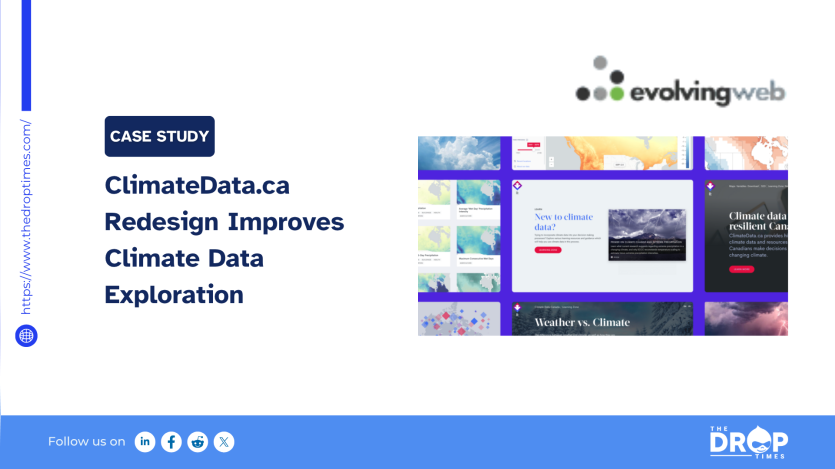
Canadian climate data platform ClimateData.ca is the focus of an Evolving Web case study by Diana Czuchry, which explains how the site was redesigned with Luqia to make climate projections and historical data easier to explore.
The post frames the challenge as one of usability rather than data availability. It notes that climate information can be difficult to apply when users must work through large volumes of scientific material without clear routes into maps, datasets, forecasts, and learning resources.
ClimateData.ca is described as a free, bilingual platform for Canadian climate projections and historical data. The case study says users can browse high-resolution maps, filter by sector or variable, explore graphs, download datasets, and access guidance on using climate information in decision-making.
The summary highlights three areas of the redesigned platform: the Learning Zone, Seasonal to Decadal forecasting, and the interactive Maps tool. The Learning Zone provides filterable resources for users across sectors and technical levels, including videos, podcasts, tools, articles, case studies, sector overviews, and regional profiles.
The Seasonal to Decadal tool places forecasts against the 1991–2020 historical reference period. The post says the underlying data come from CanSIPSv3, developed by Environment and Climate Change Canada, using two coupled atmosphere-ocean-land climate models and an ensemble of 40 model simulations.
The Maps tool supports browser-based exploration of more than 45 climate variables, including Hottest Day, Frost-Free Season, Cooling Degree Days, and Freeze-Thaw Cycles. The case study says users can compare emissions scenarios, switch between projected change and absolute values, and view data through watersheds, health regions, census subdivisions, and grid cells.
Evolving Web says the platform’s front end is built in React to support interaction across datasets and scenarios. The case study also identifies CanDCS-M6 and CanDCS-U6 as projection datasets built from 26 climate models, with CanDCS-M6 covering four emissions scenarios and CanDCS-U6 covering three.
The platform includes specialised datasets for drought, extreme heat and humidity, sea level rise, coastal infrastructure planning, and extreme rainfall. According to the post, datasets go through a formal evaluation process before being added to the portal.
ClimateData.ca is a collaborative product involving Ouranos, the Pacific Climate Impacts Consortium, the Prairie Climate Centre, ClimateWest, CLIMAtlantic, and ORCAA-CRACO. Evolving Web built and maintains the platform with Luqia, formerly the Computer Research Institute of Montréal, with support from Environment and Climate Change Canada.

ASK: Drupal Community Needs Your Support
View all →
Disclosure: This content is produced with the assistance of AI.
Note: The vision of this web portal is to help promote news and stories around the Drupal community and promote and celebrate the people and organizations in the community. We strive to create and distribute our content based on these content policy. If you see any omission/variation on this please reach out to us at #thedroptimes channel on Drupal Slack and we will try to address the issue as best we can.

Related People


Related Organizations