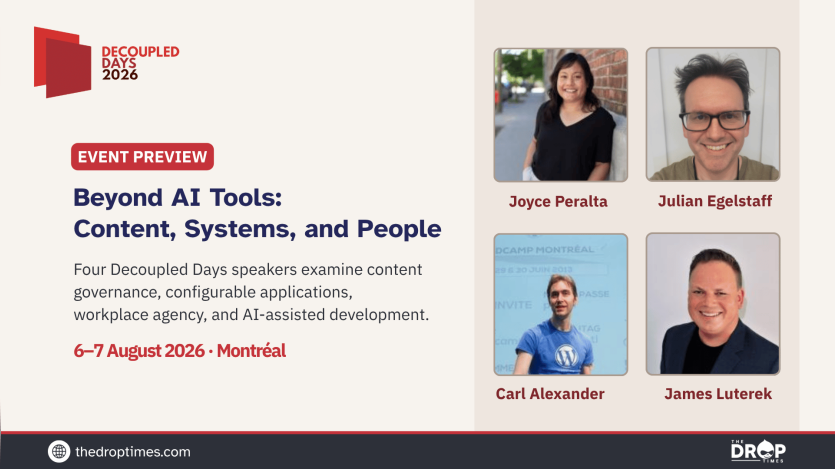
Developers and other practitioners working with open-source software, content and commerce systems, JavaScript, and decoupled architectures will meet at Montréal CoWork on 6–7 August 2026 for Decoupled Days 2026. Registration opens at 08:00 EDT, and scheduled sessions run from 09:00 to 17:00 EDT on both days. The programme combines technical presentations with discussions about governance, workplace experience, and the organisational effects of artificial intelligence.
Five tracks cover Emerging Technologies, Content Management and Commerce, JavaScript, Agency and Business, and People and Community. Their scope includes Drupal, headless and composable systems, application programming interfaces, artificial intelligence, JavaScript frameworks, project operations, accessibility, inclusion, ethics, and professional development. Four speakers gave The DropTimes written previews of sessions addressing content foundations, configuration-driven applications, neurodiversity, and AI-assisted software development.
Get the Latest in Drupal!
The first full session on 6 August is a keynote by Joyce Peralta, manager of digital communications at McGill University. Keynote: Foundations for an AI-accelerated future: Preparing our systems, content, and teams will run from 09:30 to 10:30 EDT. Joyce told The DropTimes that content models should not be treated solely as technical implementation details. Her keynote will examine how those models can support governance, consistent digital experiences, and long-term change across large, decentralised organisations.
Joyce said domain modelling can help teams look beyond individual content types and fields when describing an organisation’s content. She plans to discuss models that can be governed across teams and used as foundations for content reuse, personalisation, and future AI initiatives. She said the approaches should give developers, content strategists, user-experience professionals, and product owners ideas they can apply regardless of how far their organisations have progressed with content modelling.
Joyce Peralta
Joyce Peralta
I’ll share practical approaches for building a content model that supports governance, scales across teams, and creates a foundation for future initiatives like content reuse, personalization, and AI.
–Joyce Peralta, manager of digital communications, McGill University
Joyce said she is also interested in the conversations that follow the keynote. She described open-source events as places where practitioners can compare approaches and learn from one another. Joyce said the range of backgrounds represented at Decoupled Days should create opportunities to compare how organisations are addressing similar content challenges and where content strategy may be heading.
Julian Egelstaff, founder and lead consultant at Formulize, will present Customizable config: The secret sauce for AI from 13:30 to 14:30 EDT on 6 August in the JAKALA Room. His session will demonstrate a configuration-driven approach to application creation and the use of Formulize’s Model Context Protocol server. The Model Context Protocol, or MCP, is an open standard through which AI applications can connect with external data, tools, and workflows. Julian’s proposition is that an application’s configuration can give an AI system structured context about the application and its available functions.
Julian Egelstaff
Julian Egelstaff
There’s no substitute for outside perspectives. That’s what makes open source so great, the more the merrier. So definitely it’s the people I’m most interested in.
–Julian Egelstaff, founder and lead consultant, Formulize
Julian said applications created through the Formulize stack can also expose AI-assisted functions through the same configuration and tooling. The official session description lists data entry, validation, and ad hoc reporting among the demonstration uses. Julian also told The DropTimes that Formulize has a history of Drupal integration involving single sign-on and the display of Formulize-managed workflow screens inside Drupal sites. That integration is not the main subject of his presentation, but he said it has been updated for Drupal 11 and may provide a topic for informal discussion with Drupal practitioners.
Carl Alexander, founder of Ymir and a PHP developer and consultant, will lead Breaking the taboo: Neurodiversity in tech from 14:30 to 15:30 EDT on 6 August in the React Bricks Room. Drawing on his experience with autism and attention-deficit/hyperactivity disorder, Carl will discuss why work that appears manageable can still carry a substantial personal cost. His written response identifies regulation, masking, and burnout as experiences whose associated work may remain invisible to colleagues. The session presents Carl’s perspective rather than a general account of every neurodivergent person’s experience.
Carl Alexander
Carl Alexander
Awareness can help you recognize what you need, but it only gets you so far if you don’t have the agency to change how you work.
–Carl Alexander, founder, Ymir
The relationship between self-awareness and agency will be one of the session’s main takeaways. Carl said recognising a need can help people understand their own choices and patterns, but awareness has limited effect when they cannot change how they work. He will also consider how AI can increase output without removing the effort or personal cost attached to that additional work. Carl said he is particularly looking forward to conversations between sessions because exchanges about technology, work, and personal experience often remain with him after an event ends.
James Luterek, vice-president of engineering at Aries Solutions, will present Want to see real results from AI coding tools? You need to change your SDLC from 11:00 to 12:00 EDT on 7 August in the React Bricks Room. His session begins with a gap identified by the 2025 Stack Overflow Developer Survey: 84% of respondents use or plan to use AI tools during development, while 33% trust the accuracy of their output and 46% distrust it. James argues that development processes continue to treat different forms of work as uniform even though AI tools are being used for different types of tasks. His proposed model separates generative work from refinement and gives each phase its own definition of completion.
James Luterek
James Luterek
Different phases, each with their own definition of done.
–James Luterek, vice-president of engineering, Aries Solutions
James will introduce a scaffold phase between specification and finished software so that teams can assess generated structures before refinement, testing, and delivery. He also plans to distinguish coding speed from the wider software-development process. His argument is that widely circulated AI success stories often begin with requirements that have already been prepared, creating expectations that may not transfer to projects where requirements and development phases remain unclear. James said Aries Solutions has spent substantial time incorporating AI into its headless-development work and that he wants both to share the company’s approach and to learn what its team may have missed.
Taken together, the four previews do not present a single position on artificial intelligence. Joyce focuses on content foundations for reuse and future AI initiatives; Julian on configuration as application context; Carl on the personal cost that can accompany increased output; and James on the development stages surrounding generated code. The common thread is that AI tools operate within content, application, workplace, and delivery systems rather than replacing the need for those structures.
Image Attribution Disclaimer: At The Drop Times (TDT), we are committed to properly crediting photographers whose images appear in our content. Many of the images we use come from event organizers, interviewees, or publicly shared galleries under CC BY-SA licenses. However, some images may come from personal collections where metadata is lost, making proper attribution challenging.
Our purpose in using these images is to highlight Drupal, its events, and its contributors—not for commercial gain. If you recognize an image on our platform that is uncredited or incorrectly attributed, we encourage you to reach out to us at #thedroptimes channel on Drupal Slack.
We value the work of visual storytellers and appreciate your help in ensuring fair attribution. Thank you for supporting open-source collaboration!
Disclosure: This content is produced with the assistance of AI.
Note: The vision of this web portal is to help promote news and stories around the Drupal community and promote and celebrate the people and organizations in the community. We strive to create and distribute our content based on these content policy. If you see any omission/variation on this please reach out to us at #thedroptimes channel on Drupal Slack and we will try to address the issue as best we can.










 Kazima AbbasKazima Abbas is a sub-editor at The Drop Times