



Google Details WebMCP Origin Trial for Chrome 149 With DevTools Support

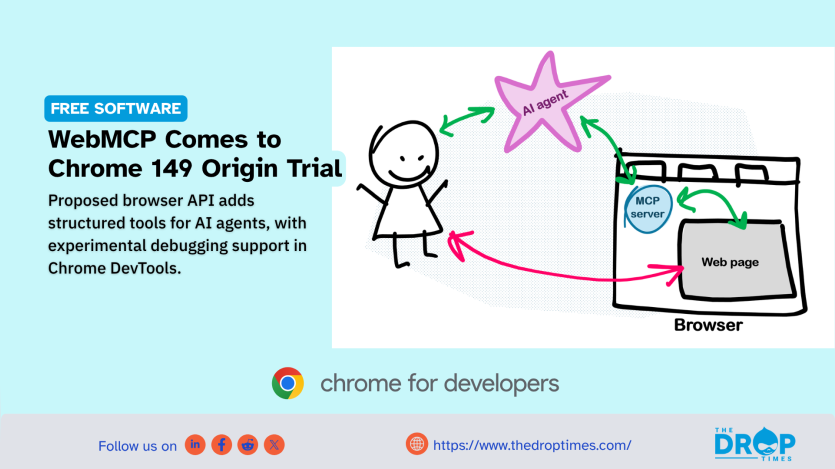
Developers can test WebMCP via the Chrome 149 origin trial, providing websites with an experimental way to expose structured tools to browser-based AI agents. Google’s Chrome documentation, published on 18 May 2026 and updated on 9 June 2026, describes WebMCP as a proposed web standard for JavaScript tools and annotated HTML form elements.
The proposal is meant to reduce reliance on actuation, where agents simulate manual clicks and text entry through a website’s visible interface. Instead of asking an agent to interpret each button, form field, or page state, WebMCP lets a site specify which actions are available and which inputs those actions require.
Chrome DevTools adds experimental WebMCP support to inspect and test registered tools. The tooling allows developers to monitor tools registered on a page, manually invoke tools, verify JSON Schema definitions, and review structured output or error messages.
Google lists two implementation paths. The imperative API lets developers define tools in JavaScript for tasks such as navigation, form input, and state management. The declarative API lets developers annotate standard HTML forms so the browser can expose them as tools for agents.
The API remains experimental and limited. Tool calls require an open browser tab or webview, and Google states that WebMCP does not support headless execution. WebMCP is also limited to origin-isolated documents and is gated by the tools Permissions Policy.
Angular’s documentation describes its WebMCP support as experimental, including support for registering tools through an application’s dependency injection lifecycle and defining route-specific tools. Cloudflare’s documentation covers WebMCP as a Browser Run lab feature and notes that lab sessions are experimental and should not be used for production workloads.
Google also points developers to the Model Context Tool Inspector Extension for testing agent interactions on live pages. The Web Machine Learning Community Group draft, dated 11 June 2026, describes WebMCP as a Community Group Report and states that it is not a W3C Standard or on the W3C Standards Track.


ASK: Drupal Community Needs Your Support
View all →
Disclosure: This content is produced with the assistance of AI.
Note: The vision of this web portal is to help promote news and stories around the Drupal community and promote and celebrate the people and organizations in the community. We strive to create and distribute our content based on these content policy. If you see any omission/variation on this please reach out to us at #thedroptimes channel on Drupal Slack and we will try to address the issue as best we can.

Related Organizations

You may also like