



James Abrahams Makes Sustainable Funding a Focus of Board Candidacy

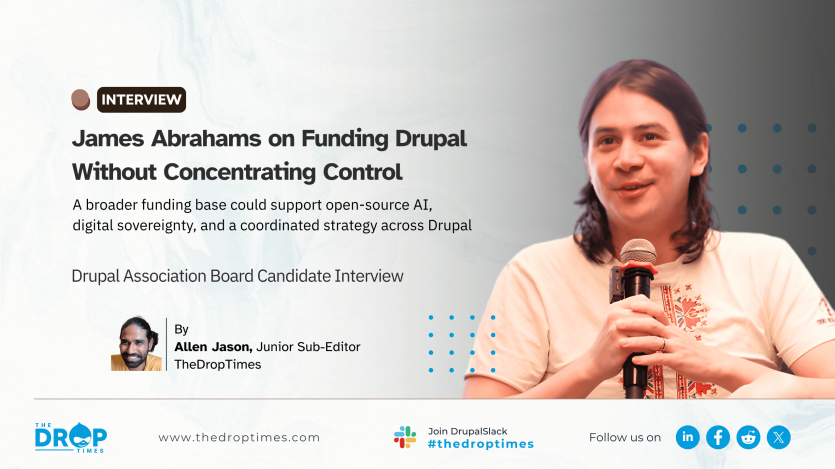
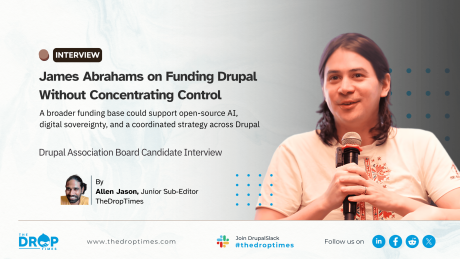
Longtime Drupal contributor James Abrahams says his candidacy for the Drupal Association Board is shaped by a financial concern: how the Association can secure sustainable funding without allowing a single company or funding source to compromise Drupal’s independence.
In written answers to The DropTimes’ Allen Jason, Abrahams connects open-source AI, stakeholder-led contribution, easier onboarding, digital sovereignty, agent permissions, and project-wide planning through a common argument: the Association should create the financial and organisational conditions for Drupal’s work while leaving technical direction to the wider community.
Abrahams co-founded FreelyGive, an agency specialising in native Drupal CRM, and says he has been involved in the Drupal community since 2011. In his candidate statement published on 7 July 2026, he describes helping to spearhead the Drupal AI module and AI Initiative while exploring alternative and sustainable sources of funding for the Association.
Drawing on that work, he argues for stakeholder-led initiatives, a more professional approach to collaboration in issue queues, infrastructure that supports digital sovereignty, clearer permissions for AI agents, and coordination across Drupal CMS, Drupal core, contributed projects, and the Drupal AI Initiative. He asks to be judged primarily on whether the Association develops a sustainable funding model and also calls for a concise Drupal-wide strategy with broad stakeholder support.
This interview is part of The DropTimes’ (TDT) series with candidates for the at-large seat on the Drupal Association Board. TDT sent each candidate five common questions and two candidate-specific questions to help readers compare their priorities, experience, and approach to the Association’s role.
Interviews in this series are being published as candidates return their completed responses.
AI, Contribution, and Access
TDT [1]: As AI-assisted and agentic site-building grows, what role should the Drupal Association play in protecting Drupal’s open-source values, data privacy, maintainer well-being, and freedom from vendor lock-in?
James Abrahams: For me, the key thing is the overall short-term goal for the Drupal Association right now: finding sustainable sources of funding. The way an organisation such as the Drupal Association raises funds goes a long way towards influencing how much it helps or hinders open source. “Open core” models, for example, tend to put a single company in control of the project, which is not how Drupal operates. In some sense, this has nothing to do with AI-assisted or agentic building; those changes just accelerate the need for this.

James Abrahams as featured on his Drupal.org profile picture.
James Abrahams as featured on his Drupal.org profile picture.
|Longer term, I think we are in a place right now where no AI is truly open source in the way we have grown to understand the term. Even open-weight models don’t come bundled with training data and can’t be trained affordably from scratch. So you can’t really control your own software and modify it as you are used to doing with true open-source software. This is changing. As many models are trained by creating training data from existing models, the intellectual property for that training data is somewhat easier to distribute, though it still presents challenges.
I also think we’re finding that the orchestration of the models is as important as, if not more important than, the models themselves in making them successful. Since the beginning of the Drupal AI module, the open-source community has gotten better at this.
So, longer term, I think the Drupal project could help push forward true open-source models, as well as smaller, more environmentally friendly models. Perhaps the Drupal Association will be key to enabling that through its infrastructure and what it supports through Drupal CMS and its site templates.
TDT [2]: Drupal benefits from enterprise users, agencies, and public institutions, but contributions are still uneven. What should the Drupal Association do to turn more of that use into visible support through developer time, code, documentation, infrastructure, or funding?
James Abrahams: I think what we’ve done with the Drupal AI Initiative is a good starting point for an approach that could extend to the Drupal Association. We’ve seen agencies very willing to provide developer resources and money when they feel heard and listened to, and when the goals fit with their own goals and sustainability. I think navigating the politics of Drupal core and making what you’ve done visible is very difficult, but the more proactively we engage anyone who wants to contribute, the more excited they become about doing so.
I wonder if we can have more visible initiatives where agencies themselves can present what they believe is important for the Drupal project—in Drupal CMS, contributed projects, or perhaps Drupal core—and make it worth their while to engage.
I also think the role of the Community Working Group (CWG) could be expanded, and perhaps the Drupal Association can help with that. I believe Drupal issue queues need to move towards a more professional, almost HR-driven approach to collaboration. In the Drupal AI module issue queue, it’s so friendly, and there is so little drama. Drupal as a whole is much better than it was, but a couple of decades ago, open source was generally known for people bringing their “whole self” in ways that made attacks, extreme anger, and frustration common in issue queues—behaviour that would not be acceptable in many of the institutions we work for.
I think the wider developer and open-source communities have turned a corner. This approach once encouraged contribution by firing people up, whereas now I think it discourages people more than it helps.
TDT [3]: How should the Drupal Association balance investment in enterprise tooling with simpler entry points for junior developers, hobbyists, and new site builders?
James Abrahams: I think this is perhaps an area where the Drupal Association is not the most appropriate body to answer the question. I think this is one for the community at large. The Drupal Association could perhaps influence the Drupal project or Drupal core by providing avenues for people to fund important work. As we have done with the Drupal AI Initiative, I wonder if we can do more for core initiatives, Drupal CMS, Drupal infrastructure, security, or other important modules. But I don’t think the Drupal Association should, or even could, easily direct the balance between enterprise tooling and simpler entry points for hobbyists and others.
At some level, Drupal.org itself can help. We have put a lot of effort into a “one-line installer” for AI best practices, and I’ve seen even seasoned developers tell me they have got DDEV working for the first time because of it. There is a lot we can do to improve the time-to-value for someone getting started with Drupal in this modern age of npx commands that “just work”, compared with the old “LAMP stack”. However, I think this will help enterprise teams, junior developers, hobbyists, and site builders alike.
Sovereignty, Funding, and Governance
TDT [4]: If digital sovereignty is increasingly defined through national ownership, where does that leave a global open-source project like Drupal? How should the Drupal Association argue that distributed international stewardship can offer a credible form of sovereignty?
James Abrahams: My understanding is that there is some exploration of a Drupal Association Europe. I think mirrors of Drupal.org in different sovereignties could help, and perhaps the DA can help with this. However, this is again something that isn’t for the DA to decide on its own. It will need to be funded. If digital sovereignty is so important, then there ought to be some level of funding from organisations, agencies, or governments that say they need it. There are solid reasons why the DA is primarily US-focused, and a large part of that comes down to its funding sources.
I think we should constantly engage stakeholders on this, see where things go, and identify models we can copy.

TDT [5]: Drupal increasingly depends on a relatively small number of organisations for major engineering investment. What role should the Drupal Association play in broadening the project’s long-term funding base?
James Abrahams: Again, with the Drupal AI Initiative, we’ve seen many organisations play a role in engineering investment. Other organisations have contributed a great deal outside the official initiative structure. I believe that, when we give stakeholders more say in what they build, we should manage and coordinate their work rather than direct them towards internal needs, so that their own goals and priorities fit within the broader picture.
Then we can allow people to do more of what they want and what they are good at, but in a way that contributes to the overall Drupal project instead of creating silos of innovation that do not connect.
It is possible that taking what we’ve done with the Drupal AI Initiative further could help with this.
TDT [6]: What governance and privacy guardrails should Drupal adopt as AI agents begin to interact with CRM, editorial, and business workflows?
James Abrahams: This is again one for the Drupal community to approach rather than the Drupal Association. With my “Drupal AI Initiative innovation lead” hat on, I believe, as I have for a while, that we need really good “observability”—not in the old-school style of DevOps logs that show you Gantt charts and a sea of events, but something that helps intelligent non-developers really trace and understand what is going on from a logical point of view. This is something everyone is exploring, and it hasn’t quite been cracked yet.
I think we have a great opportunity to win in the “governance and privacy” space with Drupal, as we can do far more with an “Execution Principle” under which our agents have clearly defined roles and permissions, rather than hard-coded, difficult-to-manage permissions across our ecosystem.
I think a lot of the benefits of Drupal for AI agents apply to mass collaboration among humans. I’ve been following the Workspaces module’s work in contrib, extending it to fields and other areas of Drupal. I think initiatives like this, as well as the Group module (which I would personally like to see included in Drupal CMS and become a core part of our arsenal), really push Drupal as an amazing space for governance and privacy in a way that end users, or at least site administrators, can truly understand.
So many tools out there that utilise AI agents do so much in the flows they build and push so many permissions into the tooling that I think they would be a nightmare to govern.
Accountability and Outcomes
TDT [7]: If elected to represent the community on the board, what is the single most important, measurable outcome you intend to deliver by the end of your term, and what specific metrics do you want the community to use to evaluate your success?
James Abrahams: For me, the key outcome is funding: whether we can have a sustainable funding model that works in this coming AI age without requiring the DA to spend most of its resources merely obtaining more funding or fulfilling requirements for the people who pay it.
If those funding sources can truly support infrastructure and, for me, even Drupal project initiatives, that is what I’d love the community to evaluate me on.
This is obviously not going to be down to me. Indeed, Tiffany Farriss has mentioned that this is a core part of what she is focusing on as interim CEO. But I believe I can help with this, given what I have done in the Drupal AI Initiative and some of the work I’ve done finding funding sources for the Drupal Association (that is happening behind the scenes, but I cannot announce anything). This is especially true as many of my colleagues in the Drupal AI Initiative are currently on the Drupal Association Board and have also contributed significantly to our ability to bring in funds.
Secondly, I’d love to see a clear Drupal-wide strategy document. Instead of Drupal CMS, the Drupal AI Initiative, and Drupal core all being totally separate, I think a short strategy document for the overall Drupal project, with true buy-in from the majority of stakeholders across Drupal’s different areas, would be powerful.
 Allen JasonAllen without organs
Image Attribution Disclaimer: At The Drop Times (TDT), we are committed to properly crediting photographers whose images appear in our content. Many of the images we use come from event organizers, interviewees, or publicly shared galleries under CC BY-SA licenses. However, some images may come from personal collections where metadata is lost, making proper attribution challenging.
Our purpose in using these images is to highlight Drupal, its events, and its contributors—not for commercial gain. If you recognize an image on our platform that is uncredited or incorrectly attributed, we encourage you to reach out to us at #thedroptimes channel on Drupal Slack.
We value the work of visual storytellers and appreciate your help in ensuring fair attribution. Thank you for supporting open-source collaboration!


ASK: Drupal Community Needs Your Support
View all →

Disclaimer: The information provided about the interviewee has been gathered from publicly available resources. The responsibility for the responses shared in the interview solely rests with the featured individual.
Note: The vision of this web portal is to help promote news and stories around the Drupal community and promote and celebrate the people and organizations in the community. We strive to create and distribute our content based on these content policy. If you see any omission/variation on this please reach out to us at #thedroptimes channel on Drupal Slack and we will try to address the issue as best we can.
Related Organizations

You may also like