


OpenKnowledgebase Reaches Beta With Self-Hosted Drupal AI Stack

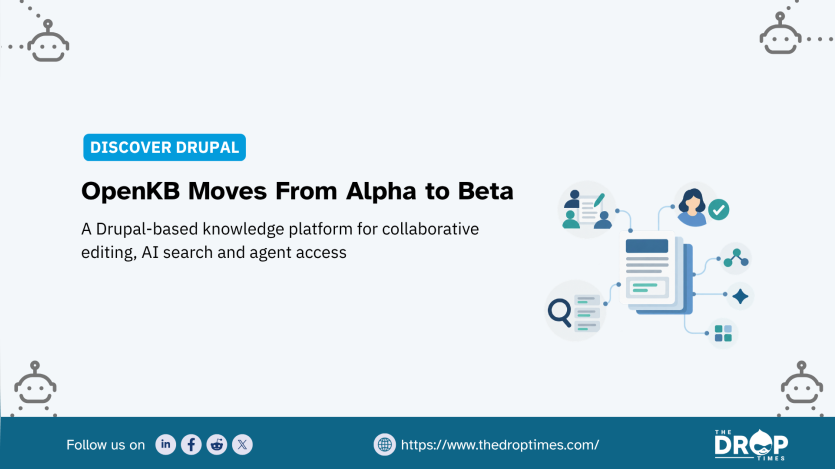
Built as an open-source knowledge base for people and AI agents, OpenKnowledgebase has entered beta with a self-hosted stack combining Drupal 11, Nuxt 4 and OpenSearch. The project, also known as OpenKB, is designed around collaboratively edited Markdown content, review before publication, hybrid search, grounded AI chat with citations and a Model Context Protocol endpoint for agent access.
Wolfgang Ziegler announced the first beta on 23 September 2026, describing OpenKnowledgebase as an open-source knowledge base for the AI era. The project has since published 1.0.0-beta2, which adds fixes around the evaluation environment, unpublished-page access and release testing while retaining the same underlying architecture.
Drupal provides the backend for content, permissions, review workflows, APIs and agent access. A decoupled Nuxt frontend provides collaborative editing, while OpenSearch supports keyword and semantic retrieval. People and agents work against the same knowledge store, with published answers able to link back to the blocks they were derived from.
The agent layer is exposed through MCP. OpenKB's documentation says agents can search, read and write through an OAuth client with permissions narrower than or equal to those of the person who granted access. Agent edits can also be subject to review before they become part of the published record.
The project uses the Drupal AI framework for provider-based chat and embeddings. OpenAI is enabled by default in the published stack, while other Drupal AI providers can be configured. Editing, review, keyword search and agent access continue to work without an AI provider configured.
Beta Releases Focus on Installation and Evaluation
The first beta introduced a more reproducible Docker-based route for evaluating the project. Its Drupal container installs the site automatically on first boot, while existing sites are held when database updates are required until an administrator runs update.php or the equivalent Drush command. The documentation recommends backing up the database, Drupal files and collaboration data together before updating.
Beta2, published on GitHub on 1 October, fixes several issues around that evaluation stack. Its quickstart OpenSearch configuration now ignores disk watermarks so indexes remain writable on a nearly full host disk, demo pages receive the site-manager recipe required by the bundled site administrator account, and unpublished pages are restricted to space editors. The release also reports that the Drupal module's cspell, PHPStan and PHPUnit tests pass on Drupal.org.
The quickstart is explicitly intended for evaluation rather than production hosting. The project documents separate production requirements for credentials, hostnames, reverse-proxy configuration, backups and OpenSearch resources, and the beta2 release notes advise testing the pre-release on a throwaway site rather than data that needs to be retained.
Open Source Across the Stack
OpenKnowledgebase's backend, including the Drupal module, is released under GPL-2.0-or-later, while the frontend is licensed under MIT. The project describes the self-hosted edition as the complete product rather than an open-core subset, with hosting, support contracts and migration services offered separately by drunomics.
For Drupal teams, the significance of the beta is less about a single feature than the way the project combines familiar Drupal permissions, workflows and APIs with collaborative editing, hybrid search and agent access. The current beta provides a concrete evaluation target for that architecture while installation, access control and production deployment continue to be hardened.
References
ASK: Drupal Community Needs Your Support
View all →
Disclosure: This content is produced with the assistance of AI.
Note: The vision of this web portal is to help promote news and stories around the Drupal community and promote and celebrate the people and organizations in the community. We strive to create and distribute our content based on these content policy. If you see any omission/variation on this please reach out to us at #thedroptimes channel on Drupal Slack and we will try to address the issue as best we can.

Related People


You may also like