Faster generation, greater automation, and more choice do not automatically make a Drupal project easier to use or maintain. Speakers heading to DrupalCon Rotterdam are approaching that problem through content modelling, migration, enterprise governance, code quality, team health, personalisation, and measurement, with a recurring emphasis on the structures that have to exist before speed becomes useful.
The practical stakes vary considerably. AI can inspect old HTML and suggest migration structures, but teams still have to decide what the resulting Drupal model should mean. A careers platform can contain hundreds of useful options while leaving people unable to decide where to begin, and an AI coding assistant can generate plausible software faster than the people maintaining it can understand what has been produced.
Get the Latest in Drupal!
Across these sessions, the useful question is therefore less about novelty than about what makes a complicated system inspectable, reviewable, and durable.
Legacy migrations are a total grind of manual HTML analysis and data mapping.
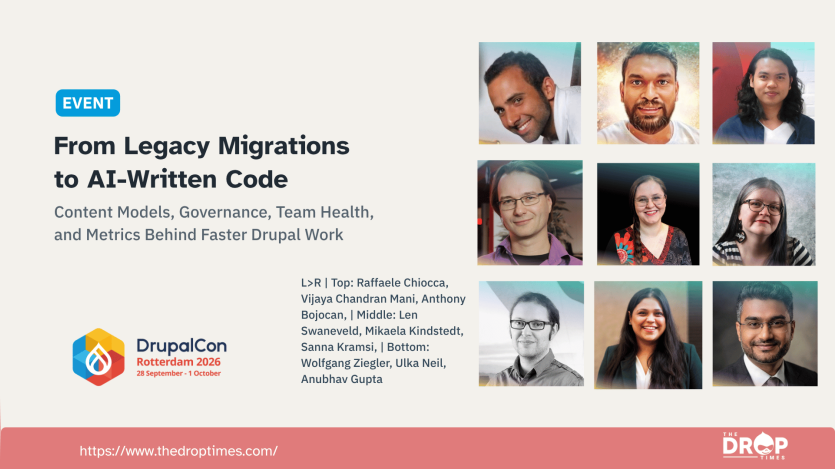
–Raffaele Chiocca, Drupal/PHP Senior Software Engineer, Hinto Group
Raffaele said attendees will see a simplified mode built specifically for Drupal CMS. AI Content Migrate can analyse legacy HTML, identify repeated structures, propose content types and fields, suggest mappings, extract structured information, and prepare migration configuration. The proposed model remains available for inspection and correction rather than being treated as an automatic answer.
His workflow emphasises iterative migration, safer rollback, and continued human judgement. The value of automation lies in reducing discovery and mapping work while leaving teams responsible for deciding whether the suggested Drupal structure reflects the meaning and relationships in the source material.
People will learn how AI can be used to automatically migrate and build sites, what strategies were considered and what worked well in the end.
–Wolfgang Ziegler, Managing Partner and CTO, drunomics
The session is less useful as a claim that AI can build a site than as a comparison of migration methods. Wolfgang wants attendees to leave with an example workflow for AI-based content migration and site building, together with a clearer view of the available ways to import content with AI and the circumstances in which one method may fit better than another.
One of the main lessons is that good personalisation doesn’t necessarily require AI. We used structured content, relationships between entities and deliberate UX to understand context and progressively guide users towards relevant careers.
–Vijaya Chandran Mani, Lead Drupal Developer, Reading Room
Vijaya said the problem was not simply making more than 350 career roles searchable. The harder question was helping somebody answer, “What could be right for me?” Drupal's content model provides the foundation by representing careers, courses, qualifications, and related information as connected structures that can support progressively narrower journeys.
Search API, Solr, facets, and Paragraphs support that guided discovery, while an external CASCAID career-matching API extends the experience for anonymous and authenticated users. Vijaya's central takeaway is to structure the content model before designing the personalisation: once Drupal understands the relationships in the information, sophisticated guidance does not necessarily require machine learning.
Managing over 350 Mars brand websites across global snacking, food and petcare segments naturally led to a fragmented digital ecosystem. Our transformation started about 6 years ago, the narrative is “from chaos, to control at scale, to cutting-edge.”
–Anthony Bojocan, Testing Process Expert, Mars
Anthony said Drupal became the company's global standard before the team made an early investment in Drupal Canvas to rethink the editorial experience. His session is intended to cover enterprise-scale governance, early-adoption lessons, pitfalls, architecture, change management, and the benefits the team has observed rather than presenting Canvas only as an interface demonstration.
The case turns editorial freedom into a governance question. A platform spanning hundreds of websites needs to decide what should remain common, where individual brands require flexibility, and how non-specialist users can gain more independence without recreating the fragmentation that standardisation was intended to reduce.
I'm not buying into the “an LLM wrote it, so just ask an LLM to fix it” approach when things go wrong.
–Len Swaneveld, Drupal Core Views Subsystem Maintainer and member of the Drupal Expert Group, iO
Len argues that naming, single responsibility, small functions, and code that communicates its purpose may become more important as AI assistance increases. His concern is a loop in which one model generates plausible code and another prompt attempts to repair it while the developers responsible for the system gradually lose their understanding of what it does.
Tests and static analysis provide the other part of the structure. Generated code can look convincing and still violate a requirement elsewhere in the system. A failing test provides a repeatable signal that does not depend on whether a developer or another model thinks the implementation appears correct.
Technology sometimes emphasizes too much on actual coding skills. While this is a big and important part of our world, we want to show that focusing on coding skills alone can be short sighted.
–Mikaela Kindstedt, Competence Manager and Senior Developer, Exove; and Sanna Kramsi, Competence Manager and Senior Accessibility Engineer, Exove
Mikaela and Sanna want teams to recognise different ways of thinking, communicating, and working as useful rather than problems to be normalised away. They also distinguish intention from impact and encourage teams to monitor realistic individual and collective capacity before sustained pressure becomes a mental-health problem.
The practical point is that a technically capable group can still become difficult to maintain if people cannot safely disagree, ask for help, communicate uncertainty, or explain their limits. Rotterdam will be the first DrupalCon for both speakers.
The broader takeaway is to look beyond what our tools and dashboards tell us and question whether we are measuring what truly matters.
–Ulka Neil, Client Engagement Manager, Axelerant
Ulka's position is not that teams should abandon metrics. She wants them to examine what behaviour a measure encourages and whether the number still represents the result the team and client actually care about as AI changes how work is produced.
If your traffic is down but your work is solid—this isn’t a failure. It’s a signal that your customers found their answers before they found you.
–Anubhav Gupta, Senior Product Manager for Digital Strategy, Material
Anubhav's proposed framework distinguishes ranking for a keyword from appearing as a source or citation in an AI-mediated answer. His session argues for broadening measurement beyond clicks towards visibility, authority, citations, and intent while retaining the underlying work of producing structured, trustworthy information.
Across these sessions, speed and scale are not treated as evidence that complexity has disappeared. Better migrations depend on inspectable models, personalisation on meaningful relationships, enterprise editing on governance, generated code on maintainability, and healthy teams on communication and realistic capacity. Metrics add the final test: whatever a system produces faster still has to be measured against an outcome that matters.
Image Attribution Disclaimer: At The Drop Times (TDT), we are committed to properly crediting photographers whose images appear in our content. Many of the images we use come from event organizers, interviewees, or publicly shared galleries under CC BY-SA licenses. However, some images may come from personal collections where metadata is lost, making proper attribution challenging.
Our purpose in using these images is to highlight Drupal, its events, and its contributors—not for commercial gain. If you recognize an image on our platform that is uncredited or incorrectly attributed, we encourage you to reach out to us at #thedroptimes channel on Drupal Slack.
We value the work of visual storytellers and appreciate your help in ensuring fair attribution. Thank you for supporting open-source collaboration!
Disclosure: This content is produced with the assistance of AI.
Note: The vision of this web portal is to help promote news and stories around the Drupal community and promote and celebrate the people and organizations in the community. We strive to create and distribute our content based on these content policy. If you see any omission/variation on this please reach out to us at #thedroptimes channel on Drupal Slack and we will try to address the issue as best we can.















 Kazima AbbasKazima Abbas is a sub-editor at The Drop Times