



Three Drupal 11 Case Studies Show Structured Content Beyond Web Publishing

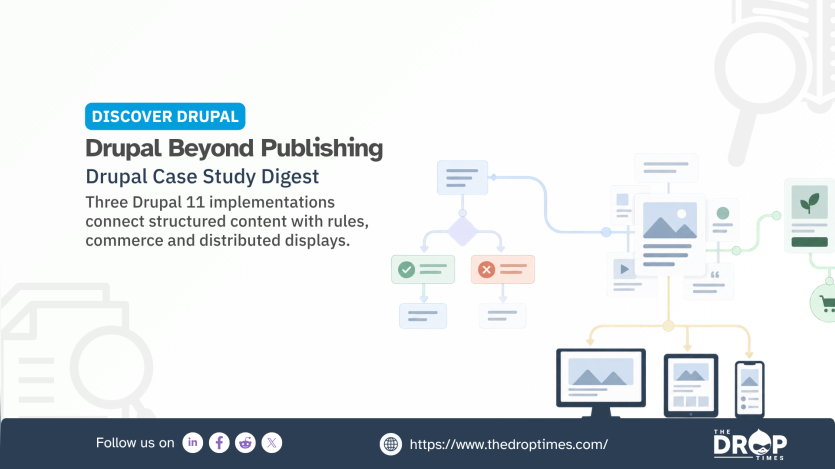
Three Drupal 11 case studies published by Drupal.org show the platform being used in regulatory assessment, specialist commerce and screen management. The projects cover a Bayer Rules as Code proof of concept, a rebuilt commerce and product-support platform for MTH Electric Trains, and BRANDCODE's DiSign system for browser-based information displays.
The three implementations are different in purpose, but each uses Drupal as a structured-content and control layer around a more specialised process. The case studies show Drupal managing submissions, product information, permissions, schedules, and integration points, while other systems or custom logic handle tasks outside ordinary web publishing.
Bayer Combines Drupal With OpenFisca for a Regulatory Prototype
Bayer's Rules as Code proof of concept, published by Drupal.org on 5 October, was developed with Salsa Digital to explore a more digital pesticide-assessment process. The demonstrator combines Drupal 11 with OpenFisca and the Webform OpenFisca module.
The case study says OpenFisca handles deterministic Tier 1 equivalence decisions, while Drupal provides the submission interface and surrounding content-management capabilities. It also notes that Drupal performs some calculation logic in the prototype. Regulators can review submissions in the backend and see whether they have been classified as Tier 1 equivalent or require Tier 2 review.
The source describes a fuller assignment and approval workflow as a possible production extension, not something already established in the proof of concept. That distinction matters: the published project demonstrates how Drupal can sit around a rules engine and regulatory submission process, but it does not establish a deployed regulator service at production scale.
MTH Connects Product Data, Commerce and Preorders
MTH Electric Trains' Drupal 11 rebuild, published on 3 October, combines a specialised product catalogue with Drupal Commerce, dealer information, technical documentation and migrated historical product records.
A separate preorder workflow handles upcoming products differently from items available for immediate purchase. Standard products follow the normal commerce process, while eligible future releases can be reserved and reviewed separately before quantities are processed when stock becomes available.
The implementation also connects product records with manuals, parts documents and other technical resources. This makes Drupal responsible for both transactional and reference content, keeping current and historical product information connected to the commerce experience.
DiSign Uses Drupal as a Screen-Management Platform
DiSign, published on 3 October, uses Drupal 11 to manage structured information for browser-based displays. BRANDCODE describes the platform as an alternative to digital-signage systems built around playlists and proprietary player software.
Drupal manages content modelling, media, scheduling and assignment to different screen views. Displays open defined URLs and retrieves the information intended for them, while roles and permissions allow decentralised editorial work within centrally governed content and configuration.
The implementation also separates content from presentation. Structured information can be reused across responsive front ends and combined with external data such as menus, events, weather, transit information or news without maintaining a separate copy for each screen.
A Shared Pattern, With Different Limits
Placed together, the three cases illustrate a common architectural role for Drupal 11. Bayer uses Drupal around a rules-based assessment process, MTH extends structured product content into commerce and preorder logic, and DiSign turns centrally governed content into information for distributed displays.
The case studies are more useful as architectural descriptions than as independent evidence of business performance. The Bayer material describes a proof of concept rather than a production regulatory service. The MTH case study does not provide independently verified commerce or performance measurements, and the DiSign case study does not identify deployment scale or measured operational outcomes.
What the sources do support is narrower: Drupal 11 can provide structured content, permissions, workflow-adjacent controls and integration points inside applications where publishing is only one part of the system. The three case studies show different ways to implement that role, while leaving questions of scale and measurable production impact open.
References


ASK: Drupal Community Needs Your Support
View all →
Disclosure: This content is produced with the assistance of AI.
Note: The vision of this web portal is to help promote news and stories around the Drupal community and promote and celebrate the people and organizations in the community. We strive to create and distribute our content based on these content policy. If you see any omission/variation on this please reach out to us at #thedroptimes channel on Drupal Slack and we will try to address the issue as best we can.

Related Organizations



You may also like