



Drupal Canvas 1.13 Adds Optional Server-Side Rendering for Code Components

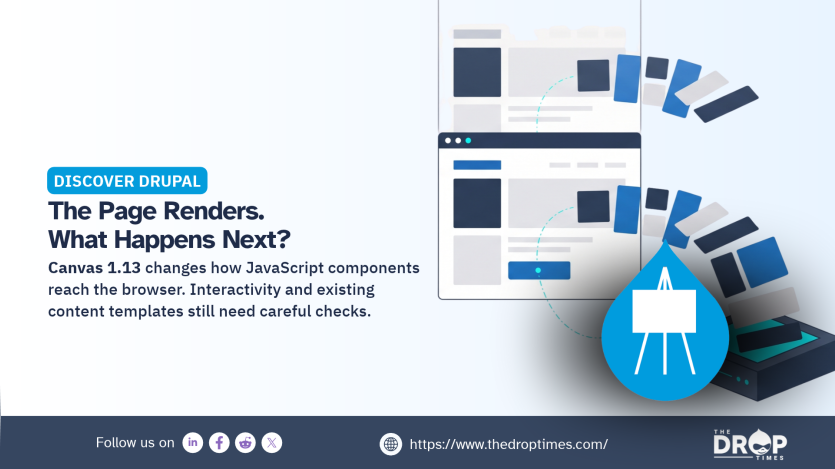
Server-side rendering for JavaScript Code Components is now available in Drupal Canvas 1.13.0, released on 18 November 2026 at 22:27 UTC. According to the project's release notes, the capability is provided through a new optional canvas_ssr submodule that uses Deno to execute JavaScript on the server. The release also expands content-template support beyond nodes and introduces translation functions for Code Components.
On Drupal-rendered pages, Canvas previously relied on browser-side rendering for JavaScript Code Components, while Twig-based components and PHP blocks could already produce server-rendered output. The new submodule allows JavaScript components to generate HTML during Drupal's rendering process, before browser-side JavaScript executes. It provides an additional rendering option for sites using Canvas without requiring a separate headless frontend application. Server-side rendering is not enabled automatically when Canvas is updated.
The implementation record for the SSR submodule describes an architecture that delegates JavaScript execution to a configurable runner, with Deno supplied as the initial implementation. The submodule requires Drupal 11.4 or later, although Canvas 1.13.0 itself supports Drupal 11.3 and later versions within the Drupal 11 series. Deno must be installed separately and made available to the runtime, which also depends on PHP process-execution functions. The additional requirements make hosting compatibility an important consideration before administrators enable the feature.
Interactive components also require attention. Under the new rendering approach, components that depend on browser-side state or event handlers need a recognised client boundary so that their JavaScript is hydrated after the initial HTML is delivered. For React-compatible Code Components, this can be declared using 'use client' at the beginning of the component source. Without a detected client boundary, a component may render its initial HTML without activating its interactive behaviour.
A staging evaluation conducted for The DropTimes on 19 November 2026 reproduced this distinction using Canvas 1.13.0, Drupal 11.4.13 and Deno 2.9.6. An interactive component rendered correctly but stopped responding to button clicks after SSR was enabled without the client directive. Adding the directive restored interaction in the browser. The evaluation used a disposable test environment rather than a production hosting configuration, so the finding establishes the behaviour in that setup rather than its prevalence across existing Canvas installations.
The implementation record describes a fallback to client-side rendering when the configured JavaScript runner is unavailable or cannot complete a render. The DropTimes staging evaluation reproduced that fallback with missing and failing Deno processes. However, the release does not establish performance or search-engine benefits across production environments. Teams evaluating SSR will need to test its effect on rendering time, resource consumption, interactive behaviour and caching under their own hosting conditions.
Another substantial change extends Canvas content templates to more Drupal entity types. The change record published on 17 November 2026 confirms that templates can now be created for eligible taxonomy terms, users, media, content blocks and supported contributed entities, including Paragraphs and Commerce products. Previously, Canvas content templates were restricted to nodes. Eligible entities must meet the storage and Field UI requirements documented in the change record, and Canvas Pages and comments are excluded.
The expansion introduces a compatibility issue for sites using Canvas Paragraphs. That contributed module previously enabled content templates for paragraphs and taxonomy terms, but its functionality now overlaps with Canvas itself. The published change record identifies Canvas Paragraphs as incompatible with the new implementation and instructs affected administrators to uninstall the contributed module when updating. This does not establish that every Canvas installation uses Canvas Paragraphs.
The DropTimes staging investigation found an additional configuration risk during that transition. Uninstalling Canvas Paragraphs removed a content template that depended on one of its component definitions, while templates without those dependencies remained intact. The result was reproduced in the test configuration but has not been established as universal upgrade behaviour. Administrators using Canvas Paragraphs should therefore review template dependencies, export their configuration and test the removal process before applying the update to a production site.
Canvas 1.13.0 also adds interface translation support for JavaScript Code Components. According to the project documentation, developers can use the useTranslation() React hook to access t() and formatPlural(). Canvas extracts supported string literals from component source files and makes them available through Drupal's interface translation system. The release also allows Code Components to receive lists of content entity references instead of being restricted to individual references.
Headless integrations receive updates alongside these changes. The Canvas Headless SDK now supports the json-render format for rendering Canvas content across supported frontend frameworks. The release notes also identify fixes to headless previews and component synchronisation. These improvements concern applications that render Canvas-managed content outside Drupal and are distinct from the new Deno-based SSR capability operating within Drupal itself.
Additional changes address editor preview responsiveness, drag-and-drop accuracy, links from components to Canvas pages, and several compatibility issues. Canvas AI now allows users to stop an ongoing response and displays the selected component in its chat interface. Fixes also cover homepage canonical URLs, empty-field translation, administration pages rendered with the frontend theme and Drupal 11.5 compatibility. The release credits 60 contributors and records 99 resolved issues.
For existing installations, the new rendering capability remains optional, while the expanded content-template implementation affects a broader set of entity types. The release gives developers new rendering and component-building options, but enabling SSR and migrating from Canvas Paragraphs require separate compatibility checks. The full release notes and associated change records are available on Drupal.org.
Research and Testing Disclosure
The DropTimes reports staging evaluations conducted on 19 November 2026 using Canvas 1.13.0, Drupal 11.4.13 and Deno 2.9.6 in a disposable test environment. The reported results concern client hydration, rendering fallback and a Canvas Paragraphs template dependency during uninstall. The underlying test scripts and logs were not supplied for independent reproduction in this editorial review. The findings should not be treated as universal production behaviour.
References
-
canvas 1.13.0 | Drupal.org (18 November 2026)

ASK: Drupal Community Needs Your Support
View all →
Disclosure: This content is produced with the assistance of AI.
Note: The vision of this web portal is to help promote news and stories around the Drupal community and promote and celebrate the people and organizations in the community. We strive to create and distribute our content based on these content policy. If you see any omission/variation on this please reach out to us at #thedroptimes channel on Drupal Slack and we will try to address the issue as best we can.

Related Drupal Initiatives

You may also like