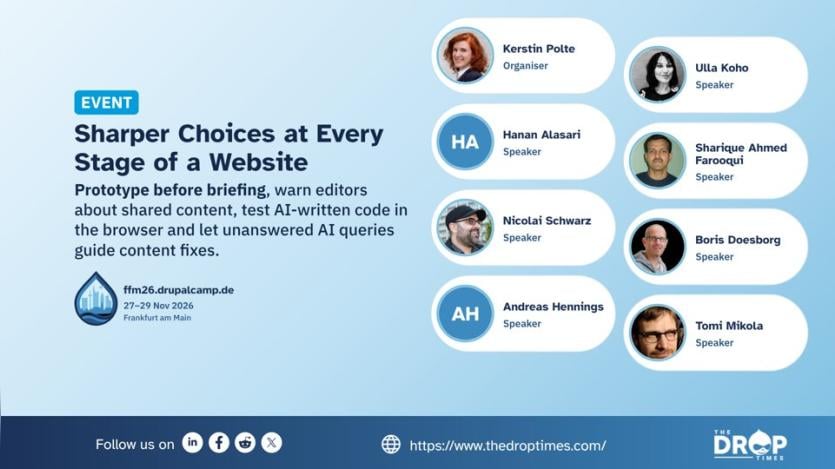
After nearly a decade, DrupalCamp Frankfurt is returning with a smaller organising team and a deliberate decision to keep the event simple. Kerstin Polte, one of its four organisers, told The DropTimes that preparations involved reconsidering sponsorship arrangements, dispensing with unnecessary extras and managing unexpected challenges within the team.
When Carsten Logemann approached her towards the end of 2025 about organising Frankfurt's third DrupalCamp, Kerstin felt the time was right. Unlike the previous editions in 2014 and 2017, this year's event operates with a smaller team and a different sponsorship arrangement supported by Auge e.V. Despite illness and competing personal and professional commitments, the organisers continued preparing for the event through mutual support.
Kerstin Polte
Kerstin Polte
We wanted to keep it simple and focus on the community.
The camp takes place from 27 to 29 November 2026 at the SAALBAU Titus-Forum in Frankfurt am Main, Germany. The programme includes the Splash Awards and a quiz on Friday evening, alongside contribution activities on Sunday.
Ahead of the gathering, seven speakers shared their experiences with The DropTimes. Their observations address challenges that extend beyond the conference: how agencies demonstrate value to clients, how editors understand the consequences of content changes, how developers verify their work and how organisations learn from websites after launch.
Replace Lengthy Briefs With Clickable Prototypes
When buyers reject Drupal for being too complex or expensive, they may be responding to the way a project is presented rather than the capabilities of the platform. That is an observation from Ulla Koho, chief commercial officer at Mearra, who spent 14 years selling a different content management system. She argues that lengthy briefs, extensive specifications and delayed demonstrations can shape buyers' perceptions before they experience the technology.
Although AI makes prototyping faster, Ulla believes stakeholder decision-making remains a bottleneck. Her recommendation is to introduce rough, clickable prototypes during early discussions, allowing stakeholders to evaluate an idea before committing to its implementation. Equally important is maintaining a record of which decisions were made, who approved them and why.
Ulla Koho
Ulla Koho
My short version: sketch with whatever’s fastest, remember in Drupal, build in Drupal.
–Ulla Koho, chief commercial officer, Mearra
Building on discussions about communicating Drupal's value that she previously shared with The DropTimes ahead of DrupalCon Rotterdam, Ulla will demonstrate her approach during Stop briefing, start trying: What marketing really needs from Drupal, scheduled for 11:00–11:45 CET on 27 November. Her proposal gives agencies an opportunity to address disagreements and establish project direction before substantial development resources are committed.
Show Editors the Impact of Shared Content Changes
Reusing content across multiple pages can simplify website maintenance, but it introduces a responsibility that is not always apparent to editors. Hanan Alasari, a DrupalCamp Frankfurt speaker examining editorial workflows in Drupal Canvas, identifies a potential gap between the technical relationships that enable reuse and the information available when editors make changes.
According to her session description, Hanan tested three approaches using Drupal 11.4.10 and Canvas 1.12.0: pattern components, pattern blocks and entity references to reusable block content. Each approach supported centrally managed content in her test, but differed in how editors could understand and interact with that content.
If changing one piece of content can affect multiple places, editors should be given enough context to make that decision confidently.
–Hanan Alasari, Drupal Developer, 1xINTERNET
Her proof of concept provides information about the original content, identifies where it is used and warns editors before changes affect other pages. It also explores permission-aware access to the shared source. These capabilities represent a proposed improvement to the editing experience rather than functionality established as part of a released Canvas feature.
Familiarity with Drupal does not necessarily mean familiarity with every way it can be implemented. For Sharique Ahmed Farooqui, a Drupal developer and open-source contributor, encountering unfamiliar architectural approaches remains part of professional development even after more than 15 years of working with the platform.
Sharique Farooqui
Sharique Farooqui
I often find new ways of using/implementing Drupal even after 15+ yrs, I hope others also find something new in my session.
–Sharique Ahmed Farooqui, Drupal developer and open-source contributor
Sharique previously discussed the breadth of Drupal implementations with The DropTimes ahead of DrupalCamp Poland 2026. His Frankfurt session extends that discussion through comparisons of multisite deployments and different forms of decoupling, including hybrid and progressively decoupled approaches. The programme also identifies deployment strategies and code management as subjects for examination.
His session, Drupal unlimited possibilities, takes place from 13:30–14:15 CET on 27 November. For developers and technical leads, the comparison offers an opportunity to evaluate alternative architectures before defaulting to familiar implementation patterns.
Reconsider What Modern CSS Can Replace
While much of the discussion around development tools focuses on AI, advances in browser capabilities continue to change how frontend developers approach familiar problems. Nicolai Schwarz, a Drupal community contributor and returning conference speaker, points to developments in CSS and HTML that offer additional options for typography, accessibility and performance.
Some newer browser capabilities can also reduce the need for JavaScript in particular frontend implementations. Nicolai distinguishes features that already have broad browser support from those that may require fallbacks or further compatibility considerations. His presentation will help developers assess modern alternatives to techniques they may have used for years.
Nicolai Schwarz
Nicolai Schwarz
But frontend developers will get lots of fun new features to play around with. There’s no reason to let AI do all of the fun parts!
–Nicolai Schwarz, Senior Freelancer
Nicolai's New in CSS session, an updated version of his presentation at DrupalCamp Kortrijk, runs from 13:30–14:15 CET on 27 November. He is also preparing the camp's Friday evening Nerd Quiz.
Use Browser Testing to Verify AI-Generated Changes
AI-assisted development can increase the volume of code changes that teams must review. Boris Doesborg, a Drupal community contributor, recommends considering automated browser testing to build greater confidence in those changes. He identifies Playwright as a tool that can support development, end-to-end testing and visual regression testing.
Applying browser tests to Drupal involves practical considerations beyond writing assertions. Developers may need to authenticate users, create content for testing and remove that content afterwards. Automated visual checks can also help identify unintended changes to a website's appearance.
Boris Doesborg
Boris Doesborg
I would say that teams that are not using Playwright at the moment as part of their testing suite should start looking into it, because of all the helpful features that it brings and also because it is more and more becoming part of the standard set of tools that many Drupal developers are using.
–Boris Doesborg, Drupal Developer, Finalist
Boris also raises an unresolved question about the future of contributed Drupal modules. As AI-assisted coding makes custom implementations easier to generate, teams may need to reconsider the trade-offs between developing their own solutions and relying on software maintained collectively by the community.
His session, Playwright and Drupal, runs from 14:30–15:15 CET on 27 November. It will also examine whether automated tests can provide safeguards for AI coding agents.
Make Git History Easier to Review
Passing automated tests does not necessarily make a code change easy to understand or maintain. Andreas Hennings, a Drupal developer and contributor, recalls reviewing pull requests across different projects and teams where unrelated changes were grouped together, commit messages failed to describe the accompanying code and minor corrections were left in separate follow-up commits.
Requests to reorganise those changes often revealed gaps in developers' understanding of Git. Andreas also identifies a concern associated with AI-assisted development: contributors may submit changes without being able to explain why those changes were made.
Be intentional about your git history
–Andreas Hennings, Drupal developer and contributor
During Git tricks to impress your team, scheduled for 16:00–16:45 CET on 27 November, Andreas will demonstrate techniques including interactive rebase. The session will examine how developers can separate unrelated changes, reorganise commits and better understand the relationships between branches, making proposed changes easier for colleagues to review.
Turn Unanswered AI Questions Into Content Improvements
For organisations operating AI-powered information services, unanswered questions can reveal problems that conventional search analytics may overlook. Tomi Mikola, head of technology at Mearra, brings an example from HelsinkiUni Help, a University of Helsinki service that incorporates AI-powered search. The university announced its launch for 27 November 2025.
Tomi and Ulla previously discussed the service's feedback mechanisms with The DropTimes ahead of DrupalCon Rotterdam 2026. His Frankfurt presentation goes further into the operational processes behind that feedback. According to Tomi, automated overnight tasks group unanswered questions, while Drupal provides tools through which staff review problems, assign responsibility and assess corrections.
Tomi Mikola
Tomi Mikola
An AI service can tell you every day what people asked and didn’t get. Use it. AI search almost always finds something, so “no results” is not the thing to look for. Look for the times the AI read your pages and still said it doesn’t know.
–Tomi Mikola, head of technology, Mearra
When an editor updates a page, the service repeats the original question during its next overnight check. If the question remains unanswered, the problem reopens. Producing an answer does not establish that the answer is correct, so a person still reviews the result.
The team also evaluated AI models against questions classified manually by the service owner. According to the session description, the older of the two models agreed with the owner's assessment more frequently on the tested sample and was selected for that task. Separate testing found that AI-generated explanations could identify missing content but frequently overlooked situations where the required information already existed.
Tomi will present these experiences during AI works the night shift. People decide in the morning, scheduled for 11:00–11:45 CET on 28 November. For website owners and editorial teams, the experience provides an example of how operating an AI service can inform decisions about maintaining the information behind it.
DrupalCamp Frankfurt 2026 opens for attendees at 08:30 CET on 27 November, with contribution activities beginning at 09:00 CET on 29 November. The complete conference programme is available on the event website.
Image Attribution Disclaimer: At The Drop Times (TDT), we are committed to properly crediting photographers whose images appear in our content. Many of the images we use come from event organizers, interviewees, or publicly shared galleries under CC BY-SA licenses. However, some images may come from personal collections where metadata is lost, making proper attribution challenging.
Our purpose in using these images is to highlight Drupal, its events, and its contributors—not for commercial gain. If you recognize an image on our platform that is uncredited or incorrectly attributed, we encourage you to reach out to us at #thedroptimes channel on Drupal Slack.
We value the work of visual storytellers and appreciate your help in ensuring fair attribution. Thank you for supporting open-source collaboration!
Note: The vision of this web portal is to help promote news and stories around the Drupal community and promote and celebrate the people and organizations in the community. We strive to create and distribute our content based on these content policy. If you see any omission/variation on this please reach out to us at #thedroptimes channel on Drupal Slack and we will try to address the issue as best we can.












 Kazima AbbasKazima Abbas is a sub-editor at The Drop Times