



Drupal Canvas Merges Exposed Slots for Per-Article Editing

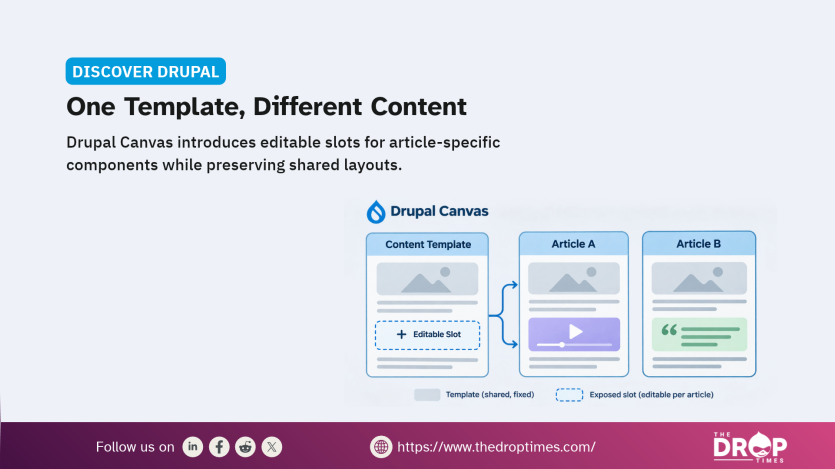
Following a code merge on 18 November 2026, the Drupal Canvas development branch gained exposed slots for article-level component editing. The feature allows selected areas of a shared content template to contain components that vary between individual articles. The implementation commit was authored by Drupal Canvas contributor Fons Vandamme and committed by fellow contributor Tim Plunkett.
Canvas content templates provide a consistent arrangement of components across articles. Previously, editors could not add free-form components to an individual article through its shared template. Exposed slots address this limitation by letting site builders designate specific areas for article-level editing. Components outside those areas remain controlled by the template.
For example, a news website could use the same Canvas template across its articles while allowing one article to include a video and another to display an additional quote or callout. A site builder enables editing for the relevant slot in the Full content template. An authorised editor can then open an article in Canvas and add, modify or remove components within that area without changing the shared layout.
According to the official Canvas documentation, exposed slots can contain default components defined in the template. Editors can override those components for an individual article and later revert to the defaults. An override can also be left empty, allowing the article to display no components in that slot. The surrounding template components remain locked during article-level editing.
Each exposed slot stores its article-specific content in a separate field on the content type. Newly created fields use the canvas_slot_ machine name prefix. A content template can contain multiple exposed slots, but exposed slots cannot be nested. Current support is limited to Full content templates for node types.
The implementation separates editing and publishing permissions. Managing exposed slots in a template requires the Administer content templates permission. Publishing template changes additionally requires Publish Drupal Canvas Content. Editors need update access to the relevant article to modify its exposed slots, while publishing those changes also requires Publish Drupal Canvas Content. The documentation advises restricting template administration to trusted users because enabling an exposed slot can create a field on the content type.
Disabling editing for an exposed slot does not delete its stored article content. Site builders can expose the same field again to restore that content. Permanently deleting the content requires deleting the associated field through Drupal's field administration interface.
The development issue describes exposed slots as a way to combine structured content with free-form component editing, similar to the approach used by Drupal sites with Paragraphs. The implementation preserves the shared template while storing article-specific changes separately.
Following the merge, Vandamme shared a community update on Reddit on 19 November 2026. He acknowledged contributors who assisted with development, testing and feedback, and confirmed that exposed slots had entered the development branch. He said the feature would ship in the next release.
Drupal Canvas 1.13.0, released on 18 November 2026, separately expanded content-template support to additional content entity types. However, its release notes do not list exposed slots among the included changes. The merge therefore represents a development milestone rather than confirmed stable-release availability. Site builders should verify that a subsequent release includes exposed slots before relying on the feature in production.
References
-
Add Exposed Slots — Implementation Commit (18 November 2026)
ASK: Drupal Community Needs Your Support
View all →
Disclosure: This content is produced with the assistance of AI.
Note: The vision of this web portal is to help promote news and stories around the Drupal community and promote and celebrate the people and organizations in the community. We strive to create and distribute our content based on these content policy. If you see any omission/variation on this please reach out to us at #thedroptimes channel on Drupal Slack and we will try to address the issue as best we can.
Related People


You may also like