



Drupal 11 Already Delivers Major Performance Gains Ahead of Drupal 12

Drupal sites do not need to wait for the next major release to benefit from substantial performance improvements in core. A comparison by The DropTimes of automated performance test assertions across Drupal 11 releases shows that the expected number of database queries for generating the Umami demonstration site's homepage with a cold cache has fallen by more than half since Drupal 11.2.0.
Drupal 12.0 and 11.5 are scheduled for release during the week of 7 December 2026. For organisations planning their next upgrade, many of the database and caching optimisations associated with Drupal 12 are already available in stable Drupal 11 releases. Moving to the new major version may bring additional benefits, but the available evidence does not establish another comparable increase in performance.
Drupal's performance improvements have accumulated across successive releases. A core performance analysis published on 17 December 2025 documents how Drupal 11.3 uses PHP Fibers to group database and cache operations that previously occurred individually. The changes improve entity loading and path alias lookups, while other optimisations reduce database operations and memory consumption during the discovery of hooks and fields.
The Drupal 11.4 release announcement, published on 1 July 2026, documents further reductions in database queries through more efficient entity field loading. Improvements to entity listing queries also benefit workloads involving JSON:API. The release introduces better compression for JavaScript and CSS assets and faster translation file handling.
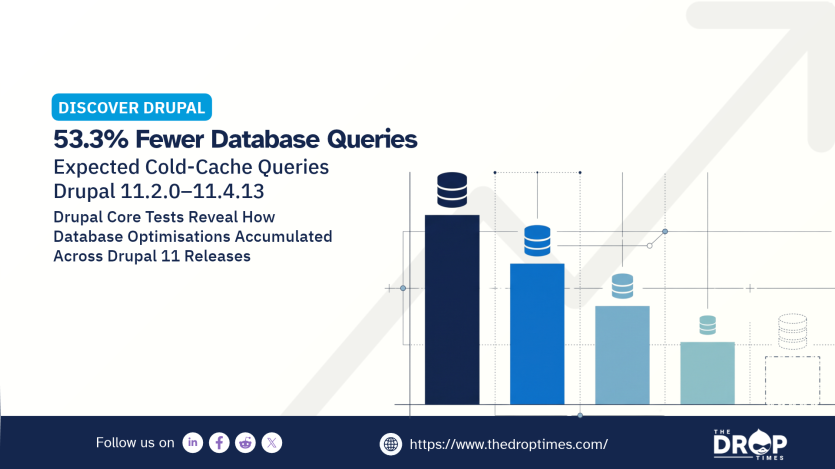
The automated performance tests included in Drupal's source code help quantify this progression. The Umami demonstration profile includes a test that records database queries, cache operations and other metrics while requesting the homepage under different cache conditions. Its expected database query count for a cold-cache request falls from 381 in Drupal 11.2.0 to 263 in Drupal 11.3.0. It falls further to 184 in Drupal 11.4.0 and 178 in Drupal 11.4.13.
The difference between Drupal 11.2.0 and 11.4.13 represents a 53.3% reduction in the expected query count. When site-wide caches are already populated but the homepage-specific caches are not, the corresponding count falls from 112 to 54, a reduction of 51.8%. Expected cache lookup and write operations also decline across the releases.
Drupal 11's Declining Database Query Counts
Expected database query counts for the Umami demonstration homepage
| Drupal version | Cold cache | Partially warmed cache |
|---|---|---|
| 11.2.0 | 381 | 112 |
| 11.3.0 | 263 | 93 |
| 11.4.0 | 184 | 59 |
| 11.4.13 | 178 | 54 |
53.3% fewer expected cold-cache queries
51.8% fewer expected partially warmed-cache queries
The fully warmed homepage presents a different picture. All four versions expect zero queries under the test's general database query metric, with a separate cache-tag lookup still recorded. The contrast illustrates why the benefits of these optimisations depend partly on how often Drupal needs to generate content rather than retrieve an existing cached response.
Evidence from more complex websites supports the relevance of these changes beyond Drupal's demonstration profile. Drupal development company MD Systems published performance findings from its internal Primer distribution on 16 December 2025. Its testing recorded a reduction from 1,097 to 420 database queries for a cold-cache request on a complex site using Paragraphs. The results incorporate improvements to contributed modules as well as Drupal core, highlighting the influence of a site's content architecture and dependencies on performance.
The relationship between Drupal 11.5 and 12.0 provides further context for upgrade expectations. The Drupal 12 beta release notes describe the two development branches as closely aligned, with differences primarily arising from deprecated code removal and major dependency upgrades. Applicable improvements developed for Drupal 12 are also backported to Drupal 11.5 and earlier branches.
One example is an optimisation to Drupal's route access-checking system. The change allows Drupal to stop performing additional checks when access has already been ruled out. Previously, subsequent checks could continue loading entities and processing cache metadata even when they could not change the outcome. The issue's commit history records the optimisation reaching Drupal 12.0.x on 2 October 2026, followed by the Drupal 11 development branch on 5 October 2026 and 11.5.x on 9 October 2026.
Performance work also continues in Drupal 11.5. A 9 November 2026 analysis of large-menu performance by MD Systems identifies an improvement that prevents Drupal from unnecessarily saving unchanged menu links when editors update content. The corresponding core issue documents how unnecessary menu updates can invalidate cached content across many pages. The direct benefit depends on access permissions, and further reductions in cache invalidation may require contributed modules or site-specific changes.
The accumulated nature of Drupal's performance improvements is also discussed by Martin Anderson-Clutz, senior product marketing manager for Drupal at Acquia, in a 23 November 2026 blog post. The shared development history and documented optimisations provide grounds to expect broadly similar performance characteristics between Drupal 11.5 and 12.0 under comparable conditions. However, differences in dependencies, system requirements and removed code could affect individual workloads, and equivalent performance between the releases has not been established.
Database query counts alone cannot establish how much faster a website becomes. A performance regression reported after Drupal 11.4.0 illustrates this limitation. A developer reported that an upgrade test involving content with several multi-value fields recorded entity-loading times of approximately 134 seconds, compared with 235 milliseconds on Drupal 11.3. Combining database queries had produced an excessively large result set. Drupal addressed the regression in Drupal 11.4.1.
Drupal's performance-testing documentation distinguishes predictable metrics, such as query counts, from timing measurements that can fluctuate between test runs. The figures examined by The DropTimes are expected metrics recorded in tagged core test files. The tests were not independently executed, and equivalent runtime measurements comparing Drupal 11.5 with Drupal 12.0 were not obtained. The figures therefore document reductions in expected database operations, not equivalent reductions in response times or infrastructure costs.
For organisations evaluating upgrades, the benefits of the documented database and caching optimisations are likely to be more apparent on websites that frequently generate uncached pages, load complex content structures or invalidate cached content through regular editorial updates. Websites that serve most requests through a content delivery network may see less noticeable changes for requests that do not reach Drupal. Measurements of database execution time, cache hit rates, memory consumption and server response times can help establish the impact on individual installations.
Organisations that need more time to resolve contributed-module compatibility or infrastructure requirements for Drupal 12 can already access many of these performance optimisations through supported Drupal 11 releases. This does not remove the need to plan for the next major version. Security support, dependency requirements and long-term maintenance remain important considerations alongside performance measured against a site's own workloads.
References
-
Drupal 11.3.0: Biggest performance boost in a decade | Drupal.org (17 December 2025)
-
Drupal 11.4.0 is now available | Drupal.org (1 July 2026)
-
drupal 12.0.0-beta1 | Drupal.org (30 September 2026)
-
-
-
drupal 11.4.1 | Drupal.org (3 July 2026)
-
Performance tests | Drupal.org (5 February 2026)
 Allen JasonAllen without organs

ASK: Drupal Community Needs Your Support
View all →
Disclosure: This content is produced with the assistance of AI.
Note: The vision of this web portal is to help promote news and stories around the Drupal community and promote and celebrate the people and organizations in the community. We strive to create and distribute our content based on these content policy. If you see any omission/variation on this please reach out to us at #thedroptimes channel on Drupal Slack and we will try to address the issue as best we can.

Related Organizations


Related People


You may also like