



Accessibility Beyond Compliance for Government and University Platforms


Accessibility is no longer a side requirement for public-facing digital platforms. With the United States Department of Justice’s compliance deadline approaching, government agencies and universities are under increasing pressure to meet defined accessibility standards. But for the team behind the session "Future-Proofing Accessibility: Strategies for Government & University Platforms", compliance is only the starting point.
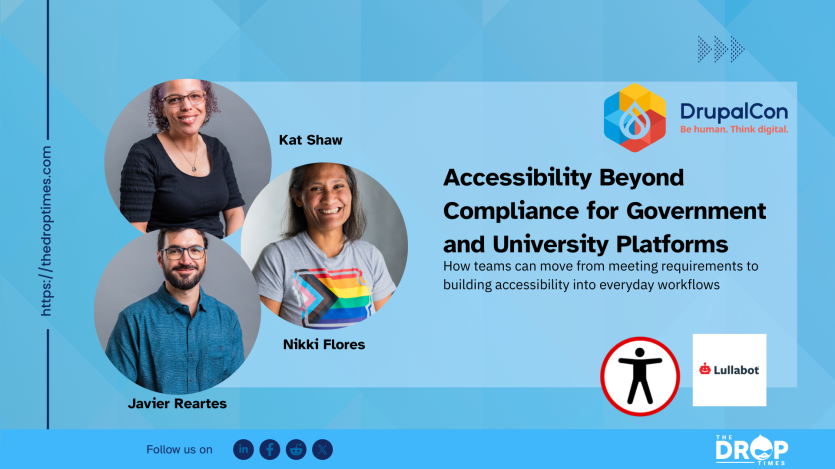
Scheduled for 24 March 2026 from 15:00 to 15:50 CDT at DrupalCon Chicago, the session will take place in Continental Room C (Lobby Level) under the user experience, accessibility and design track. It brings together M. Nikki Flores, Javier Reartes, and Kat Shaw, CPACC. Their experience spans federal, state, and university platforms, including Iowa.gov, the State of Maryland platform, Carnegie Mellon University, Dartmouth Health, UMass Amherst, Harvard Library, and the State of Massachusetts.
The session centres on a shift in approach. Rather than treating accessibility as a final step, the presenters argue for embedding it throughout the project lifecycle, drawing from Lullabot’s work integrating accessibility into design, development, and content workflows. Speaking to The Drop Times, Shaw emphasised the need to move accessibility earlier into the process:
“Make accessibility a continuing part of your workflow.”
The session will present practical guidance based on project experience, including common pitfalls and the decisions that helped address them. Attendees will be offered actionable steps aligned with both immediate timelines and longer-term planning. The discussion also covers prioritisation strategies, including evaluating issues based on user impact, traffic, and implementation effort, as well as approaches to self-audits and the use of existing accessibility resources.
The discussion is aimed at a broad audience, including government managers and product owners navigating compliance requirements, as well as developers, designers, content teams, and UX professionals working within Drupal environments. Across these roles, the emphasis remains consistent: accessibility is most effective when built into everyday workflows rather than added at the end.
The presenters also plan to include a question-and-answer segment and share resources for continued learning. They encourage ongoing engagement beyond the session, including connecting through Lullabot’s LinkedIn, and emphasise openness in sharing lessons learned from past challenges.
“We’re excited to connect with others in the field. It can be very challenging and sometimes isolating work to advance accessibility. Working together helps ensure the websites we build better serve the public, especially where government services are involved.”
“If accessibility becomes a required and welcomed part of development, we will have done the best we can to ensure these practices are applied consistently across projects.”
The session positions accessibility as an ongoing responsibility grounded in practical action and shared effort, at a time when expectations for public digital services continue to increase.
 Kat (Katherine) ShawMakes accessibility part of the build, not a bug report.
 Kazima AbbasKazima Abbas is a sub-editor at The Drop Times
ASK: Drupal Community Needs Your Support
View all →
Note: The vision of this web portal is to help promote news and stories around the Drupal community and promote and celebrate the people and organizations in the community. We strive to create and distribute our content based on these content policy. If you see any omission/variation on this please reach out to us at #thedroptimes channel on Drupal Slack and we will try to address the issue as best we can.
Related Drupal Initiatives

Related Events



Related Organizations

Related People


You may also like