



Mautic Content Provider Module Standardises Drupal–Mautic Content Workflows


The Drupal–Mautic integration space has gained a new open-source module designed to reduce the custom development typically required to migrate Drupal content into Mautic campaigns. The Mautic Content Provider module exposes selected Drupal content to Mautic, allowing teams to use nodes and Views inside email templates and related marketing workflows.
The module requires the Drupal Integrated Content plugin to be enabled on the Mautic installation. It provides two main capabilities: exposing selected nodes in selected view modes and adding a dedicated Views display type for Mautic output. The goal is to give site builders and marketing teams a more standardised way to connect Drupal-managed content with Mautic’s marketing automation tools.
Kazima Abbas, Sub Editor at The DropTimes, connected with Niels Aers, CPO at Dropsolid AI and one of the maintainers of the Mautic Content Provider module, to understand the thinking behind the release. Niels answered questions on the module’s purpose, architecture, performance considerations, privacy implications, and future direction. The module is maintained by Laurens Van Damme, Product Engineer at Dropsolid AI, and Abhishek Mazumdar, Product Engineer at Dropsolid AI.

Niels Aers and Abhishek Mazumdar at Drupalcon Nara
Niels Aers and Abhishek Mazumdar at Drupalcon Nara
|The module emerged from repeated project-level efforts to solve the same integration problem.
“We saw a recurring pattern where every project required a custom-built bridge to get Drupal content into Mautic emails. Rebuilding this integration from scratch every time was inefficient and created technical debt. We realized the community needed a standardized, plug-and-play open-source solution that democratizes the flow of data between the CMS and the marketing automation tool.”
Before the module, teams commonly relied on manual copying or custom code to move Drupal-managed content into Mautic. According to Niels, these approaches were difficult to scale and often tied to individual implementations.
Instead of requiring marketers to duplicate content manually or developers to rebuild integrations for each project, the module exposes Drupal content in a structured way for use inside Mautic workflows.
Drupal’s API-first architecture, rendering system, Views, view modes, and Twig theming layer formed the technical foundation for the integration. By creating a dedicated Views display and using Drupal’s structured content capabilities, the module gives site builders a configuration-based method for preparing content for Mautic while preserving developer control over markup and presentation.
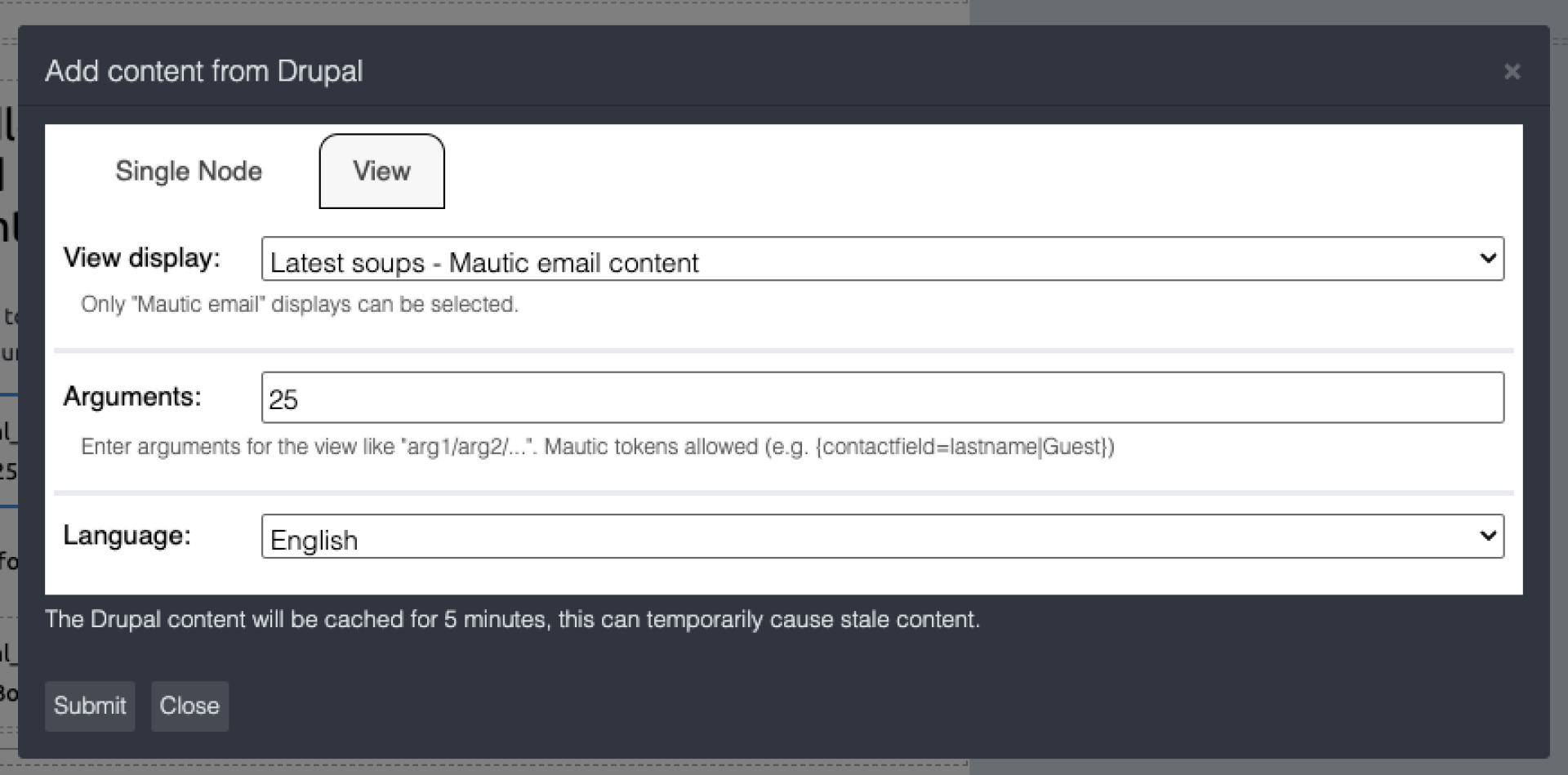
When content reaches Mautic, the module delivers HTML generated by Drupal. This allows the output to respect Drupal’s theming system while still being adapted for email or landing-page use. Teams can use standard view modes and Twig templates to tailor markup for destinations such as email clients that require simplified HTML structures.
“The module delivers the HTML directly from Drupal to Mautic. The beauty of this approach is that it respects Drupal’s theming system.”
The release is also connected to another module, Mautic Personalisation, which was released alongside the Content Provider module. Dropsolid AI views the two tools as related parts of the same integration challenge. Mautic gathers behavioural and segment data through its tracking script, while Drupal controls the website experience. The Personalisation module allows Drupal to use Mautic segment data to adjust what visitors see on the front end.
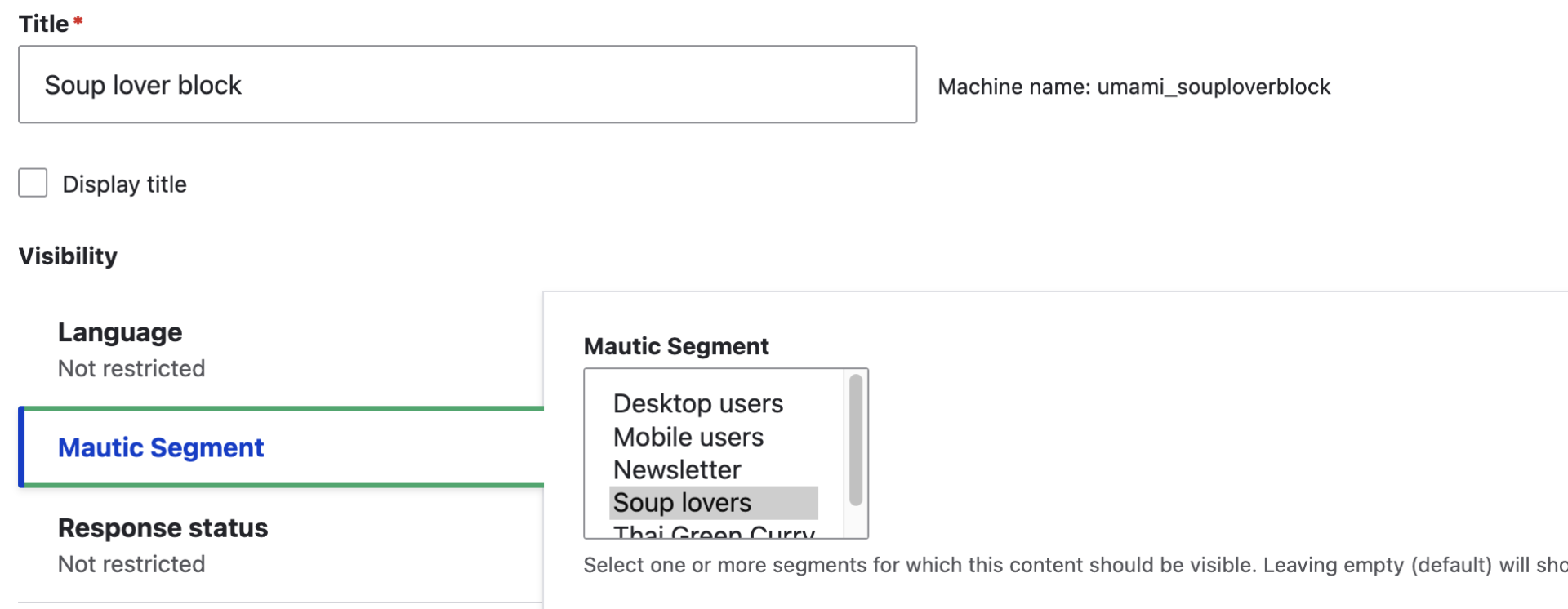
Segment data integrates into Drupal’s core condition plugin system, allowing Mautic segments to function as visibility rules in tools that rely on Drupal’s standard condition API, including the core Block overview page and Layout Builder. The company is also monitoring ongoing Drupal CMS, Starshot, Canvas, and Experience Builder developments to maintain compatibility with future site-building workflows.
The setup depends on Mautic’s tracking script, mtc.js, and a segment-tracking plugin. Niels described these dependencies as standard within the Mautic ecosystem. The tracking script is designed to work with Drupal cookie compliance tools, including EU Cookie Compliance, while the segment-tracking plugin adds segment data to the existing tracking payload.
Performance was a major concern during development. The module uses Drupal’s caching system, including cache tags and cache contexts, to vary content based on Mautic segments while preserving cacheability. Segment data is stored in a configurable cookie so that the server, Varnish, or CDN layers can serve the correct cached page variation without requiring additional API calls during page load.
“lightning-fast delivery of personalised content at scale without any performance trade-offs.”
The choice to store segment data in cookies was driven by the need to bridge client-side tracking and server-side rendering. By making segment information available to the server, Drupal can serve the correct version of a page immediately, which is especially important for cached experiences.
Privacy remains the responsibility of the site implementation. The modules do not bypass consent requirements. According to Niels, the setup is designed to work with standard consent management tools, including Drupal modules such as EU Cookie Compliance or Klaro, as well as third-party services. Site owners can control when the Mautic tracking script loads so cookies and personalisation activate only after user consent.
For cases where segment data is delayed, missing, or unavailable, the system falls back to the base version of the site. The recommended approach is enhancement-based, where every visitor receives a complete default experience and personalisation is used only to refine that experience.
Cross-domain tracking remains outside the module’s scope. Niels noted that Mautic does not provide cross-domain tracking out of the box. Workarounds such as URL decoration or CNAME-based approaches may be possible, but they are typically handled at the infrastructure level.
Version 1.0.0 of the modules was released on 6 March 2026. According to Niels, the logic behind the modules had already been tested in closed-source enterprise environments before being released publicly.
The modules are part of the company’s Digital Experience Platform offering and are included in its continuous integration and update cycle. Niels also linked the release to the company’s broader Drupal involvement, including its role as a Platinum Drupal Partner and founding member of the Drupal AI initiative.
The modules are likely to be most useful for organisations with complex communication requirements and multiple audience segments. Universities were cited as one example, where messaging may differ for prospective students, current students, alumni, and other groups.
For marketers and content managers, the primary advantage is reduced duplication between systems. Drupal-managed content can be exposed directly inside Mautic, while Mautic segments control personalisation inside Drupal. The setup can also work alongside the Mautic ECA module to support no-code automation workflows.
The minimal setup requires a Drupal site, a Mautic instance, the Mautic tracking script, the Mautic Content Provider module, the Mautic Personalisation module, and the Segment Tracking plugin on the Mautic side. Once connected through the Mautic API and tracking URL, Drupal content becomes available as components inside the GrapeJS mail builder, while Mautic segments become available as visibility conditions inside Drupal’s block and layout systems.
Looking ahead, the team is exploring ways to simplify styling workflows, including the possibility of allowing users to adjust CSS for Drupal-sourced content directly from the Mautic interface. Niels said the team is also monitoring how the community adopts the modules before deciding where to expand next.
 Kazima AbbasKazima Abbas is a sub-editor at The Drop Times
Image Attribution Disclaimer: At The Drop Times (TDT), we are committed to properly crediting photographers whose images appear in our content. Many of the images we use come from event organizers, interviewees, or publicly shared galleries under CC BY-SA licenses. However, some images may come from personal collections where metadata is lost, making proper attribution challenging.
Our purpose in using these images is to highlight Drupal, its events, and its contributors—not for commercial gain. If you recognize an image on our platform that is uncredited or incorrectly attributed, we encourage you to reach out to us at #thedroptimes channel on Drupal Slack.
We value the work of visual storytellers and appreciate your help in ensuring fair attribution. Thank you for supporting open-source collaboration!

ASK: Drupal Community Needs Your Support
View all →
Disclosure: This content is produced with the assistance of AI.
Note: The vision of this web portal is to help promote news and stories around the Drupal community and promote and celebrate the people and organizations in the community. We strive to create and distribute our content based on these content policy. If you see any omission/variation on this please reach out to us at #thedroptimes channel on Drupal Slack and we will try to address the issue as best we can.

Related Organizations

Related People


You may also like