Drupal teams are asking software to do more work that once depended almost entirely on people: prepare coordinated changes, inspect content, validate accessibility, recommend revisions, and answer questions from structured information. Several DrupalCon Rotterdam speakers are concentrating on the point after those capabilities become possible: where automation should stop and a person should still have to decide.
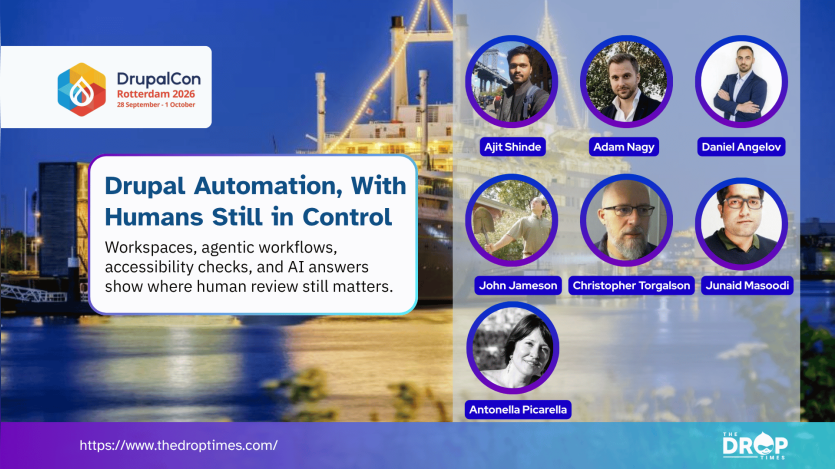
That boundary appears across very different kinds of Drupal work. Ajit Shinde of Tag1 Consulting is looking at Workspaces as a controlled layer for content, configuration, and AI-assisted changes. Adam Nagy and David Galeano are presenting an agentic editorial workflow in which human approval is enforced by the system. Daniel Angelov, John Jameson, Christopher Torgalson, and Junaid Masoodi approach the boundary through accessibility, while Antonella Picarella applies a similar control problem to AI-assisted answers built from Drupal content.
Get the Latest in Drupal!
The common thread is not resistance to automation. These speakers are using it, extending it, and building workflows around it. What changes from session to session is where human judgement re-enters the system: before publication, during accessibility review, when deciding whether generated code makes sense, or when determining which information an AI system should be allowed to use.
Ajit will present Beyond content staging: where Drupal Workspaces is heading on 29 September. In his response to The DropTimes, he described Workspaces as increasingly useful beyond its established content-staging role, pointing to Content Moderation, AI governance, configuration changes, previews, and safer publishing workflows.
Ajit Shinde
Ajit Shinde
Workspaces is becoming useful for much more than content staging.
The session examines how Workspaces can support coordinated changes that should not immediately reach production. Workspaces Extra extends that model through capabilities including wse_config and wse_preview, while tool_workspace is being explored for human-in-the-loop AI workflows. The practical attraction is that groups of machine-assisted changes can be isolated, inspected, and approved rather than being treated as trustworthy simply because an automated process produced them.
The starting problem is editorial scale. European Commission editors manage hundreds of websites in 24 official languages while trying to keep facts aligned with policy, metadata complete, accessibility and consistency maintained, and existing pages current as policies change. Adam said the team used AI to assist that work while keeping the final decision with editors.
Adam Nagy
Adam Nagy
AI assists, humans decide, and in our case that is enforced by the system rather than requested in a prompt.
–Adam Nagy, Senior Drupal Consultant, European Commission
Drupal orchestrates the workflow rather than handing the entire process to an autonomous agent. Rule-based checks handle work suited to deterministic validation, while AI is used where contextual evaluation is useful. Proposed changes remain separate from published content until an editor approves them, making the checkpoint part of the system architecture rather than an instruction that a language model is expected to remember.
Adam and David will also cover asynchronous execution, model integration, cost, speed, reliability, and data sovereignty. Adam describes the work as a functioning solution and a set of architectural decisions rather than a forecast of what autonomous agents might eventually do.
Accessibility exposes another limit: software may establish that a rule has been satisfied without establishing that the result makes sense to the person using the page. That difference is central to Daniel Angelov's The Reality of Accessibility Automation.
Daniel Angelov
Daniel Angelov
A tool confirms alt text exists; it can't tell you it's right.
–Daniel Angelov, QA Domain Knowledge Lead, JAKALA
Daniel separates what remains for people into meaning, flow, recovery, and experience. An automated check can establish the presence of a technical feature without knowing whether it communicates the intended meaning or allows somebody to complete a task. His session will also examine why apparently conflicting estimates of automated accessibility coverage can refer to different measurements, and where AI can extend testing without replacing human evaluation.
John Jameson approaches automated checking from inside the editorial workflow. His Getting the most out of Editoria11y v3 session examines what teams can do once a live checker becomes part of everyday content work rather than a final scan.
John Jameson
John Jameson
I want people pondering what recurring problems can be addressed by extending a live checker.
–John Jameson, Editor in Chief, Editoria11y LLC
John described users writing custom tests, matching alerts to user roles, mapping false positives, changing themes in response to checker behaviour, experimenting with automatic fixes, and beginning to integrate editorial style guidance. The result is not a universal pass-fail standard but a checker that can be adapted to the recurring problems of a particular editorial environment.
Christopher Torgalson of Annertech shifts the discussion from tools to responsibility across the wider team. His Accessibility Worst Practices session draws on remediation experience and the 2026 WebAIM Million study to examine recurring accessibility failures.
Christopher Torgalson
Christopher Torgalson
Virtually everyone involved in web projects can meaningfully contribute to their overall accessibility.
Christopher's argument widens responsibility beyond an accessibility specialist. Developers, designers, editors, and site builders all make decisions that can introduce or remove barriers, and he notes that many frequently occurring problems are also comparatively straightforward to address once teams recognise them.
Junaid Masoodi brings that problem directly into AI-assisted front-end development in Can AI Fix the Web? The Promises and Perils of "Automated" Accessibility. His concern is that generated ARIA attributes, alternative text, and focus-management code can appear technically plausible, pass automated checks, and still make the screen-reader experience worse.
Junaid Masoodi
Junaid Masoodi
Accessibility has quietly become an AI problem. Teams are shipping ARIA attributes, alt text and focus management written by models they haven't audited, and those fixes pass automated checks while breaking the screen-reader experience underneath.
–Junaid Masoodi, Country Manager and Enterprise UX & Front-End Architect, bbg bitbase India
Junaid is not asking developers to stop using Claude, ChatGPT, Copilot, or similar tools. He wants teams to change the role assigned to them. His practical recommendation is to use AI as an auditor that identifies risks and challenges assumptions rather than automatically replacing components, with human sign-off required before generated accessibility changes are merged.
Antonella said the implementation controls which Drupal content enters the knowledge base, what retrieved information is supplied to the AI, and how the system is instructed to answer. That gives the team a defined information boundary instead of treating the language model as an unrestricted source.
Antonella Picarella
Antonella Picarella
One of the most interesting outcomes for us was something we hadn’t fully anticipated: AI also became a tool for improving our content.
–Antonella Picarella, Senior Drupal Developer, European Personnel Selection Office (EPSO)
Backend and usage statistics can show what people are asking, where they struggle to find information, and where existing material may be incomplete or unclear. The assistance layer therefore becomes a source of editorial feedback as well as a way to retrieve information.
These sessions put different technologies around the same operational question. Workspaces can hold changes away from production, agentic workflows can enforce approval outside the model, accessibility tools can expose problems without deciding whether an experience works for a person, and constrained AI systems can limit the information available to an answer.
The human role therefore extends beyond approving whatever a machine produces. It includes deciding what the system may change, what evidence is sufficient, what a user actually experiences, and what should happen when automation produces a technically valid result that is still wrong.
Image Attribution Disclaimer: At The Drop Times (TDT), we are committed to properly crediting photographers whose images appear in our content. Many of the images we use come from event organizers, interviewees, or publicly shared galleries under CC BY-SA licenses. However, some images may come from personal collections where metadata is lost, making proper attribution challenging.
Our purpose in using these images is to highlight Drupal, its events, and its contributors—not for commercial gain. If you recognize an image on our platform that is uncredited or incorrectly attributed, we encourage you to reach out to us at #thedroptimes channel on Drupal Slack.
We value the work of visual storytellers and appreciate your help in ensuring fair attribution. Thank you for supporting open-source collaboration!
Your contributions matter a lot for the community. Do your part becoming a sponsor, this also ensures your brand recognition and visibility at Southwestern DrupalCamp 2026..
Disclosure: This content is produced with the assistance of AI.
Note: The vision of this web portal is to help promote news and stories around the Drupal community and promote and celebrate the people and organizations in the community. We strive to create and distribute our content based on these content policy. If you see any omission/variation on this please reach out to us at #thedroptimes channel on Drupal Slack and we will try to address the issue as best we can.













 Kazima AbbasKazima Abbas is a sub-editor at The Drop Times