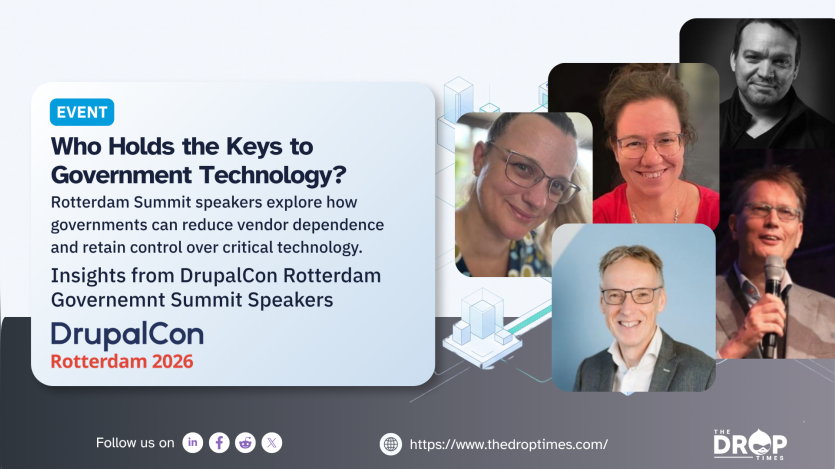
Five contributors to the Government Summit at DrupalCon Rotterdam have described how governments can pursue digital sovereignty without attempting complete technological independence. In written responses to The DropTimes following the summit on 28 September 2026, they examined the risks of relying on individual technology suppliers, the importance of credible alternatives and the role of cooperation among public institutions.
Their answers distinguish between the right to change a technology provider and the practical ability to make that change. Open-source software can give governments access to code and greater freedom to modify or reuse it, but it does not automatically provide the staff, infrastructure, funding or alternative suppliers needed to exercise that freedom. The contributors identify different priorities for governments seeking greater control, from protecting essential services to strengthening municipalities and safeguarding individual autonomy.
Prioritising Critical Systems Rather Than Pursuing Complete Independence
Teun van der Vorm, general director of the Dutch government IT service provider DICTU, argues that governments should approach digital sovereignty according to the risks posed by individual technology dependencies. Teun delivered the summit's opening keynote, The Struggle for Digital Sovereignty in Government, and participated in a panel examining who should sustain the open-source ecosystems on which digital sovereignty depends. His response identifies open source as the main enabler of sovereignty, while rejecting complete technological independence as a necessary or realistic short-term objective.
"It is better to do it risk based, so critical applications for government processes or applications with sensitive data first."
Teun van der Vorm
Teun van der Vorm
–Teun van der Vorm, general director, DICTU
For Teun, governments should begin with applications that support critical administrative processes or handle sensitive information. These systems may present greater consequences if a supplier becomes unavailable, changes its contractual conditions or introduces restrictions that affect government operations. Other applications can be addressed according to their importance, existing dependencies and the availability of workable alternatives.
His position reflects an operational problem faced by public institutions. Attempting to replace every proprietary system simultaneously could introduce disruption without necessarily improving the security or reliability of essential services. A risk-based approach allows governments to identify where greater control is most urgent and direct resources towards those areas first.
DICTU has already documented one way of assessing such dependencies. On 11 March 2026, the organisation published a cloud sovereignty assessment instrument that evaluates cloud services against criteria including data sovereignty, legislation, autonomy and reliability. The tool is intended to help public organisations make informed decisions when selecting or evaluating cloud providers. It illustrates how sovereignty can be examined through specific risks and requirements rather than a general distinction between proprietary and open-source technology.
Control Depends on Knowing When and How to Leave
Esmeralda Tijhoff, a product owner at DICTU and board member of Stichting Drupal Nederland, similarly rejects complete independence as the immediate objective. In her written response, she said there was broad agreement at the summit that governments needed to act rather than leave their current dependencies unchanged. She also acknowledged the scale of the challenge, particularly for public organisations that depend on established technology, contracts and administrative processes.
Esmeralda expects governments to operate mixed technology environments for years. Some applications will be migrated, others developed collaboratively with public-sector organisations, and some retained under revised conditions. For her, this mixture is not necessarily evidence of failure. The decisive question is whether governments understand the systems on which they depend and have the means to change those arrangements when required.
"It's control: knowing what you depend on, being able to verify and adapt it, and having a credible way out when you need one."
Esmeralda Braad-Tijhoff
Esmeralda Braad-Tijhoff
–Esmeralda Tijhoff, product owner, DICTU
That definition requires more than a contractual right to terminate a supplier relationship. Governments also need the technical knowledge to assess their systems, access to the information required to migrate services and sufficient organisational capacity to maintain an alternative. Without those conditions, the theoretical ability to change providers may have limited practical value.
Esmeralda's involvement in DICTU's Generieke Basis Website initiative provides a related example of developing capabilities within the public sector. According to DICTU's account published on 23 January 2026, nine teams developed reusable Drupal components for government websites, including content structures, user roles and common security and accessibility requirements. Esmeralda serves as community manager for the initiative, which allows organisations to reuse established technical foundations rather than commissioning equivalent functionality independently.
The project does not address every form of government technology dependence, but it demonstrates how shared development can increase the options available to public institutions. Esmeralda's broader argument is that governments can make progress without controlling every component of their infrastructure, provided that remaining dependencies are understood, manageable and open to change.
Combining Municipal Demand to Influence Technology Markets
Bert Boerland, chair of Stichting Drupal Nederland and a Drupal contributor for more than 25 years, approaches sovereignty through the purchasing power of local governments. At Rotterdam, Bert chaired the panel Can Local Government Build and Sustain the Digital Commons It Needs?, which examined how municipalities and their technology partners could collaborate on common digital requirements. His response to The DropTimes argues that governments acting individually often lack the influence needed to shape the products and services they purchase.
Bert observed that municipalities frequently approach suppliers with similar requirements but relatively small individual budgets. Each authority may commission a separate solution to a problem shared by many others, leaving it dependent on the company responsible for developing and maintaining that system. When municipalities combine their requirements, however, they can create sufficient demand to influence what suppliers build and the conditions under which the resulting technology is delivered.
"Small alone, large together: that is where sovereignty begins."
Bert Boerland
Bert Boerland
–Bert Boerland, chair, Stichting Drupal Nederland
His argument introduces a distinction between technological freedom and market influence. A municipality may be legally free to select another supplier but still lack the budget, expertise or bargaining power to obtain a suitable alternative. By pooling resources and coordinating procurement, public institutions could become more influential customers and develop shared solutions that are less dependent on the priorities of individual vendors.
The approach has an existing parallel in LocalGov Drupal, where councils and suppliers collaborate on reusable website functionality. The initiative allows participating organisations to benefit from common development while adapting services to local requirements. Rather than each council purchasing equivalent functionality separately, the shared codebase provides a foundation that different public bodies can use and improve.
Bert's argument extends beyond the financial advantages of shared development. His concern is whether public institutions collectively possess enough influence to make decisions about the technology they rely on. Combining requirements and budgets can help municipalities move from purchasing isolated solutions towards participating in the development of common infrastructure.
Protecting Individual Sovereignty Alongside Government Autonomy
Klara Binon, Drupal team lead at the Flemish public employment service VDAB, raises a different question about digital sovereignty. Klara participated in Bert's local-government panel and presented a session on making greater use of existing Drupal infrastructure. In her response to The DropTimes, she welcomed initiatives intended to reduce vendor lock-in and increase government control over data and expenditure, but stressed that the interests of individuals must also be considered.
"The most valuable ones to me are those that take digital sovereignty of individuals into account too."
Klara Binon
Klara Binon
–Klara Binon, Drupal team lead, VDAB
Klara warned against reproducing existing dependencies through new technology arrangements. A government might reduce its reliance on a proprietary supplier while creating another centralised system over which individuals have little meaningful control. Her concern broadens the discussion beyond the independence of public institutions to include the people who interact with government technology and depend on its services.
She also supports European initiatives that encourage open-source adoption and cooperation among organisations. In her view, pooling resources could make shared technologies more widely available while avoiding the expense of each government developing equivalent systems independently. However, she considers it important that such arrangements do not create another central point of failure.
Her position identifies a tension within collaborative approaches to sovereignty. Sharing technology can reduce duplication and dependence on particular commercial products, but the governance and architecture of those shared systems also matter. Replacing one dominant arrangement with another would not necessarily resolve the concerns that motivated the change.
Klara's Rotterdam presentation, Saving Money by Using the Drupal Website You Already Have, offered a practical example of examining existing capabilities before purchasing another system. VDAB's Drupal intranet was already gathering, enriching and sharing location data that a proposed commercial master-location tool was intended to manage. The session explored how existing Drupal functionality could address requirements that might otherwise lead to additional expenditure and dependencies. Although the example concerns an internal government platform, Klara's wider argument is that sovereignty must be assessed beyond the immediate interests of the institution operating the technology.
Making Digital Sovereignty Possible for Smaller Governments
Mike Gifford, open standards and practices lead at CivicActions and a Drupal core accessibility maintainer, places particular emphasis on the municipal level. Mike participated in the summit panel on sustaining open-source ecosystems and presented The Accessible Digital Commons: Aligning Government Procurement to Sustain Open Source. His response questions the tendency to discuss digital sovereignty primarily in terms of nation-states when many of the services people use are delivered by local authorities.
Mike noted that many municipalities lack the resources to build and maintain complex digital services independently. Small administrations may have limited technical teams, constrained budgets and insufficient capacity to manage every component of their infrastructure. For him, collaboration with other public institutions and an active network of smaller technology businesses provides an alternative to relying on a single supplier or expecting each municipality to become self-sufficient.
"Meaningful control will only come through collaboration via open source communities like Drupal."
Mike Gifford
Mike Gifford
–Mike Gifford, open standards and practices lead, CivicActions
Mike connected the Rotterdam discussions to his experiences at Drupal4Gov EU earlier in 2026 and European open-source events surrounding FOSDEM. He observed that the relationship between digital sovereignty and open source appeared more widely understood in his conversations at Rotterdam. He also noted the presence of the LocalGov Drupal community across these events, viewing it as an example of public institutions working together to develop and sustain shared technology.
LocalGov Drupal provides a concrete illustration of that approach. On 9 October 2026, the project announced that the Digital Public Goods Alliance had recognised it as a Digital Public Good, following confirmation on 8 September. The recognition followed an assessment of requirements including openness, governance, privacy and security. It does not establish that participating councils are independent of every supplier, but it documents the project's commitment to a platform that public organisations can adopt and adapt.
Mike's argument also concerns the distribution of technical knowledge and responsibility. Governments may continue to depend on external specialists for hosting, development or support, but cooperation among councils, suppliers and open-source contributors can expand the number of organisations capable of providing those services. In this model, sovereignty does not require every municipality to maintain its own independent technology stack. It depends on whether municipalities can participate in a shared ecosystem without surrendering meaningful control to one provider.
What Practical Digital Sovereignty Requires
The five responses address different aspects of a question also receiving attention at the European policy level. A study published by the European Commission's Joint Research Centre on 31 July 2026 identified people, markets and products, infrastructure, and governance as four areas requiring attention in public-sector digital sovereignty. It highlighted the need to assess dependencies, strengthen institutional capabilities and use procurement to encourage more diversified technology markets.
The European Union's Open Source Strategy, introduced in June 2026, similarly addresses the adoption of open-source alternatives, cooperation among public institutions, procurement practices and support for critical software ecosystems. These policy directions provide wider context for the Rotterdam discussions, although proposals and strategies should not be mistaken for evidence that individual governments have already achieved greater independence.
The contributors do not describe a single path towards digital sovereignty. Teun prioritises critical systems and sensitive information, while Esmeralda focuses on understanding dependencies and retaining a credible ability to leave suppliers. Bert considers how combined municipal demand can influence the market. Klara asks whether government autonomy also protects individuals and avoids new forms of centralisation. Mike emphasises collaboration as a way for resource-constrained municipalities to obtain greater control over their services.
Taken together, their responses distinguish complete technological independence from the ability to make and implement independent decisions. Governments may continue using proprietary products, external contractors and shared infrastructure while seeking greater control over the systems on which public services depend. The practical question is whether those arrangements preserve meaningful alternatives, sufficient technical capacity and the ability to change course when circumstances require.
Image Attribution Disclaimer: At The Drop Times (TDT), we are committed to properly crediting photographers whose images appear in our content. Many of the images we use come from event organizers, interviewees, or publicly shared galleries under CC BY-SA licenses. However, some images may come from personal collections where metadata is lost, making proper attribution challenging.
Our purpose in using these images is to highlight Drupal, its events, and its contributors—not for commercial gain. If you recognize an image on our platform that is uncredited or incorrectly attributed, we encourage you to reach out to us at #thedroptimes channel on Drupal Slack.
We value the work of visual storytellers and appreciate your help in ensuring fair attribution. Thank you for supporting open-source collaboration!
Disclosure: This content is produced with the assistance of AI.
Note: The vision of this web portal is to help promote news and stories around the Drupal community and promote and celebrate the people and organizations in the community. We strive to create and distribute our content based on these content policy. If you see any omission/variation on this please reach out to us at #thedroptimes channel on Drupal Slack and we will try to address the issue as best we can.











 Allen JasonAllen without organs