


John Richards II on What Decoupling Reveals About Drupal and WordPress


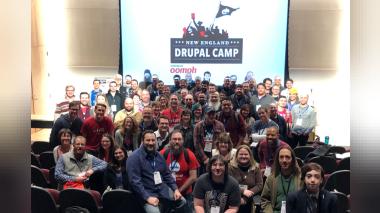
Ahead of NEDCamp 2022, The DropTimes spoke with John Richards II, also known by the handle JRastaban, about Drupal’s community, stakeholder collaboration, developer advocacy, Drupal 7 migration choices, and the differences between Drupal and WordPress. At the camp, he presented “The Magic of Collaboration” and “5 Risk Mitigation Tips for Deploying Drupal at Scale.”
At the time of the conversation, Richards was manager of developer advocacy at Pantheon. With a background primarily in WordPress and experience working across open-source communities, he reflected on what drew him to Drupal, how developer advocates represent developers in two directions, and what Pantheon’s decoupled work revealed about the capabilities of Drupal and WordPress.
This written interview was originally published as part of The DropTimes’ short speaker interview series around NEDCamp 2022.
Editor’s note: References to professional roles, Drupal 7’s scheduled end-of-life date, outreach between the Drupal and Backdrop communities, Pantheon’s decoupled efforts, and the capabilities of Drupal, WordPress, Next.js, and related tooling reflect the context when this conversation took place in November 2022.
TDT [1]: Please introduce yourself and your work in Drupal.
John Richards II: I’m the Manager of Developer Advocacy at Pantheon, and I live in the greater St. Louis area with my wife and a clowder of cats. I started getting involved in community events and quickly became hooked by the amazing people. I switched careers so I could be more involved in Open Source communities. I am thankful for how Drupal is so intentionally inclusive and collaborative. Apart from work, I enjoy playing board games with friends, trying new food, and spending time reading with a cat curled in my lap.
TDT [2]: The Drupal community often says that people “come for the code but stay for the community.” How were you first introduced to the community?
John Richards II: It is so true! I remember being at my first Drupal event and being worried I wouldn’t fit in. Instead, incredible community members, including AmyJune, Mike Herschel, and Chris Teitzel, went out of their way to make me feel accepted and part of the amazing Drupal community.
TDT [3]: What are you presenting at NEDCamp 2022, and who should attend your session?
John Richards II: I’m giving a talk on the Magic of Collaboration. Even including the infamous Drupal learning curve, one of the most challenging parts of building a website is stakeholders’ changing and conflicting needs. Collaboration is an essential web development skill. If you are looking for better ways to collaborate with your teammates and stakeholders, come check it out.
TDT [4]: After multiple extensions of Drupal 7’s end of life, a final sundown is set for November 2023. It has been around for more than a decade, and many websites still run on Drupal 7. What is your advice for people staying on Drupal 7?
John Richards II: I’ll flip the script a bit and instead answer with my advice for those of us who have moved past D7. D7 folks are facing hard choices and are certainly looking at alternatives, hopefully open-source ones like Backdrop.
- How do we show them that Drupal is still the best path for them going forward?
- What can be done to make it easier for D7 developers to stay in the Drupal community?
There isn’t a great solution yet, but to make this happen, there need to be open conversations instead of sweeping the problem under the rug. I’m hopeful that the recent embracing of the Backdrop community at events like DCColorado and BADCamp are signs that we are ready to engage instead of ignoring the problem.
To be clear, while Backdrop is fine, I doubt it is the right solution for most teams. However, including as many perspectives as possible is needed to understand how to address the concerns D7 developers have with moving forward.
TDT [5]: Your profile says you are a developer advocate at Pantheon. The job title interests us. What is the role of a developer advocate?
John Richards II: It’s a “for developers, by developers” role focused on enabling developer success. I really appreciate that the role gives the opportunity to advocate for developers in two directions. I’m certainly an advocate for my company, and that means working to make developers on Pantheon as successful as possible through education and resources. Perhaps more importantly, the second way I advocate is by advocating on behalf of developers.
For me, hearing that something is wrong is actually a gift because I can take that feedback to the team so the right people can work to get the problem fixed or the feature added to the roadmap.
TDT [6]: As someone with extensive experience in WordPress who also knows Drupal, how do you see these two open-source CMSs side by side? What about the DXP capabilities provided by each platform?
John Richards II: It’s been very interesting seeing some of the biggest differences start to fade away. WordPress decided to break some backward compatibility to adopt newer technology, while Drupal worked to make upgrading smoother to give easier ways for community members to stay current.
Lately, I have been involved in Pantheon’s decoupled efforts, and it has highlighted some foundational differences. I found it easier to get WordPress spun up and configured to talk to a Next.js site than it is with Drupal. However, once I started wanting to extend beyond default functionality, the Drupal feature set started bringing so much value.
For instance, Drupal’s Cache API makes server-side rendering so much easier, and trying to back something equivalent on the WordPress side is proving to be very difficult.
 Sebin A JacobFighting procrastination at every step is a journey half accomplished


ASK: Drupal Community Needs Your Support
View all →
Disclaimer: The information provided about the interviewee has been gathered from publicly available resources. The responsibility for the responses shared in the interview solely rests with the featured individual.
Note: The vision of this web portal is to help promote news and stories around the Drupal community and promote and celebrate the people and organizations in the community. We strive to create and distribute our content based on these content policy. If you see any omission/variation on this please reach out to us at #thedroptimes channel on Drupal Slack and we will try to address the issue as best we can.
Related Organizations