

Shared Public-Sector Platforms Shape Big Blue Door’s DrupalCon Rotterdam Focus

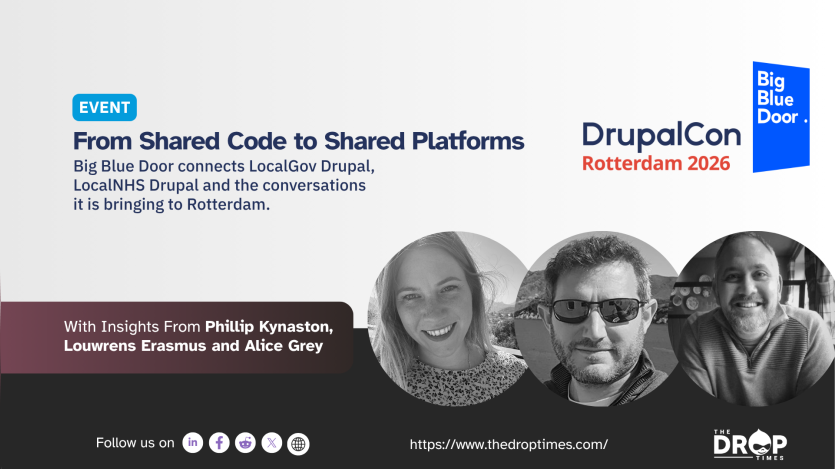
Ahead of DrupalCon Rotterdam 2026, sponsor Big Blue Door says shared public-sector platforms, practical uses of AI, and exchanges between Drupal practitioners are shaping the conversations its team wants to have at the event. In responses provided to The DropTimes, the company connected those themes with its work around LocalGov Drupal and the emerging LocalNHS Drupal platform. The examples place collaborative platform development, rather than individual website delivery, at the centre of its public-sector focus.
That platform approach already has a live healthcare implementation behind it. Bristol NHS Foundation Trust launched its website on 1 July 2026 as the first live implementation of LocalNHS Drupal, with Big Blue Door involved in the design and development. The project adapts the collaborative model established by LocalGov Drupal, where councils share components, patterns, and functionality rather than commissioning each capability independently.
Phillip Kynaston, managing partner at Big Blue Door, identified Drupal’s increasing use as the foundation for shared and reusable digital platforms as one of the more interesting shifts in the ecosystem. He pointed to LocalGov Drupal as an established example and to LocalNHS Drupal as an attempt to carry a similar approach into healthcare. The Bristol implementation gives that comparison practical context, although it remains an early example rather than evidence that the model will transfer unchanged across NHS organisations.
Kynaston also identified AI as an important part of the wider Drupal conversation, but framed Big Blue Door’s interest around uses that provide tangible value rather than adoption for its own sake. He said the company is interested in what the technology can offer users, editorial teams, designers, and developers as it develops. The responses do not describe a specific Big Blue Door AI implementation, so the company’s position is better understood here as an area of interest for discussion in Rotterdam.
Louwrens Erasmus, product delivery director at Big Blue Door, linked the company’s DrupalCon sponsorship to its reliance on open-source software and contributions from across the ecosystem. He described sponsorship as one way of supporting a community from which the company benefits, while also creating opportunities to compare public-sector delivery experience with teams working in other organisations and countries. Erasmus is also listed among the Big Blue Door team involved in the Bristol NHS Foundation Trust implementation.
The Rotterdam sponsorship extends to the Government Summit on 28 September. LocalGov Drupal says Big Blue Door’s support made ten places available to council digital teams that would otherwise have been unable to afford the summit. Those places cover the Government Summit rather than the wider DrupalCon programme.
Alice Grey, product delivery director at Big Blue Door, placed more emphasis on the exchanges that happen outside scheduled conference sessions. She said conversations with contributors, agencies, and other practitioners can expose teams to approaches that make them reconsider their own work. Grey has participated in similar exchanges within LocalGov Drupal, where she and Paul Jenkins led a workshop at LocalGov Drupal Camp 2026 on content paragraphs, including structure, naming, duplication, and the editor experience.
Taken together, the responses make shared public-sector platforms the clearest connection between Big Blue Door’s recent work and the conversations it expects in Rotterdam. LocalGov Drupal provides an established collaborative model, while LocalNHS Drupal has now produced its first live healthcare implementation. The broader question is how far that reuse can extend across organisations whose services, content structures, editorial practices, and governance requirements are not identical.
 Allen JasonAllen without organs
ASK: Drupal Community Needs Your Support
View all →
Disclosure: This content is produced with the assistance of AI.
Note: The vision of this web portal is to help promote news and stories around the Drupal community and promote and celebrate the people and organizations in the community. We strive to create and distribute our content based on these content policy. If you see any omission/variation on this please reach out to us at #thedroptimes channel on Drupal Slack and we will try to address the issue as best we can.

You may also like