



Dropsolid Ties DrupalCon Rotterdam Sponsorship to Governed AI and Shared Infrastructure

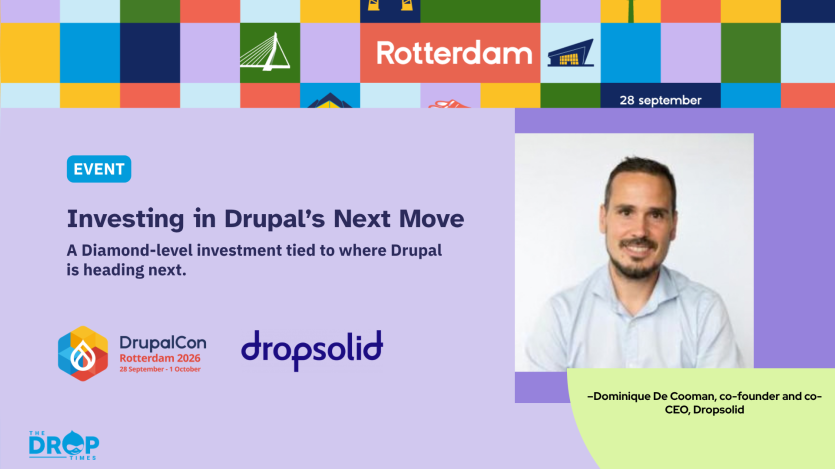
DrupalCon Rotterdam 2026 will give Dropsolid a place to make a more specific argument than simply that Drupal needs more artificial intelligence. The company says Drupal's opportunity lies in connecting AI to the content structures, permissions, workflows and organisational rules that already determine how information can be used. Written responses shared with The DropTimes by Dominique De Cooman, co-founder and co-CEO of Dropsolid, place that argument at the centre of the company's Diamond sponsorship of DrupalCon Rotterdam 2026.
The distinction matters because adding a language model to a website does not give that model an understanding of an organisation's authority structure. A model does not inherently know what information a visitor may access, which actions require approval, which sources should be used or when a person must intervene. Drupal already provides structures for content, permissions and editorial workflows, and Dominique argues that those controls can also help shape the context and boundaries within which AI operates.
“The opportunity is not simply to make Drupal work faster with AI. It is to make Drupal a platform where AI can work responsibly.”
The Drupal AI Initiative provides a wider technical setting for that argument. The current Rotterdam programme for Drupal AI Product Update: From Foundation to Agentic Workflows includes AI Guardrails, AI Observability and the Context Control Center alongside AI Recipes, automated content reviews, semantic search and embedded assistants. Those components address different parts of the problem Dominique describes: supplying useful context, applying controls to AI interactions and making model activity visible enough to inspect.
Dropsolid says customer projects have helped shape its contribution to that work. Dominique pointed to Trusted Answers, an approach intended to return responses grounded in an organisation's own published information while exposing sources users can verify. He also cited work involving the European Personnel Selection Office and Belgian water company Pidpa as experience that has informed AI Search contributions to Drupal. Those implementation claims come from Dropsolid's responses and should be read as company-supplied accounts rather than independent measurements of effectiveness.
AI Search shows more concretely what part of that architecture can look like. The Drupal project integrates vector embeddings with Search API so content can be retrieved through semantic similarity rather than exact keywords alone. It supports content chunking, multiple vector-database providers, configurable relevance thresholds, post-query entity access checks and retrieval-augmented generation workflows that can pass retrieved material to AI assistants and agents.
Those controls matter because answer quality depends not only on what a model can generate but also on which material the system retrieves and whether the person asking the question is permitted to receive it. AI Search's current documentation describes access checks after retrieval and configurable filtering of low-relevance results, placing retrieval and permission handling inside the search architecture rather than leaving them entirely to the language model.
The project's maturity provides an important boundary around the story. Drupal.org currently lists no supported stable release for AI Search. Its latest 1.x alpha, 1.3.0-alpha5, was released on 23 September, while development also continues on the 2.x line. The project page nevertheless recommends the 1.x line for production sites using AI Core 1.x. That unusual combination makes it important to distinguish the project's documented deployment guidance from formal stable-release status.
That distinction also helps explain why Dominique presents contribution as part of Dropsolid's sponsorship rationale. He said lessons from customer projects should strengthen shared foundations that other agencies and organisations can use rather than remain confined to individual implementations. “We should compete on how well we serve customers, not on keeping the foundations to ourselves,” he said.
The argument is more specific than conventional open-source sponsorship language. Shared modules and common infrastructure do not remove competition between Drupal agencies; they can shift competition towards implementation quality, architecture, domain knowledge, support and the services built around those foundations. Dropsolid says it is particularly interested in working with agencies and organisations that want to deliver useful AI together rather than reconstruct every layer independently.

The European setting also shapes Dominique's reasoning. He said organisations should be able to adopt AI while retaining meaningful choice over their technology, providers and data. Once AI systems connect external models with institutional information, user permissions and automated actions, provider portability, data handling, access policy and human approval become architectural concerns rather than abstract arguments about openness.
“We are not just investing in visibility at an event. We are investing in the people and partnerships needed to turn that opportunity into something real.”
The current programme for Wednesday, 30 September places that proposition beside three different discussions. Niels Aers and Christoph Breidert are scheduled to present Drupal AI Product Update: From Foundation to Agentic Workflows from 13:40 to 14:25 CEST. The session covers AI Recipes and the governance layer around Guardrails, Observability and Context Control, alongside content reviews, semantic search and embedded assistants.
The next session deliberately examines the other side of AI adoption. Dieter Blomme and Valery Lourie are scheduled to present AI Mid-Life Crisis: failure stories from the silent majority from 14:45 to 15:30 CEST. The programme focuses on cases where AI tools fail developers and on the gap between polished demonstrations and less predictable day-to-day results. That discussion gives the wider AI programme a counterweight by making failure modes part of the conversation.
Antonella Picarella is then scheduled to present From Drupal Content to AI Answers: Learnings from EPSY from 16:00 to 16:45 CEST. The session draws on the European Personnel Selection Office implementation and starts from the question of whether a useful AI interface can behave more like constrained search than an unrestricted chatbot. Its focus on retrieval and controlled answers gives the broader governance discussion a public-sector setting.
The three sessions create a sequence around architecture, failure and implementation. One examines the AI infrastructure being assembled, another gives space to where AI does not work as expected, and the third looks at a system operating under public-sector constraints. Together they provide several ways to test Dropsolid's proposition that Drupal's strengths in structured information, permissions and workflows can remain useful as digital interfaces move from publishing information towards generating answers and assisting with actions.
Dropsolid's sponsorship therefore provides a starting point rather than the conclusion of the story. The company is making a case that Drupal can differentiate by giving organisations greater control over the information, permissions and processes surrounding AI. Rotterdam will not establish whether that proposition succeeds across the ecosystem, particularly while parts of the technical stack remain under active development, but it will put the claim beside current architecture, implementation experience and acknowledged failure cases.
 Kazima AbbasKazima Abbas is a sub-editor at The Drop Times
ASK: Drupal Community Needs Your Support
View all →
Disclosure: This content is produced with the assistance of AI.
Note: The vision of this web portal is to help promote news and stories around the Drupal community and promote and celebrate the people and organizations in the community. We strive to create and distribute our content based on these content policy. If you see any omission/variation on this please reach out to us at #thedroptimes channel on Drupal Slack and we will try to address the issue as best we can.

Related Events
DrupalCon Rotterdam, 2026


Rotterdam, Netherlands
Related Organizations

Related People


You may also like