



Sampled Drupal Pages Score Below Web Average in Agent Readiness Index

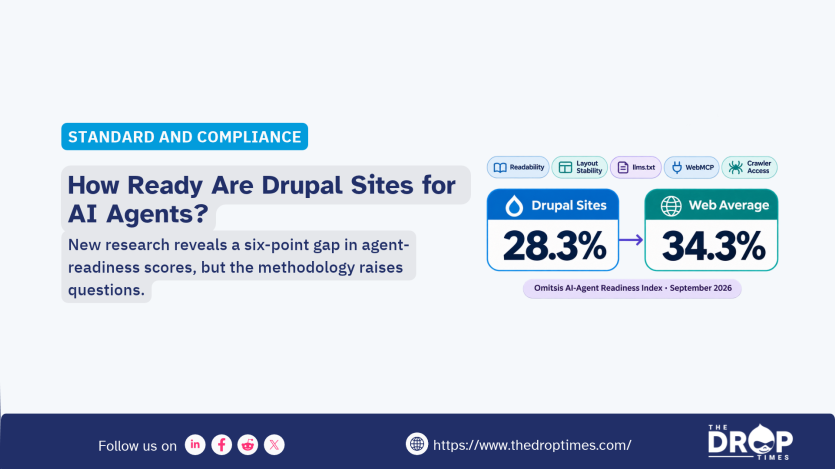
New research from Barcelona-based digital agency Omitsis reports an average score of 28.3% for sampled Drupal pages on its AI-agent readiness index, against 34.3% for the overall web sample. Published on 2 November 2026, the Agentic Web Census draws on September measurements from HTTP Archive, Lighthouse audits and website crawler-access rules.
According to the census’s Drupal results page, the sample includes 1,306 pages, with 1,270 providing the relevant Lighthouse measurements. These sample counts and component results have not been independently reproduced by The DropTimes. Omitsis reports that 26.9% passed its agent-readability check, while 2.4% had a valid llms.txt file. Omitsis reports detecting no registered WebMCP tools in the Drupal sample; this does not establish that no sampled site can be used by AI agents. These figures describe the sampled websites and do not establish that Drupal core caused their results.
The comparison depends on how Omitsis defines readiness. Under the five-dimension method described in its announcement, readable page structure accounts for 40% of the score, layout stability 25%, a valid llms.txt file 20%, and WebMCP tools 15%. A separate robots.txt-based measure adjusts the total according to access allowed for tracked AI agents. The weights are assigned by Omitsis, not Google.
That distinction matters when interpreting the six-percentage-point gap. Google's Lighthouse documentation says its Agentic Browsing category is experimental and does not produce a weighted score out of 100. Google also treats llms.txt as optional. WebMCP remains an emerging browser interface, so sites that do not expose it can lose points under Omitsis's formula without necessarily being unusable by AI assistants.
The reported lower readability pass rate is a more direct subject for Drupal developers to investigate. Lighthouse considers whether an agent can identify page landmarks, interactive controls and their accessible names through the accessibility tree. Those outcomes may depend on a site's theme, templates, forms and other implementation choices. The census does not isolate those factors or test whether an agent can reliably finish a real task on the measured sites.
Drupal's Outside AI workstream addresses a related but different problem: helping external agents discover, operate and verify Drupal capabilities with appropriate permissions. Separately, Drupal developers are experimenting with WebMCP integrations for browser-based actions, as previously reported by The DropTimes. Neither initiative is a direct measure of how ordinary public-facing Drupal pages performed in September.
The findings therefore provide a baseline for further investigation, not a verdict on the platform. To understand the gap, Drupal teams would need to inspect individual sites, separate core behaviour from implementation decisions, and test agent tasks alongside the automated checks. Independent confirmation of the census's Drupal sample and scoring calculations would also strengthen comparisons across technologies.
ASK: Drupal Community Needs Your Support
View all →
Disclosure: This content is produced with the assistance of AI.
Note: The vision of this web portal is to help promote news and stories around the Drupal community and promote and celebrate the people and organizations in the community. We strive to create and distribute our content based on these content policy. If you see any omission/variation on this please reach out to us at #thedroptimes channel on Drupal Slack and we will try to address the issue as best we can.

Related Organizations

You may also like