



Acquia Session Connects Drupal’s AI-Agent Case to Governance

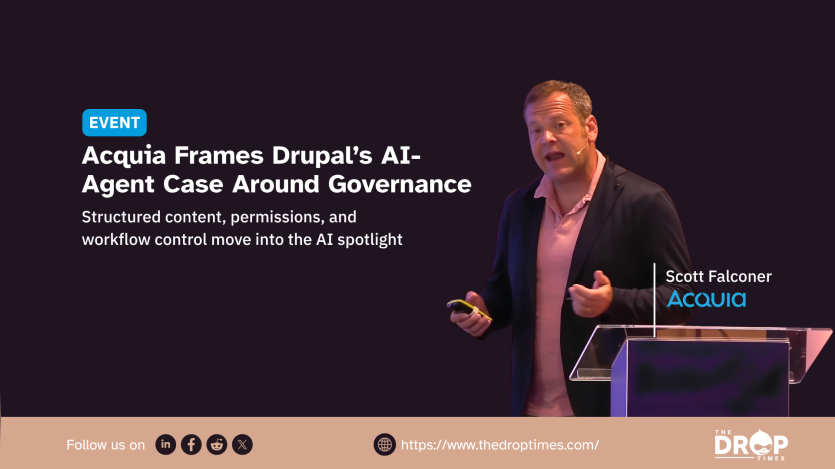
During an Engage Paris 2026 session later published by Acquia, Scott Falconer makes the case that Drupal’s structured content, permissions, and governance controls position it for AI-agent workflows. The session, The Best CMS for AI Agents, presents governance rather than content generation as Drupal’s potential advantage.
The argument shifts attention from content generation to the controls surrounding automated action. According to Acquia’s event summary, enterprise requirements for structured content, multilingual publishing, permissions, integrations, scale, and security gave Drupal capabilities that AI agents now need when creating or changing governed content.
The Drupal AI Initiative placed that proposition within a formal work structure on 25 June 2026. Its announcement divided the initiative’s execution into Inside AI, led by Christoph Breidert, and Outside AI, led by Falconer. Inside AI covers tools used within Drupal, while Outside AI focuses on helping external agents select, connect to, inspect, modify, verify, and launch Drupal sites.
The initiative’s 2026 roadmap identifies advanced governance and multi-channel campaigns among its priorities. Those areas support the broader case for Drupal as a control layer where content models, approvals, revisions, permissions, and audit processes can constrain AI-assisted work.
Drupal founder and project lead Dries Buytaert described a related model in his 23 June 2026 blog post, Drupal’s Role in Agentic Workflows. Dries wrote that external tools could coordinate work across campaign systems while Drupal assembles, validates, governs, and publishes the resulting content. He also argued that external agents should be able to invoke Drupal-native workflows instead of reproducing the platform’s rules outside the CMS.
The material documents a developing strategic position: Drupal has governance infrastructure relevant to agent-assisted work, but its practical advantage will depend on whether agents can discover its capabilities, act through them, and verify results with less friction.
References
-
Drupal AI Initiative: introducing Inside AI and Outside AI (25 June 2026)
-
Drupal's AI Roadmap for 2026 (11 February 2026)
-
Drupal's role in agentic workflows (23 June 2026)

ASK: Drupal Community Needs Your Support
View all →
Disclosure: This content is produced with the assistance of AI.
Note: The vision of this web portal is to help promote news and stories around the Drupal community and promote and celebrate the people and organizations in the community. We strive to create and distribute our content based on these content policy. If you see any omission/variation on this please reach out to us at #thedroptimes channel on Drupal Slack and we will try to address the issue as best we can.

Related Organizations

Related People


You may also like