


Lullabot Details Design System Strategy for Iowa State Digital Platform

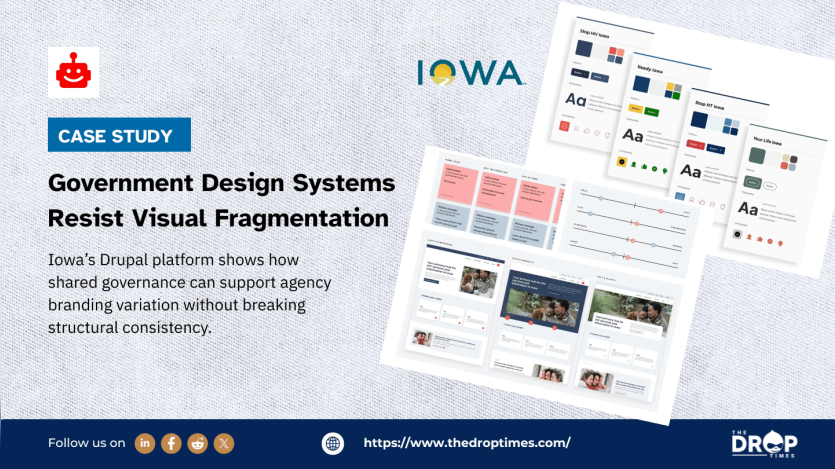
A case study on Iowa’s state digital platform outlines how a shared Drupal-based system was extended to support distinct agency branding without altering its core architecture. The work, published by Lullabot, focuses on enabling variation within a controlled design framework across multiple government websites.
The project reflects a broader challenge in public-sector digital infrastructure: balancing platform consistency with the need for agency-specific identity. Iowa’s shared system consolidates more than 80 state agency websites into a unified Drupal platform, requiring a design strategy that allows visual flexibility without fragmenting governance, implementation workflows, or frontend architecture.
According to the case study, the solution centred on extending the design system rather than modifying structural components. Elements such as colour palettes, typography, and visual presentation were made configurable, while layouts, content models, and core component structures remained consistent across agency sites.
Lullabot describes the approach as a “switchboard” model in which predefined design options can be combined to create distinct visual identities within shared system constraints. The method allows agencies to express branding differences while maintaining compatibility with the broader platform and reducing implementation complexity.
The design process included workshops intended to translate subjective branding preferences into reusable system configurations. Techniques such as “style spectra” were used to map aesthetic choices to technical variables, followed by iterative prototyping using existing and extended component patterns.
Implementation relied on design tooling and component-driven frontend workflows intended to keep visual decisions aligned with development behaviour. The case study highlights the use of variables, component variants, and reusable styling logic to reduce manual adjustments and maintain consistency across implementations.
The resulting system supported four agency websites with distinct visual identities built on the same Drupal infrastructure. The project demonstrates how design systems can accommodate variation at scale while preserving governance, operational efficiency, and structural consistency across large public-sector digital ecosystems.
ASK: Drupal Community Needs Your Support
View all →
Disclosure: This content is produced with the assistance of AI.
Note: The vision of this web portal is to help promote news and stories around the Drupal community and promote and celebrate the people and organizations in the community. We strive to create and distribute our content based on these content policy. If you see any omission/variation on this please reach out to us at #thedroptimes channel on Drupal Slack and we will try to address the issue as best we can.
Related Organizations

You may also like