



Nick Opris Develops Daily Digest for Drupal AI Initiative Activity


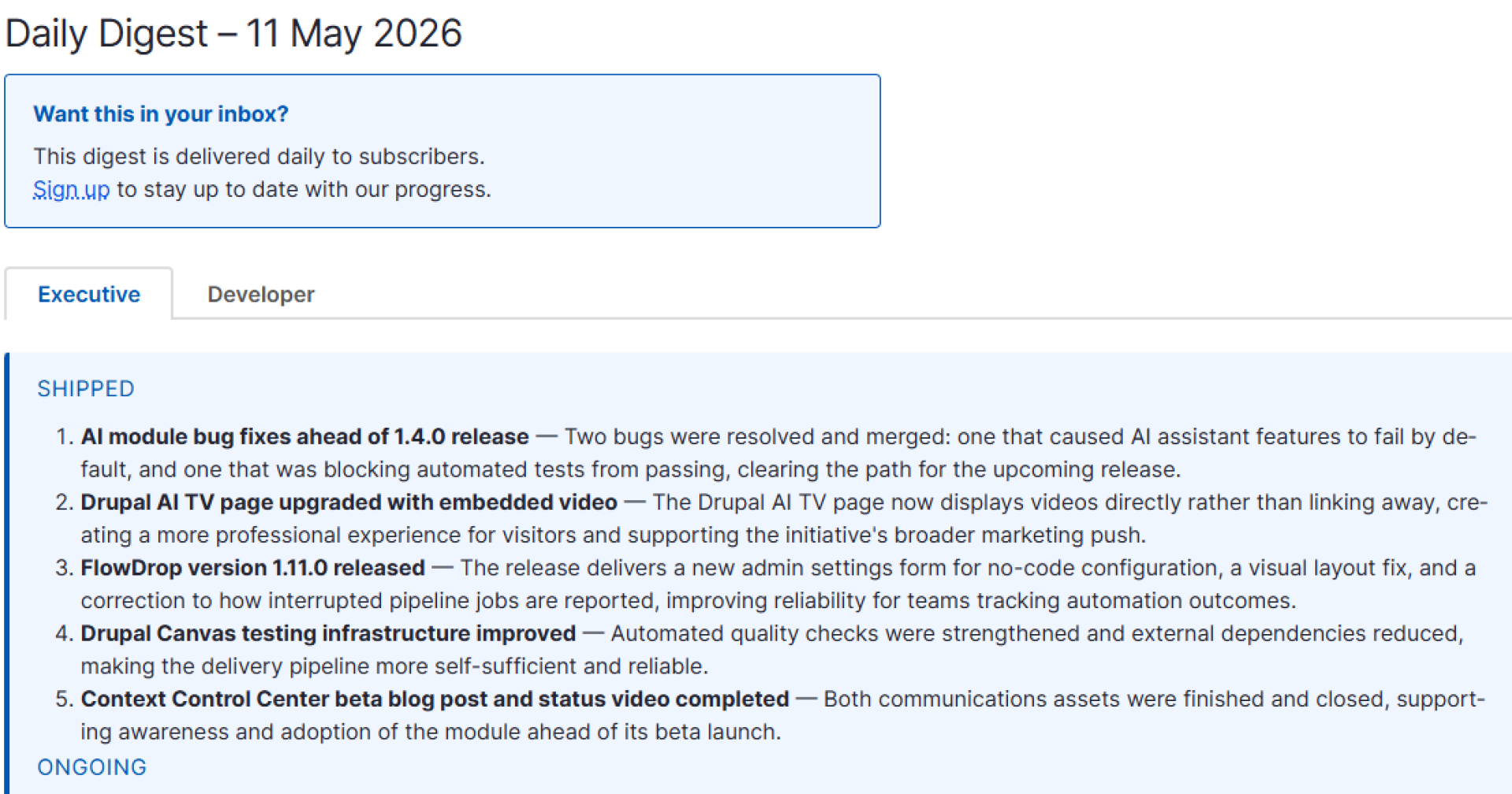
Following activity across the Drupal AI Initiative increasingly means monitoring scattered issue queues, merge requests, comments, and review discussions across multiple projects. To reduce that overhead, Nick Opris has developed a daily digest that summarises the previous 24 hours of contribution activity and generates separate briefings for developers and non-technical stakeholders.
The digest is designed to reduce the overhead of monitoring fragmented issue queues, merge requests, and discussion threads spread across multiple Drupal AI projects. Instead of requiring contributors to follow activity repository by repository, the system attempts to create a single reference point for understanding completed work, unresolved blockers, and areas where contributor attention may be needed.
The system gathers updates from multiple repositories, processes them through a large language model, and produces separate summaries for developers and executive-level readers. Recent editions include updates from the AI module, Gemini Provider, Drupal Canvas, Context Control Center, AI Agents, and related ecosystem projects.
The digest operates within a broader tracking dashboard that aggregates activity across Drupal AI Initiative projects. Alongside the daily summaries, the system includes project views, roadmap tracking, Kanban-style organisation boards, calendar-based activity monitoring, and documentation sections intended to help contributors and stakeholders follow work across distributed teams and repositories.
The summaries separate completed work from ongoing discussions and include sections intended to surface pending reviews, unresolved blockers, and contribution opportunities.
Nick told The DropTimes that the system was designed around a simple premise: contributors should not have to manually monitor every queue and merge request to understand where work is moving. Issue descriptions are included in prompts only as contextual background for the model, while the digest itself reports solely on activity that occurred within the reporting window.
"The digest pulls issues, comments, and merge requests that changed within the reporting window. The issue description is included as background context so the model understands what the work is about, but it's explicitly told not to report on the description as news."
That distinction matters because summarising technical contribution work with language models introduces a recurring risk: compressing nuanced implementation discussions into overly broad conclusions. Nick said the system attempts to counter that in several ways. Every issue and merge request included in prompts carries its original URL, and the model is instructed to reference work by title rather than by issue number alone.
According to Nick, that approach makes attribution errors easier to identify during review. A post-processing layer also reconnects issue IDs, merge requests, commit hashes, and usernames appearing in generated summaries back to structured source data so references remain verifiable even when prose is condensed.
The summaries are intentionally constrained. Sections are capped at roughly 200 words, forcing the system to prioritise developments rather than generate exhaustive inventories. The model is also instructed to write in prose instead of reducing activity into repetitive item-by-item reporting.
Two different editorial personas shape how the same underlying activity is presented. The developer edition keeps technical references intact, including module names, merge request identifiers, blockers, functions, and implementation details.
The executive version removes branch names and API-level discussion in favour of delivery progress, operational risks, and roadmap framing. One recurring section maps recent work against Dries Buytaert's Drupal AI roadmap for 2026, connecting day-to-day issue activity to broader capability areas such as context management, page generation, and AI-assisted content workflows.
The digest itself is still new. Nick said it has only been operating for about a week, making it too early to conclude how it may alter contributor coordination patterns over time. Even so, one operational change has already emerged: each project summary now includes a “How can I help?” section intended to surface open reviews, unassigned issues, and contribution opportunities.
That feature may ultimately prove more useful to contributors than the summarisation itself. Large distributed contribution efforts often struggle because visibility is uneven rather than because participation is absent. Review queues become bottlenecks while contributors miss opportunities to help simply because they are not watching the right projects at the right time.
Nick explained that the underlying infrastructure was built generically enough that the current AI Initiative focus is largely a configuration choice. The import system operates from lists of Drupal project machine names, meaning the same approach could theoretically be redirected toward other clusters of Drupal contribution activity with relatively minor changes.
"Whether that's useful beyond the AI initiative depends on whether there's a community with enough distributed contributors that aggregation adds value."
Nick said a weekly or bi-weekly edition is already being considered for contributors working in sprint cycles or for teams unable to realistically follow daily updates. Long term, the project could evolve into a Drupal module that organisations contributing across multiple Drupal.org projects could configure for their own workflows.
 Kazima AbbasKazima Abbas is a sub-editor at The Drop Times
Image Attribution Disclaimer: At The Drop Times (TDT), we are committed to properly crediting photographers whose images appear in our content. Many of the images we use come from event organizers, interviewees, or publicly shared galleries under CC BY-SA licenses. However, some images may come from personal collections where metadata is lost, making proper attribution challenging.
Our purpose in using these images is to highlight Drupal, its events, and its contributors—not for commercial gain. If you recognize an image on our platform that is uncredited or incorrectly attributed, we encourage you to reach out to us at #thedroptimes channel on Drupal Slack.
We value the work of visual storytellers and appreciate your help in ensuring fair attribution. Thank you for supporting open-source collaboration!
ASK: Drupal Community Needs Your Support
View all →
Disclosure: This content is produced with the assistance of AI.
Note: The vision of this web portal is to help promote news and stories around the Drupal community and promote and celebrate the people and organizations in the community. We strive to create and distribute our content based on these content policy. If you see any omission/variation on this please reach out to us at #thedroptimes channel on Drupal Slack and we will try to address the issue as best we can.

Related Drupal Initiatives

Related People


You may also like