Talking Drupal #558 Explores AMS Toolkit for AI Agent Handoffs

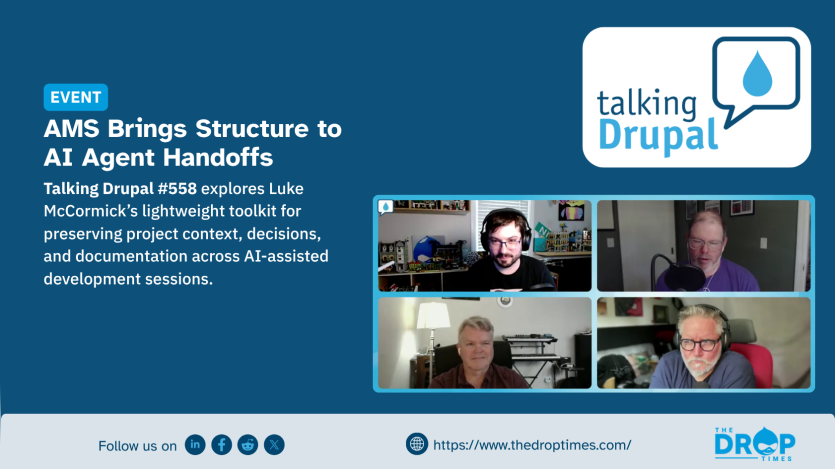
Drupal Practitioners experimenting with AI coding agents face a recurring problem when the project context disappears between sessions. In Talking Drupal episode 558, Luke McCormick, a San Francisco Bay Area-based Drupal solution architect, discussed Agent Management System, or AMS. The episode framed AMS as a workflow toolkit for preserving handoffs, decisions and documentation outside an AI model’s context window.
The main issue, as Luke described it, is not that AI agents fail to produce useful work. It is that agents can lose track of what they solved when context limits are reached, sessions restart or work moves between tools. AMS responds by asking agents to write durable Markdown files that humans and later agents can read before continuing the work.
AMS uses a file-based structure built around handoffs and documentation. Its GitHub repository describes a default AMS/ directory containing AGENT.md, HANDOFF/ and DOC/. Handoff files record recent session context, while documentation files preserve project knowledge by topic.
The approach draws from Scrum without turning the process into a full project-management platform. Luke compared the handoff format to a standup-style report that records completed work, failed attempts, open questions, changed artifacts and suggested next steps. The aim is to give the next agent enough context to continue without rebuilding the conversation from memory.
The episode also emphasised human supervision. Luke described keeping the human in the loop, expanding agent permissions gradually and stopping agents when their actions become unclear. His workflow separates agents by role, including librarian, coder and clerk functions, with different AI models assigned according to task complexity and cost.
The discussion connects to Luke’s Stanford WebCamp session, “Agile for Agents – Managing Robots the Way We Manage Humans.” The session description presents AMS as a tool-agnostic approach that borrows from Scrum and Kanban to give AI agents persistent memory, project context and structured handoffs. The public AMS repository also states that the framework is not limited to coding and may apply to design, content, marketing, research and other knowledge work.
The Module of the Week segment covered AI Auto-reference, presented by Martin Anderson-Clutz, product marketing manager for Drupal at Acquia. The module uses AI to suggest relationships to other content within the same Drupal site. Its Drupal.org project page lists 1.0.0-rc4, compatibility with Drupal 10 and Drupal 11, 19 reported sites, six open issues and three open bug reports.
For site builders, the module’s value is narrower than generic AI tagging. It can work with entity reference fields, shorten content to fit token limits and allow suggestions to be reviewed before they are saved. That makes it relevant for curated content structures where editors want AI to choose from existing taxonomy terms, nodes or other referenced entities rather than generate new labels.

ASK: Drupal Community Needs Your Support
View all →
Disclosure: This content is produced with the assistance of AI.
Disclaimer: The opinions expressed in this story do not necessarily represent that of TheDropTimes. We regularly share third-party blog posts that feature Drupal in good faith. TDT recommends Reader's discretion while consuming such content, as the veracity/authenticity of the story depends on the blogger and their motives.
Note: The vision of this web portal is to help promote news and stories around the Drupal community and promote and celebrate the people and organizations in the community. We strive to create and distribute our content based on these content policy. If you see any omission/variation on this please reach out to us at #thedroptimes channel on Drupal Slack and we will try to address the issue as best we can.

Related Organizations



Related People


You may also like