

Red Hat’s Technically Speaking Frames Sovereign AI Around Open Source Control

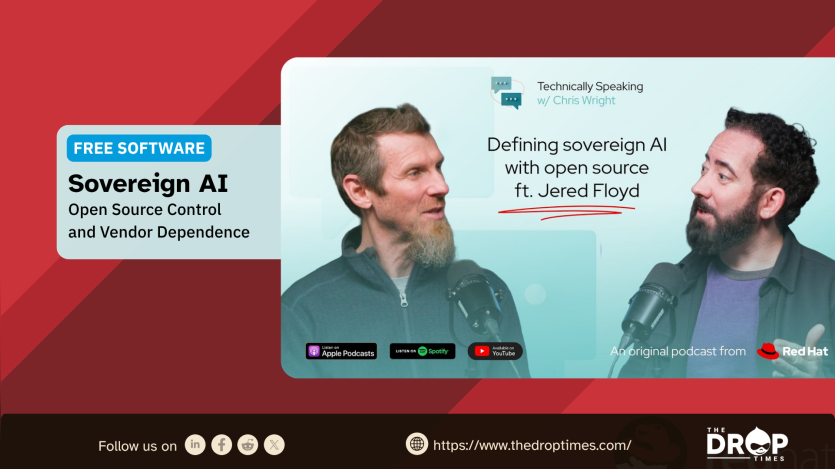
Sovereign AI is the focus of a Technically Speaking with Chris Wright episode published by Red Hat on 1 July 2026. The episode features Chris Wright, chief technology officer at Red Hat, and Jered Floyd from Red Hat’s Field CTO team. The discussion frames sovereignty as a question of agency over data, operations, technology, and assurance rather than a compliance label based only on where data is hosted.
For Drupal and open source readers, the relevance is indirect but clear. The episode does not address Drupal implementation, Drupal CMS, or a Drupal project. Its value is in how it connects open source practice to broader questions of vendor dependence, auditability, infrastructure placement, and control over AI-enabled platforms.
Jered describes four areas of sovereign operations: data sovereignty, operational sovereignty, technology sovereignty, and assurance sovereignty. The discussion covers where data is stored and processed, who can operate systems, whether software can be inspected or modified, and how organisations can test resilience when a provider relationship changes. The episode also treats sovereignty as a business continuity and innovation issue, not only a regulatory risk.
The episode presents open source as one way to retain agency over the software stack. Jered says open source licensing can allow organisations to keep using software, take over responsibility, or move to another provider if business terms change. The discussion contrasts that agency with proprietary software models that can increase dependence on renewal terms, service availability, or provider strategy.
The AI section applies the same sovereignty questions to model selection and infrastructure placement. Jered contrasts large black-box models with smaller open-weight models that organisations may be able to run closer to their own data or infrastructure. The episode does not provide benchmarks or implementation examples, but it frames model choice around visibility, data movement, operational control, and long-term dependence.
The conversation also extends sovereignty concerns to agentic workflows. Jered says organisations need to audit where agents send data, what data they can access, and whether they have permission to act across business processes. The episode presents sovereignty as a platform capability involving control points, auditability, and infrastructure choices rather than a compliance checkbox.
ASK: Drupal Community Needs Your Support
View all →
Disclosure: This content is produced with the assistance of AI.
Disclaimer: The opinions expressed in this story do not necessarily represent that of TheDropTimes. We regularly share third-party blog posts that feature Drupal in good faith. TDT recommends Reader's discretion while consuming such content, as the veracity/authenticity of the story depends on the blogger and their motives.
Note: The vision of this web portal is to help promote news and stories around the Drupal community and promote and celebrate the people and organizations in the community. We strive to create and distribute our content based on these content policy. If you see any omission/variation on this please reach out to us at #thedroptimes channel on Drupal Slack and we will try to address the issue as best we can.
Related Organizations
You may also like