



TDT August Town Hall Tracks Editorial Shift and Wider Community Outreach

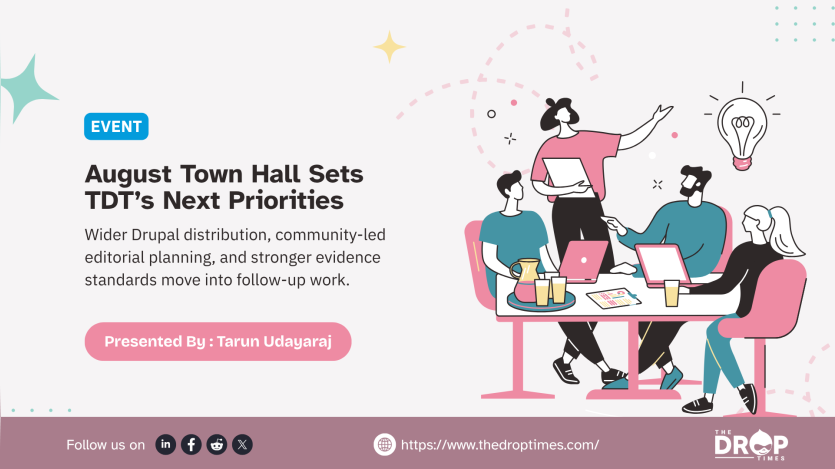
The Drop Times used its August Open Town Hall on 19 August 2026 to report on a shift towards more original, evidence-led coverage while outlining plans to broaden Drupal media outreach and community participation. Tarun Udayaraj, head of community relations at The Drop Times, presented outreach and community initiatives, while Sebin A. Jacob, chief editor, described an editorial approach that more clearly separates what sources claim from what available evidence establishes. The meeting followed proposals raised during the July Town Hall.
Tarun said TDT is working to strengthen relationships with publishers that can take Drupal stories beyond established project channels. The initiative includes an ongoing collaboration with Goodtech.info and a newer collaboration with FOSS Force. TDT wants to develop those relationships into a repeatable model for deeper media partnerships and wider geographic reach, and invited community members to introduce technology publishers and local media contacts in their regions.
A related initiative is a publicly accessible media database intended to support wider Drupal outreach. Tarun said he had discussed the effort with Alejandro Moreno, who is expected to support the initiative. TDT is also developing an editorial working group around digital sovereignty, with guidelines completed and plans for community participation, a content series, interviews, and possible webinars.
Sebin said recent coverage has changed the questions TDT is asking about artificial intelligence in Drupal. Reporting is becoming less concerned with what AI systems can generate in isolation and more concerned with the context agents receive, the actions they are allowed to perform, how those actions are validated, and where human review belongs. He described that developing focus as a move from generation towards governed action.
Sustainability and public-sector technology were two other themes he identified. Coverage of Drupal Association finances and interviews with board candidates raised questions about how infrastructure, security work, contribution, and community services are funded over time. Drupal GovCon reporting similarly sought practical context from speakers on governance, accessibility, bot protection, migration, search, performance, project cost, scope, and delivery.
Sebin also said security reporting should help site owners understand the action required rather than presenting severity scores alone. He pointed to contributed-project advisories where supported projects had fixes available while unsupported projects with unresolved security issues required removal. More broadly, he said TDT is becoming more deliberate about identifying what has been demonstrated, what remains aspirational, and what the available evidence does not yet establish.
That approach does not mean narrowing coverage only to major initiatives. Sebin said TDT would continue reporting on maintained modules, bug fixes, tutorials, migrations, performance work, and other smaller technical developments that shape Drupal in practice.
Ben Peter Mathew presented TDT's July social-media activity. LinkedIn ended the month with 9,664 followers after adding 84 new followers during July. Content generated 75,779 impressions and 10,999 engagements, while TDT published 206 social-media posts during the period.
Ben said that activity included promotion of case studies from Drupal service providers, articles, blog posts, organisational updates, Drupal Module Spotlight coverage, community projects and initiatives, Drupal Association election candidates, and events. Event coverage also drew on updates and photographs supplied directly by organisers, speakers, and other community members.
TDT's organisation network increased from 366 through June to 377 after 11 organisations were added. Ben said the team worked directly with 30 organisations on marketing and branding activity, including case studies, articles, and blog posts, while another ten organisations received support for community-focused initiatives.
The jobs section published 115 Drupal-related roles during the month. Ben said TDT is exploring a stronger jobs pipeline that could include sourcing vacancies directly from organisations through RSS feeds or other automated methods, with the aim of connecting Drupal employers and job seekers more consistently.
Event promotion covered ten Drupal events, while TDT partnered more closely with four events. The outreach work also highlighted 20 event speakers and ten sponsoring organisations. Ben cited DrupalCamp Asheville, Decoupled Days, Drupal GovCon, DrupalCamp Colorado, DrupalCamp Poland, and DrupalCon Rotterdam among the events promoted during the period.
The media-partnership work is intended to extend that visibility beyond Drupal's existing channels. Ben said the Goodtech.info and FOSS Force collaborations form part of a broader model TDT wants to replicate with technology publications and regional media, with taking Drupal news into new networks and audiences described as a priority.
Allen Jason, from the editorial team, presented a June-to-July comparison showing how the newsroom's publishing mix is changing. Total output fell from 185 pieces in June to 147 in July, a reduction he described as deliberate. External blog summaries fell from 66 to 25, while news reporting remained at 84 stories and accounted for 57.1% of July's output.
Higher-effort formats increased during the same period. Interviews rose from four to eight, featured articles from 12 to 16, and case studies from four to six. Allen described the lower overall volume as a trade-off intended to redirect editorial capacity from routine curation towards more original and higher-effort reporting.
The subject mix also changed. Drupal module coverage rose from five stories in June to 19 in July, supported by six practical tutorials. Drupal organisational updates increased from three to 16 and event coverage from five to 17. July also included 18 Beyond Drupal pieces, nine security advisories and updates, five DrupalGov stories, three accessibility stories, and two focused on the Drupal AI Initiative.
Allen said August coverage is building on that approach through GovCon reporting, Drupal Association board-election interviews, more interviews and higher-effort articles, technical reporting, and deeper module coverage. Editorial listening around DrupalCon Rotterdam and DrupalCamp Colorado is also being used to identify technical discussions and community feedback that may warrant further reporting.
The meeting closed with an invitation for continued community participation. Sebin asked readers to identify missing stories, overlooked projects or contributors, factual corrections, weak coverage, and disagreements with TDT's editorial direction. Tarun and Ben also invited media introductions, organisational collaboration, community projects, event information, and other opportunities to help Drupal stories reach audiences beyond their existing networks.
ASK: Drupal Community Needs Your Support
View all →
Disclosure: This content is produced with the assistance of AI.
Note: The vision of this web portal is to help promote news and stories around the Drupal community and promote and celebrate the people and organizations in the community. We strive to create and distribute our content based on these content policy. If you see any omission/variation on this please reach out to us at #thedroptimes channel on Drupal Slack and we will try to address the issue as best we can.

You may also like