



Built for TDT, Now Used Beyond It: The Journey of a Drupal Module

Drupal's Image Scale and Fill Background Effect reached its first stable release on 24 August 2026 after the project gained coverage under Drupal's security advisory policy. The 1.0.0 release followed a community review that led to stricter configuration bounds, safeguards around GD image processing, automated tests, continuous integration checks, and other changes to the module. Version 1.1.0 followed later the same day, adding dedicated handling for images with transparent backgrounds.
The stable release closes a two-year path that began with a specific production problem at The DropTimes. The publication needed photographs and logos with widely different aspect ratios to fit fixed layouts without cropping away part of the source image. What began as a narrowly scoped fix was instead released as a general-purpose Drupal project, and its subsequent use outside The DropTimes changed how its maintainer came to think about the code and the responsibility attached to it.
Vimal Joseph, maintainer of Image Scale and Fill Background Effect, told The DropTimes that the module began as a weekend project.
“The DropTimes had one specific problem: images that did not match the aspect ratio the design needed. I could have written an image effect plugin inside a custom module, and that would have been the end of it,” he said. “But while building it, I kept thinking that if TDT has this need, other Drupal sites probably have it too. So I spent some extra time to make it general and put it on drupal.org.”
Once the module was running in production, however, Vimal had little reason to return to it. “Then it went into TDT production, and I forgot about it. There was no further requirement from that side, and I did not look at it again for a long time,” he said. A problem with transparent images eventually brought him back. “What brought me back was a bug. Transparent images were not being handled properly. That is fixed now.”
Returning to the project also showed that the module had acquired a life beyond the site for which it was built. Vimal said he was surprised to find around 100 sites using it, several bug reports waiting for attention, and no security advisory coverage. He applied for that coverage in 2024 but did not complete the process, and the application was eventually closed for inactivity.
Solving my own problem was one thing. Being responsible for other people's sites is something else, and I had not really thought about that part when I published it.
Vimal reopened the security advisory coverage application on 2 August 2026 and went through the review process again. “I thought the code was already clean when I submitted it. Once more eyes were on it, a lot of things came up that I had not seen at all,” he said. The review examined configuration validation, test coverage, attribution of reused code, CI configuration, memory risks from oversized canvases, GD allocation failures, configuration schema, and other issues before the application was approved.
Vimal specifically credited Vishal Kadam, Rushikesh Raval, Francis Santerre, Binquan Wang, drupal entity, and Alberto Paderno for reviewing the project. Paderno, from the Project Applications team, completed the final review and approved the application on 20 August 2026. “I am really humbled by the support I got from people who had nothing to gain from it. That is the big positive I see in this community,” Vimal said.
The review also helped Vimal reacquaint himself with current Drupal development practices. “The other part was personal. I am not writing Drupal code in my day-to-day work now, so this was a learning exercise for me as well,” he said. “Current best practices, the testing system, CI checks, all the things that have moved on since I was doing this daily.” Vimal said Zyxware Technologies supported his return to the project and gave him time to work toward the stable release.
The distinction between solving a known problem and maintaining software for unknown environments became one of the main lessons of the process.
“Maintaining something general purpose is much harder than solving your own problem. For TDT, one effect was enough. Once it is on drupal.org it has to work on sites I will never see, with images and settings I cannot predict, and that is where most of the effort goes,” Vimal said. “But it also gives me the satisfaction of having contributed something. For a module this specific I think around 100 sites is a good number. It has given me the motivation to keep maintaining it, and I am looking forward to more people using it.”
The module scales a complete source image into a configured fixed-size canvas without cropping or distorting it, then fills the unused area with a generated background. This was particularly useful for The DropTimes, where event logos and other submitted images arrive in proportions that the publication does not control and may not be suitable for cropping. The DropTimes covered the module's initial alpha release in 2024, when the production problem and the first implementation were documented.
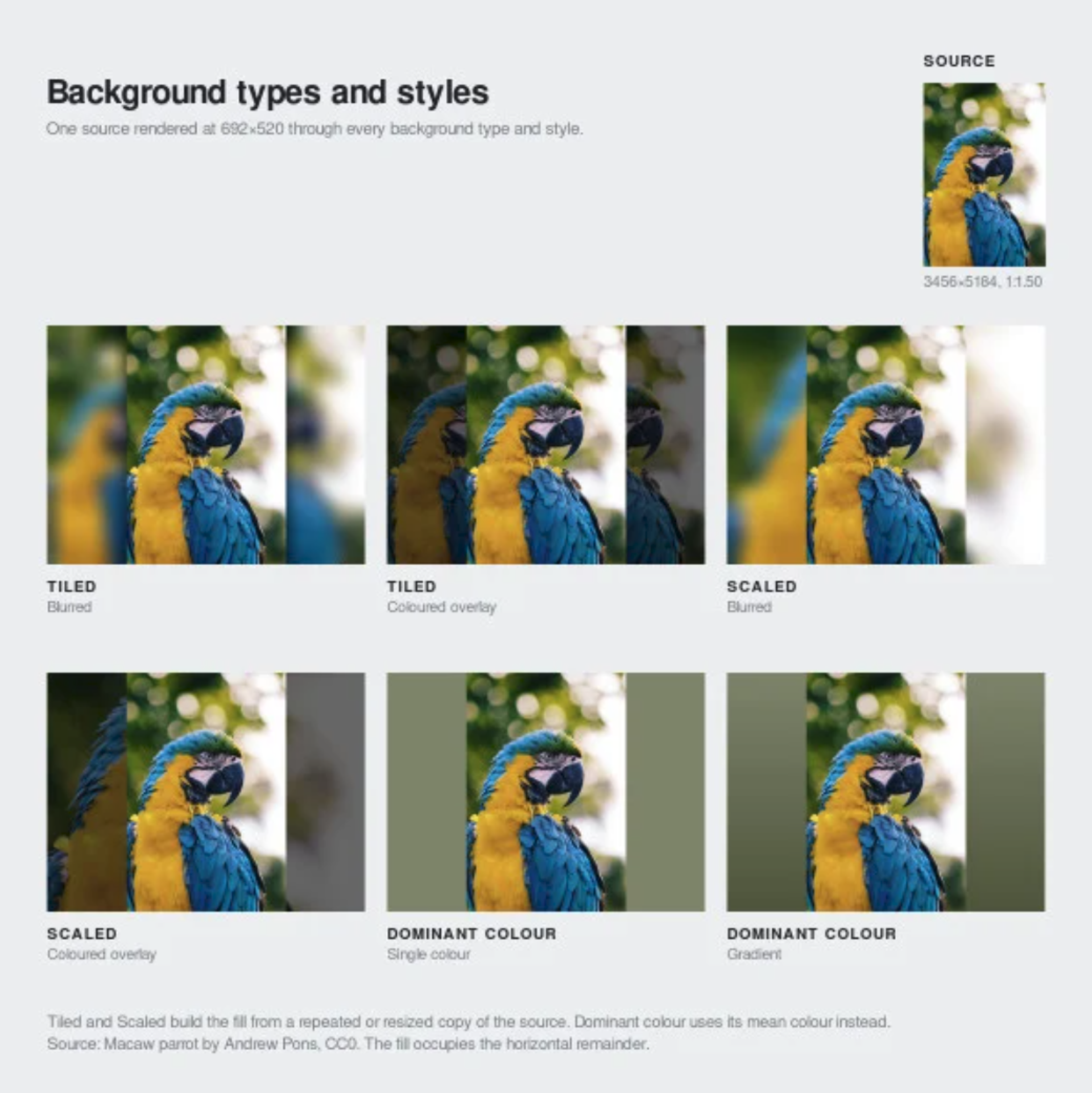
Version 1.1.0 addresses the transparent-image problem that prompted Vimal to revisit the project. Earlier versions could composite a transparent logo onto a black canvas, while a single-colour logo using the dominant-colour treatment could effectively disappear against a background derived from its own colour. The new release can choose a light or dark fill automatically, use a configured fixed colour, derive a tint from the artwork, or retain the previous treatment. Images without transparency are left on the normal processing path, allowing the same image style to handle feeds containing both photographs and logos.
The module also sits alongside more established Drupal image-processing projects rather than attempting to replace them. When Vimal started the project two years ago, he expected that its specialised effect might eventually be contributed to a larger module such as Image Effects. “When I started this two years back I was thinking of getting the module up and running fast and eventually collaborating with a larger module like Image Effects, so that it would be maintained better in the long run,” he said.
His position has changed as the standalone project has accumulated its own users and security advisory coverage. “Being independent has some value of its own. It is a small module, it addresses one specific use case, and it does that job well. So I expect it to continue like this for some time,” Vimal said. He has not ruled out consolidation later.
“If the module stops needing changes of its own, and there is a clean upgrade path so the existing sites do not get stranded, then moving it into a bigger module would make sense,” Vimal said. “Right now it still has its own bugs and its own direction to work through, so standalone is working fine for its users.” The module supports Drupal 10.3, Drupal 11, and Drupal 12 with the GD image toolkit, and its documentation and demonstration, issue queue, and source repository are publicly available.
 Allen JasonAllen without organs
Image Attribution Disclaimer: At The Drop Times (TDT), we are committed to properly crediting photographers whose images appear in our content. Many of the images we use come from event organizers, interviewees, or publicly shared galleries under CC BY-SA licenses. However, some images may come from personal collections where metadata is lost, making proper attribution challenging.
Our purpose in using these images is to highlight Drupal, its events, and its contributors—not for commercial gain. If you recognize an image on our platform that is uncredited or incorrectly attributed, we encourage you to reach out to us at #thedroptimes channel on Drupal Slack.
We value the work of visual storytellers and appreciate your help in ensuring fair attribution. Thank you for supporting open-source collaboration!
ASK: Drupal Community Needs Your Support
View all →
Disclosure: This content is produced with the assistance of AI.
Note: The vision of this web portal is to help promote news and stories around the Drupal community and promote and celebrate the people and organizations in the community. We strive to create and distribute our content based on these content policy. If you see any omission/variation on this please reach out to us at #thedroptimes channel on Drupal Slack and we will try to address the issue as best we can.

Related Organizations

Related People


You may also like