



Dev AI Summit at DrupalCon Rotterdam Focuses on Production AI Workflows

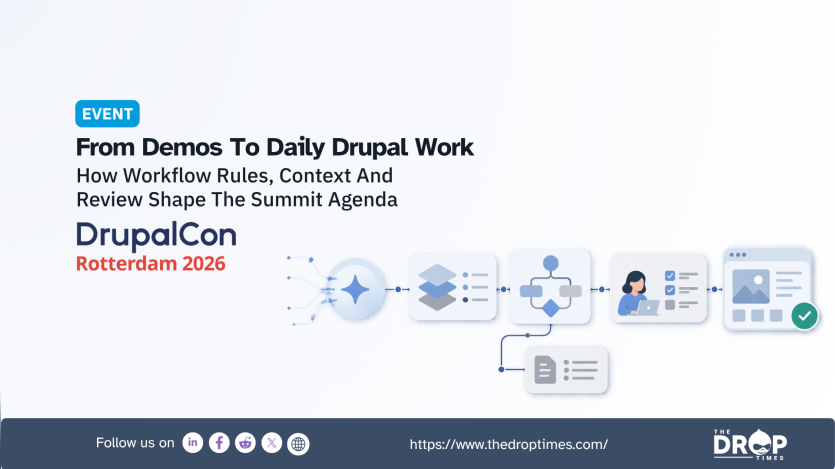
The Dev AI Summit at DrupalCon Rotterdam will run on 28 September 2026 with a programme covering AI-assisted contribution, agent workflows, guardrails, governed context and author review. The published agenda follows AI from development tooling into workflows where cost, access, validation and human oversight become operational concerns. The Drupal Events schedule lists the summit from 08:45–17:00 CEST in Leeuwen Room I&II at the Postillion Hotel & Convention Centre WTC Rotterdam.
Across the agenda, several sessions address where AI decisions sit inside controlled workflows. The programme covers observable execution, token and latency budgets, context filtering, deterministic validation, prompt-injection defences and human review before AI-generated content is saved. Together, those subjects place operational controls alongside the systems that generate content or make workflow decisions.
Nick Veenhof, director of developer relations at GitLab, opens the technical programme with a session on AI-assisted open-source contribution. According to the session description, public, machine-readable documentation and contributor enablement have reduced onboarding work that previously took weeks to hours, and Nick will discuss the measurements, trade-offs and cases where the approach breaks down. Shibin Das, developer at Factorial, follows later in the morning with a session on FlowDrop in production, covering observable and replayable agent decisions, asynchronous execution, and measurable token and latency budgets. A July interview with Shibin by The DropTimes previously examined FlowDrop's runtime model and the boundaries between deterministic automation and agentic workflows.
Marcus Johansson, technical lead for the Drupal AI Initiative, will cover Drupal AI Context, including scope plugins, agent-to-context selection and controls over how context is filtered and assembled. Luca Lusso, lead developer at SparkFabrik, will demonstrate the Drupal AI Guardrails subsystem, contrasting deterministic checks such as regular expressions and structural validation with evaluators that use large language models, along with pre- and post-generation controls. Michael Anello, co-founder and lead instructor at DrupalEasy, will show the Field Widget Actions module, which lets authors review and modify AI-generated field values before saving content.
Jürgen Haas, Drupal architect at LakeDrops, closes the scheduled presentation sessions with examples that pair the ECA workflow engine's deterministic logic with AI agents for non-deterministic decisions. His session includes permission boundaries, AI-assisted comment moderation and an MCP server that can generate ECA workflow models from natural-language instructions. The DropTimes covered the ECA Guide's machine-readable documentation in July and a live AI-assisted workflow demonstration in August. The final hour is allocated to topic-table breakouts covering AI core, ECA, FlowDrop and Context Control Centre, with short reports from the tables listed in the fuller summit programme. DrupalCon describes its summits as add-ons to the main conference programme.

ASK: Drupal Community Needs Your Support
View all →
Disclosure: This content is produced with the assistance of AI.
Note: The vision of this web portal is to help promote news and stories around the Drupal community and promote and celebrate the people and organizations in the community. We strive to create and distribute our content based on these content policy. If you see any omission/variation on this please reach out to us at #thedroptimes channel on Drupal Slack and we will try to address the issue as best we can.

You may also like