



Six Banks Fund OSERA's Shared Open-Source Security Fixes

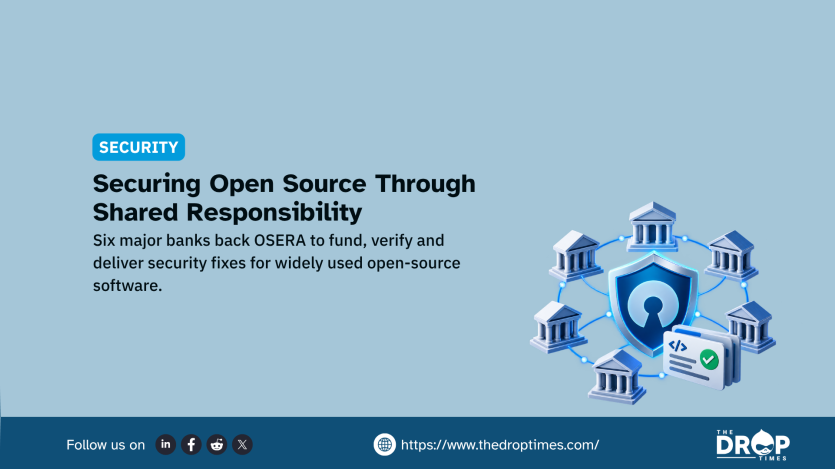
Financial institutions are pooling resources to maintain security fixes for widely used open-source software through the Open Source Enterprise Resiliency Alliance (OSERA). The Fintech Open Source Foundation (FINOS) announced on 7 October 2026 that the alliance is operational, with funding from six Premier members, an initial remediation standard and patches for more than 50 Java and Spring ecosystem projects.
The programme addresses security maintenance duplicated across banks that continue using some of the same dependencies, including versions no longer supported upstream. FINOS named Deutsche Bank, Goldman Sachs, Morgan Stanley, NatWest and Royal Bank of Canada among the six initial Premier members but did not identify the sixth in its announcement. Members can coordinate priorities and commission fixes against common standards instead of maintaining separate patches independently.
Initial Work Covers 58 Libraries in Spring-Related Software
OSERA's project inventory reports 58 libraries prioritised for its first wave, associated with Spring Boot 2.7, Spring Framework 5.3 and Spring Security 5.7. The fixes target publicly disclosed vulnerabilities affecting versions still used by participating institutions. The 58 figure represents the prioritised library set, not a verified count of distinct vulnerabilities closed or production deployments completed.
Source code for maintained project lines is available through public forks, allowing non-members to inspect and build fixes. OSERA distinguishes those public sources from the packaged releases, attestations and audit evidence distributed to members. It says patches are offered back to upstream projects where possible. A public fork does not, by itself, provide a non-member with a ready-to-deploy verified package.
A Common Standard Governs Patch Acceptance
The alliance's remediation standards pack OSERA-SP-0.1.0 was ratified on 10 September 2026. Its required checks and evidence cover matters such as source provenance, test reports, runtime compatibility, approved producers, package metadata and release identification. Some additional measures, including signed build-provenance attestations, are listed as observe-only checks for a future standards pack rather than mandatory gates in version 0.1.0.
FINOS says specialist vendors produce and maintain fixes under service-level agreements, while the alliance sets priorities and acceptance criteria. The existence of those standards establishes a common process for evaluating remediation; it does not independently demonstrate that every release is free of vulnerabilities or that every member has installed the resulting packages.
Further Patch Delivery and Platform Work Are Planned
OSERA follows FINOS's 26 June 2026 intent-to-form announcement. Its stated targets for the remainder of 2026 include a minimum of 80 patches per month and the first end-to-end release of its remediation platform at the Open Source in Finance Forum in New York in November. FINOS identified Moderne as a vendor maintainer and ControlPlane as the developer of a secured platform with quarantine controls. These are targets and planned deliveries, not completed results.
Although OSERA's first supported lines concern Java and Spring rather than Drupal or PHP, the initiative addresses a wider maintenance problem for organisations dependent on older open-source components. Its model separates publicly inspectable patches from member-ready releases and pools the cost of remediation across users of the same software. No Drupal-specific OSERA coverage has been announced in the cited sources.
References

ASK: Drupal Community Needs Your Support
View all →
Disclosure: This content is produced with the assistance of AI.
Note: The vision of this web portal is to help promote news and stories around the Drupal community and promote and celebrate the people and organizations in the community. We strive to create and distribute our content based on these content policy. If you see any omission/variation on this please reach out to us at #thedroptimes channel on Drupal Slack and we will try to address the issue as best we can.

Related Organizations

You may also like