



Editoria11y 3.x to Receive First Public Tour at DrupalCamp NJ 2026


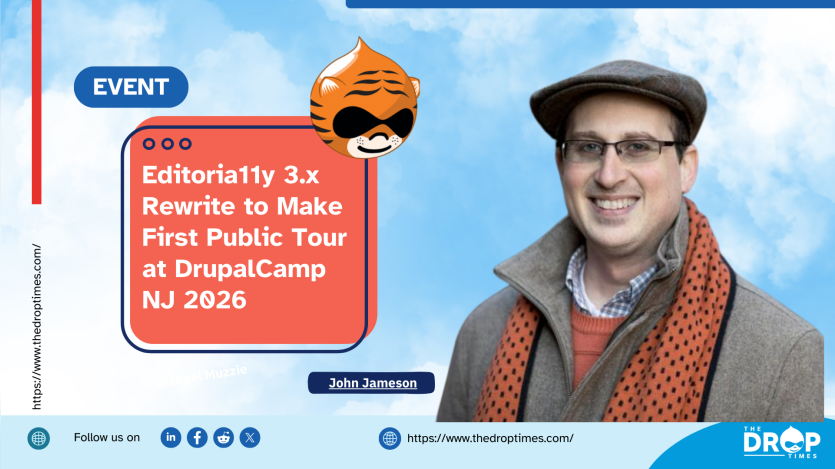
Attendees at DrupalCamp NJ 2026 will receive the first public walkthrough of the upcoming 3.x rewrite of the Drupal accessibility module Editoria11y Accessibility Checker ("editorial accessibility ally"). Accessibility developer John Jameson outlined the technical changes behind the rewrite and the collaboration that has recently brought the Editoria11y and Sa11y projects closer together in written responses provided to The DropTimes, ahead of the event.
John’s talk, titled “Editoria11y Phase 3: from Sweet to Suite”, will focus on both backend and frontend developments introduced during the rewrite. According to John, the backend work introduces deeper integration with Drupal’s Views system, enabling site administrators to customise accessibility dashboards more easily. The update also adds new crawler and maintenance tools intended to help administrators monitor site accessibility across large content collections.
The upcoming release represents the next stage in the project’s evolution. Earlier versions focused on helping authors catch accessibility problems during the editing process. Editoria11y 1.x introduced automated inline alerts for accessibility issues that appeared directly in the editing interface, while Editoria11y 2.x expanded reporting capabilities, added an as-you-type checker, and supported integrations such as Drupal CMS accessibility tools.
John explained the significance of the rewrite in his own words:
“This will be the first public tour of the 3.x rewrite. On the backend, that means quite a few new capabilities that have already made it into the beta: deeper Views integration to allow for easy dashboard customisation, crawlers and maintenance tools for site admins, and a set of default translations for 16 languages.”
The new version expands the scope of the module beyond inline alerts. Planned capabilities include additional tests for code issues, readability and colour contrast, “split configuration” that allows different alerts to appear for different user roles, site-wide dismissal options for certain issues, and expanded data exposure through Views to support custom filters and reporting dashboards.
The frontend side of the rewrite reflects a shift in collaboration between the Editoria11y and Sa11y accessibility projects. Both tools began as separate initiatives addressing accessibility checks within content editing environments. Over time, their development paths diverged, with different priorities shaping each project’s feature set.
John described how that relationship has evolved:
“Editoria11y and Sa11y have now merged our test suites. In the years since we forked, I focused on live, as-you-type checking and server-side reporting, and Adam Chaboryk focused on writing new tests.”
The merged effort combines those strands of work. Sa11y now incorporates optimisation and parameterisation improvements from Editoria11y, while Editoria11y gains a large expansion of automated accessibility tests. These additions include contrast analysis, readability scoring, and configuration options that separate developer-level settings from those used by content editors.
John noted the scale of the testing expansion:
“Sa11y has now picked up more of my optimisation and parameterisation, and Editoria11y has picked up around 60 new tests, including contrast checking and readability scoring, as well as the ability to split configuration between developers and content editors.”
The two projects are now being developed cooperatively, a change that John expects will accelerate feature development.
“We are now co-developing our modules, so the pace of new features should pick up considerably.”
The session will also introduce a new experimental component being developed as a submodule known as Editoria11y CSA, short for Community Supported Add-ons. This initiative is intended to extend the module beyond core accessibility checks.
John said the session will explain how the add-on system works and where it may lead next:
“Many of the new features are being developed in a submodule currently referred to as ‘Editoria11y CSA’ (Community Supported Add-ons). I will talk about how to get the most out of these new features, as well as the roadmap for building out CSA into a much broader open-source web governance suite.”
The add-on framework is also tied to the project’s sustainability planning. According to John, the community is exploring contribution and funding models to support the continued development of the broader governance toolkit.
John’s work on Editoria11y is influenced by the principles of the Authoring Tools Accessibility Guidelines (ATAG), which emphasise building editing environments that help authors create accessible content from the outset.
Beyond the talk’s technical focus, John also reflected on the role of regional Drupal events in building community connections within the ecosystem.
“Long-running, well-run regional conferences are great because they develop into a community. You show up and start sipping your coffee, and all around you, people can be heard exclaiming, ‘Hey! You made it!’ to their annual camp friends.”
He added that these gatherings can provide a more approachable entry point for new contributors.
“It’s an easier point of entry to the Drupal world for the more introverted folks.”
DrupalCamp NJ 2026, held at Princeton University, is expected to bring together developers, site builders, and community contributors from across the region. John’s session, scheduled from 11:00 to 11:45 on 13 March in Room A09, will offer attendees an early look at the direction of the Editoria11y 3.x rewrite and how its collaboration with Sa11y may shape the next generation of accessibility tooling in the Drupal ecosystem.
 John JamesonAccessibility detective who hunts down broken web experiences with screen readers, keyboards, and a bit of PHP.
 Kazima AbbasKazima Abbas is a sub-editor at The Drop Times
ASK: Drupal Community Needs Your Support
View all →
Note: The vision of this web portal is to help promote news and stories around the Drupal community and promote and celebrate the people and organizations in the community. We strive to create and distribute our content based on these content policy. If you see any omission/variation on this please reach out to us at #thedroptimes channel on Drupal Slack and we will try to address the issue as best we can.
Related Events


Related People


You may also like