



EvolveDigital NYC 2026 Speakers Address CMS Decisions, Drupal Crawlers and AI

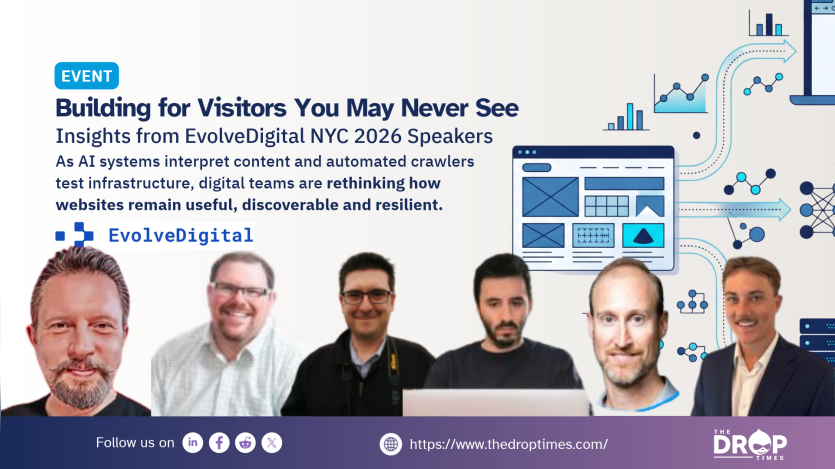
Six speakers have shared their session insights with The DropTimes ahead of EvolveDigital NYC 2026, taking place on 19–20 November at Civic Hall near Union Square in New York City. Organised by Evolving Web, the summit will address content management decisions, automated traffic, complex data, reusable AI workflows and visibility in AI-generated search responses.
In their written replies, the speakers describe planned demonstrations, practical questions and their own assessments of how digital work is changing. Their answers are previews of their sessions, not independent evidence that every proposed approach has been tested or that predicted changes are inevitable. The official event programme provides additional session information.
Robert Jacobi on the Changing Role of Content Management
Robert Jacobi, CXO at Blackwall, will join The Future of CMS: An Honest Panel Discussion on 20 November. He is approaching the CMS discussion through the changing relationship between publishers, interfaces and audiences. He argues that AI-mediated content discovery requires agencies and enterprises to reconsider their assumptions about who consumes material and who controls its presentation. His remarks are a perspective on where the industry may be heading, rather than proof that people have stopped visiting CMS-powered sites.

Robert Jacobi
Robert Jacobi
The new UI/UX is no longer under your control.
For Jacobi, the value of attending is the chance to assess how CMS platforms, AI and communities may evolve together. He said this will be his first EvolveDigital and he is looking forward to experiencing the event.
John Picozzi on Choosing a CMS in an Agentic Future
John Picozzi, solutions architect at EPAM, is participating in the same CMS panel intended to move beyond routine comparisons between platforms. He encourages organisations to bring questions about their specific needs, how those needs may change and whether emerging AI and agentic features provide substantive value. His emphasis is on making a better-informed selection, not endorsing one CMS. The published programme also lists John Doyle, CEO of Digital Polygon, and Christina Dulude, senior manager of solutions architects at Webflow, for the panel.

John Picozzi
John Picozzi
Choosing a CMS has never been more important—or more complicated.
He wants participants to leave with a clearer set of criteria for evaluating and evolving content platforms, as well as the ability to distinguish genuinely useful features from hype. He is also looking forward to exchanging perspectives with fellow speakers and attendees.
Rich Lawson on Bot Traffic and Drupal Site Protection
Rich Lawson, associate director of technology at Evolving Web, will examine the operational effect of automated crawlers in his session Surviving the Swarm: Bot and Crawler Protection for Drupal Sites. He says excessive bot traffic may appear to teams as unexplained slowdowns, escalating infrastructure costs or distorted analytics. Not all bots are harmful, however, and protections must distinguish unwanted requests from legitimate visitors and useful search crawlers.

Rich Lawson
Rich Lawson
How to defend your site without blocking the real visitors and search engines you actually want
Lawson plans to explain how site operators can identify crawler-related problems and evaluate measures, including Drupal modules and infrastructure-level protections. He also plans to moderate sessions and join a roundtable, and said he values the questions and conversations that follow conference presentations. His response did not supply a measured traffic percentage for any particular Drupal installation.
Romain Nugou on Making Complex Data Maintainable
Romain Nugou, senior full-stack developer at Evolving Web, will present Visualizing Complex Data with Naomi Keena of McGill University and Kamil Sekut of the Global Repository of Income Dynamics (GRID). Their examples include McGill’s Data Homebase and GRID, which Nugou says spans 300 statistics, 26 countries and 50 years—dimensions that create millions of possible data views rather than a fixed collection of finished charts.

Romain Nugou
Romain Nugou
Build one system for every chart rather than designing each one by hand.
His advice is to inventory the data before designing visualisations, use a reusable approach instead of producing charts individually and plan for datasets to change. The focus is on maintainable information architecture as much as presentation.
Brian Piper on Reusable AI Skills and Agent Readiness
Brian Piper, founder of AIreFlow Solutions, proposes a workshop titled Stop Prompting: Taking Your AI to the Next Level in which attendees audit their own websites, feed those results into subsequent checks and assemble reusable AI skills. His starting problem is repetition: teams repeatedly have to explain audience, brand voice and standards in every new prompt.

Brian Piper
Brian Piper
You are building assets rather than a pipeline.
He identifies two aspects of agent readiness: machine readability, including whether facts are accessible as text and product names are consistent, and agent completability, or whether an automated assistant can finish the task a page offers. Piper treats these primarily as content-modelling challenges that need both marketing and engineering input. His response outlines an instructional method, not a validated universal scoring system.
Anton Holm on Search Visibility Beyond the Website
Anton Holm, senior digital content and SEO officer at the International Rescue Committee (IRC), will present GEO Beyond Your Website with IRC director of digital engagement Sarah Arnold. Drawing on work at the International Rescue Committee (IRC). He argues that reference sources, reviews, relevant roundups and professional communities may influence which organisations appear in AI-generated answers. His proposed tactics include studying the sources AI systems cite, seeking appropriate third-party coverage and strengthening on-site content and structured data.

Anton Holm
Anton Holm
Models are probabilistic, not deterministic.
Holm cautions that authority-building does not guarantee visibility or citations and that measurement remains partly estimated. His account describes an approach being explored rather than reporting quantified improvements in IRC visibility. He hopes to learn from practitioners outside the nonprofit and SEO fields as well.
 Kazima AbbasKazima Abbas is a sub-editor at The Drop Times
Image Attribution Disclaimer: At The Drop Times (TDT), we are committed to properly crediting photographers whose images appear in our content. Many of the images we use come from event organizers, interviewees, or publicly shared galleries under CC BY-SA licenses. However, some images may come from personal collections where metadata is lost, making proper attribution challenging.
Our purpose in using these images is to highlight Drupal, its events, and its contributors—not for commercial gain. If you recognize an image on our platform that is uncredited or incorrectly attributed, we encourage you to reach out to us at #thedroptimes channel on Drupal Slack.
We value the work of visual storytellers and appreciate your help in ensuring fair attribution. Thank you for supporting open-source collaboration!

ASK: Drupal Community Needs Your Support
View all →
Disclosure: This content is produced with the assistance of AI.
Note: The vision of this web portal is to help promote news and stories around the Drupal community and promote and celebrate the people and organizations in the community. We strive to create and distribute our content based on these content policy. If you see any omission/variation on this please reach out to us at #thedroptimes channel on Drupal Slack and we will try to address the issue as best we can.

Related Drupal Initiatives

Related Events


Related Organizations





Related People


You may also like