




Document Loader 2.0.0 Adds Plugin-Based Ingestion to Drupal

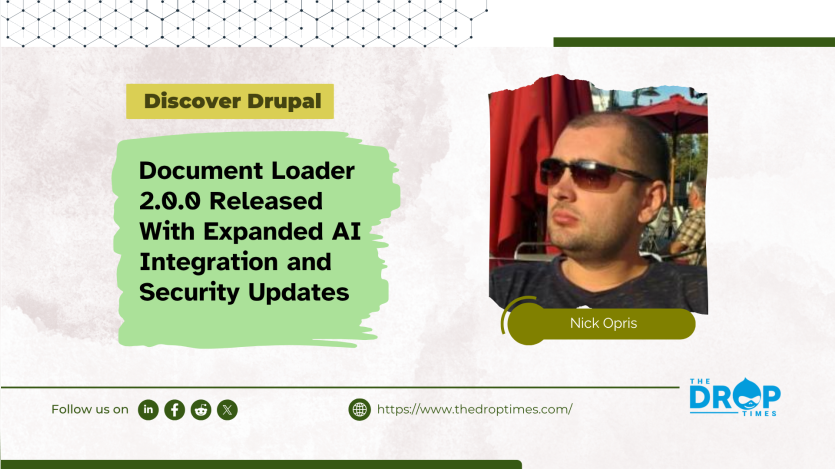
A new release of the Document Loader module, version 2.0.0, introduces a structured, plugin-based system for ingesting and processing documents within Drupal, extending support for multiple file formats and AI-driven workflows. Published on 19 March 2026, the release includes security advisory coverage and positions the module as a reusable ingestion layer for content pipelines.
The module provides a consistent API for loading documents from sources such as PDFs, CSV files, Word documents, spreadsheets, web pages, APIs, and Parquet files. It standardises how input data is discovered, configured, and transformed into reusable output formats, reducing the need for custom ingestion logic in downstream modules.
A two-layer plugin architecture underpins the system. DocumentLoaderType plugins define source categories and input structures, while DocumentLoader plugins handle execution and output transformation. This separation allows developers to extend ingestion capabilities without modifying core functionality.
The release introduces integration with Drupal’s AI tooling through agent-facing components that expose document loaders as usable tools. A Field Widget Action is also included, enabling document loading directly from entity fields, which simplifies integration into editorial workflows.
Developer-facing features include command-line utilities such as document-loader:list, document-loader:inputs, and document-loader:load, supporting inspection and execution of loaders via Drush. An administrative interface, referred to as the Document Loader Explorer, allows testing across input types and formats.
The module was developed by Nick Opris, a senior Drupal developer, and released following collaboration with Ahmad Khader and Rob Loach. The idea originated from Marcus Johansson, initially as part of work on a Context Control Center for AI agents. “The module has since evolved into a more flexible system beyond its original scope,” said Nick in a LinkedIn post.
Additional ecosystem support is provided through companion modules that extend ingestion capabilities, including parsers for PDFs, integrations for APIs and web pages, and tools for handling structured formats such as Parquet. The project page reports 132 sites currently using the module.
While the release outlines architectural structure and supported formats, the announcement does not provide detailed implementation examples or performance benchmarks. The available information focuses primarily on capabilities and extensibility rather than demonstrated use cases.


ASK: Drupal Community Needs Your Support
View all →
Note: The vision of this web portal is to help promote news and stories around the Drupal community and promote and celebrate the people and organizations in the community. We strive to create and distribute our content based on these content policy. If you see any omission/variation on this please reach out to us at #thedroptimes channel on Drupal Slack and we will try to address the issue as best we can.

Related Drupal Initiatives

Related People


You may also like