EvolveDigital Montréal26 Speakers Discuss AI Governance and CMS Evolution

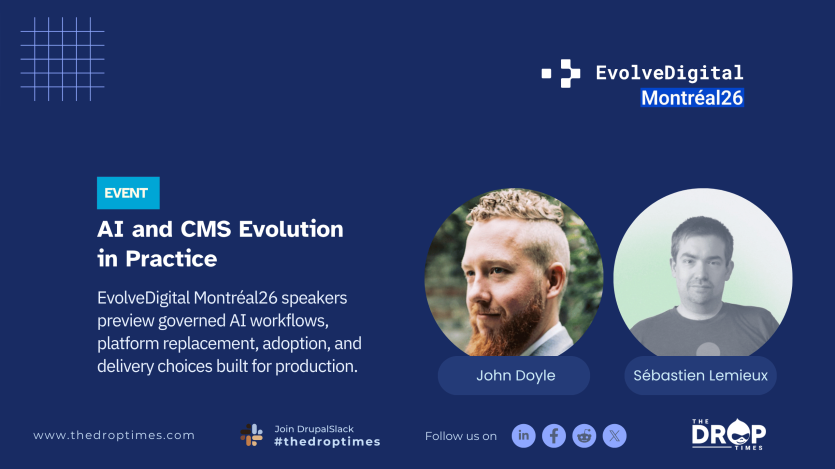
Practical questions around AI adoption and CMS migration will shape two production-focused sessions at EvolveDigital Montréal26, where speakers will examine how digital teams move from experimentation to systems that can be used, reviewed, and maintained. Ahead of the summit, The DropTimes spoke with John Doyle, CEO and Drupal and WordPress expert at Digital Polygon, and Sébastien Lemieux, senior Drupal developer at Evolving Web.
John previewed a session on moving AI from experimentation into governed CMS workflows. Sébastien discussed a presentation with HEC Montréal on a CMS migration project completed with Evolving Web, including the challenges and decisions that shaped the work. Together, the conversations point to a summit programme concerned less with digital ambition in the abstract and more with the constraints that shape delivery.
EvolveDigital Montréal26 is a one-day bilingual summit focused on practical digital delivery across digital strategy, marketing, design, technology, accessibility, AI, Drupal, and WordPress. Its programme includes applied sessions, case studies, panels, and networking for teams working across higher education, non-profit, government, healthcare, and related sectors.
Two sessions preview that production-minded focus from different directions: one through AI governance inside CMS workflows, and the other through the practical constraints of large-scale migration.
From AI pilots to governed workflows
John said the distinction gives his session its practical focus. AI tools are easy to test in limited pilots, but harder to place inside production systems where accuracy, review, permissions, and accountability matter. His session is aimed at teams that have experimented with AI but have not yet found a reliable way to integrate it into their content operations.
AI isn't a new tool. It's a new way of working — and treating it like the first is why most pilots fail.
John is not framing AI as a novelty layer around a CMS. He is looking at what it takes to define AI work clearly enough for a team to use, review, and maintain it. That includes setting expectations for inputs, outputs, service levels, ownership, and the points where human judgment enters the process.
For content teams, this is where AI adoption often becomes difficult. A pilot may show that AI can summarise content, suggest metadata, assist with drafting, or support editorial review. Production use requires more than a working prompt. Teams need to decide who can trigger the process, what content the system can access, where the output appears, who reviews it, and how mistakes are corrected before publication.
John’s CMS-centred argument is that many organisations already operate the structures needed for this kind of governance. Mature content platforms manage permissions, content types, workflow states, revisions, editorial roles, and publishing controls. He framed the CMS as the natural foundation for governed AI work.
Your CMS is already your AI foundation. Most orgs are buying middleware to recreate what Drupal already does.
For Drupal teams, that point connects AI adoption to the platform's familiar strengths. Drupal is often used where structured content, complex permissions, multilingual needs, and editorial workflows are central to a site’s operation. If AI is introduced without reference to those structures, it can become a side process that adds work rather than reducing friction. If it is designed within the CMS, it can become part of a traceable workflow.
John also places review at the centre of production AI. His point that “Human-in-the-loop is a workflow state, not a hope” speaks to a common weakness in AI pilots: review is assumed but not designed. In a governed workflow, review must have a defined place. It should be clear when AI assistance stops, when a person takes responsibility, and how the system records that handoff.
That approach is especially relevant for organisations where published information carries institutional responsibility. Universities, government bodies, healthcare-related organisations, and non-profits often manage public-facing content that must remain accurate, accessible, and accountable. In those settings, AI cannot be adopted as an informal shortcut. It needs a workflow that supports trust.
Migration as organisational work
Sébastien’s session turns to a different kind of implementation challenge. He will join Alexandra Claveau, directrice de service et partenaire d'affaires TI at HEC Montréal, and Vincent Demers, conseiller en communications numériques at HEC Montréal, for the French-language session “Migration, refonte, adoption : simplifier aujourd'hui, faire évoluer demain.” The session examines HEC Montréal’s platform replacement and targeted website redesign, including the governance, prioritisation, and adoption decisions that shaped the work.
The presentation will cover the project itself, its challenges and the solution that allowed us to reach the finish line.
The case-study format gives the session practical value for teams preparing similar work. CMS migration is often described as a technical process, but large organisational migrations usually involve more than moving content from one system to another. They can expose outdated content structures, unclear ownership, legacy workflows, stakeholder misalignment, integration dependencies, and training needs that were previously hidden or tolerated on the previous platform.
Sébastien said the presentation is intended for people working on a migration project or preparing to begin one for a large organisation. That audience is likely to recognise the pressure points: deciding which content should move, mapping legacy structures into a new model, maintaining continuity for users, managing redirects, coordinating approvals, and ensuring the new CMS can support editors after launch.
The migration context also changes the meaning of technical decisions. A content model is not only a development artefact. It shapes how editors create pages, reuse components, manage media, apply metadata, and maintain consistency over time. A redirect strategy is not only a technical requirement. It protects discovery, search continuity, and user access. A governance decision is not only an internal agreement. It determines who can change the system once the migration is complete.
Large organisations often carry years of accumulated content into a migration. Some pages may have no clear owner. Some sections may reflect older institutional structures. Some content may remain online because previous systems made review or consolidation difficult. A migration can create the moment when these issues must be addressed, but it also adds pressure because those decisions are within a delivery timeline.
Sébastien’s background adds context to that work. He has nearly a decade of experience with recognised companies in the Bas-Saint-Laurent region. Described as resourceful and pragmatic, he is known for finding practical solutions and bringing that approach to the projects he contributes to. In a migration project, that kind of pragmatism matters because teams often need workable decisions under real constraints.
The HEC Montréal presentation is expected to cover both technical and organisational challenges. The event description says the project combined platform replacement with a targeted redesign and focused on governance, prioritisation, adoption, and decisions that simplified content operations. That combination is important because a successful migration is measured after launch as much as at launch.
For agencies and internal platform teams, the session may offer a useful way to think about migration risk. Risk can sit in data quality, integration complexity, or content volume. It can also sit in late feedback, unclear approval paths, underestimated training, or assumptions about how editors will adapt to the new system. Addressing those risks requires project planning that treats organisational coordination as part of delivery, not as a separate concern.
Shared lessons for delivery teams
John’s session explores how AI can be integrated into governed CMS work. Sébastien’s session examines how a migration project navigates technical and organisational complexity. Both previews point to sessions grounded in the conditions digital teams face when systems must be used, maintained, and trusted.
That focus fits the summit’s broader audience. Digital teams across education, public service, healthcare, non-profit, and agency environments often work with long-lived platforms and layered responsibilities. They need to balance innovation with maintenance, accessibility with speed, governance with usability, and strategy with the limits of real implementation. EvolveDigital Montréal26 gives those conversations a shared setting.
EvolveDigital Montréal26 will take place on 12 June 2026 from 9:00 to 18:00 EDT at Montréal CoWork in Montreal, Quebec. The event brings together digital professionals working across open-source platforms, AI, accessibility, design, marketing, and strategy. Its speaker-led sessions emphasise practical lessons from production work, migration planning, and the systems that support long-term digital delivery.
 Kazima AbbasKazima Abbas is a sub-editor at The Drop Times
ASK: Drupal Community Needs Your Support
View all →
Disclosure: This content is produced with the assistance of AI.
Note: The vision of this web portal is to help promote news and stories around the Drupal community and promote and celebrate the people and organizations in the community. We strive to create and distribute our content based on these content policy. If you see any omission/variation on this please reach out to us at #thedroptimes channel on Drupal Slack and we will try to address the issue as best we can.

Related Events


Related Organizations


Related People


You may also like