


Editor's Pick | Vol. 4 |
Issue. 34
Open-Weight AI Is Reopening an Old Web Question
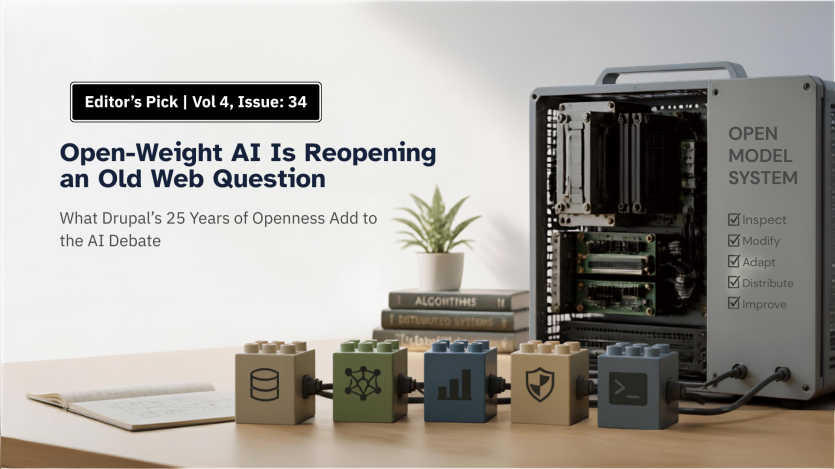
Last week’s AI releases put a familiar question back into view: who controls the technology that digital systems depend on? On 10 August 2026, Meta released Muse Glimmer, a 30-billion-parameter model optimised for local agent workflows, with its weights under the Apache 2.0 licence. Mark Zuckerberg, Meta founder and CEO, argued in an essay published the same day that superintelligence should be broadly distributed rather than concentrated in a small number of hands. On 14 August, Alibaba Group’s Qwen team released Qwen3.8-27B, another downloadable model with weights under Apache 2.0.
There is a catch in calling all of this “open AI.” Downloadable weights under an open-source licence do not by themselves establish that an entire AI system is open source. Under the Open Source Initiative’s Open Source AI Definition, the preferred form for modification also requires sufficiently detailed information about the data used to train the system, the complete source code used to train and run it, and the model parameters. Even so, downloadable weights can expand practical deployment choices by allowing organisations to run and adapt models on infrastructure they control rather than relying solely on a vendor-hosted service.
Drupal is relevant here not because a content management system and an AI model are equivalent, but because the project has spent 25 years working within open-source principles. Drupal marked its 25th anniversary on 15 January 2026, and the Drupal Association’s Open Web Manifesto describes the open web through principles including freedom, decentralisation, participation, choice, privacy and security. The comparison should remain limited: a content management system, model weights, training data, source code and computing infrastructure are different layers with different licensing and governance problems. The shared principle is practical: leave organisations room to choose infrastructure, modify systems, and avoid unnecessary dependence on a single provider.
The larger question is whether those principles are becoming easier to recognise beyond software-development communities. AI is forcing organisations to consider what happens when a technology provider changes terms, raises prices, closes a service or simply stops fitting their needs. Drupal cannot answer AI’s licensing, computing, data-governance or portability questions, and open source does not guarantee independence. What Drupal can offer is a 25-year example of why choice, modification and exit matter when digital infrastructure becomes important enough to depend on.
As AI becomes another dependency inside websites and digital services, that old open-web argument has a new place to land. The question is no longer only what an AI model can do, but how much control remains with the people and organisations that build on it.
Follow The DropTimes on LinkedIn, X, Bluesky, and Facebook, or join #thedroptimes on Drupal Slack.
This issue of Editor’s Pick was written and curated by Kazima Abbas.