



Drupal Advocacy Program Brings Public Outreach Into Contribution Credit

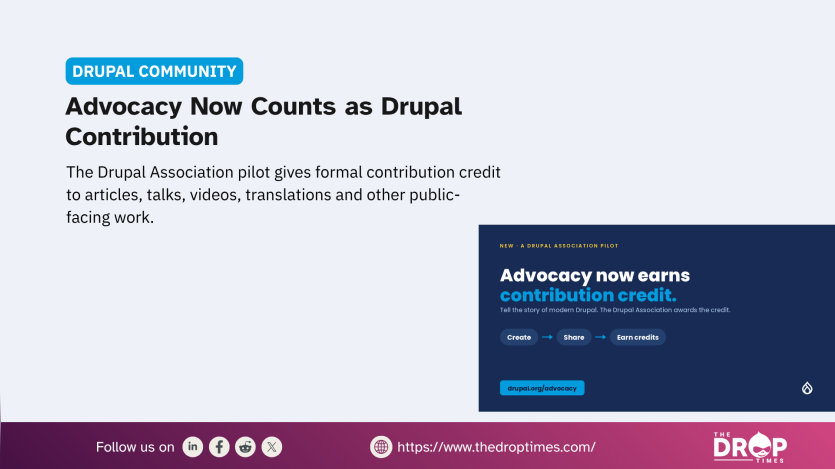
The Drupal Association has launched the Drupal Advocacy Program, a pilot that brings public-facing outreach into Drupal's contribution-credit system. Articles, videos, talks, translations, podcasts, tutorials, customer stories and thoughtful amplification of other community work can now qualify for credit when they help explain modern Drupal to audiences beyond the project's usual channels.
The programme is built around a problem the Association states directly: Drupal's market reputation has not kept pace with the platform's current capabilities. Rather than relying only on central marketing, the pilot asks people who already build with Drupal to explain what it can do in their own words, for the industries, regions and communities they know.
Advocacy uses the same contribution-credit system that recognises code and other project work. Credits count toward a contributor's standing in the ecosystem, including organisational visibility connected with the Drupal Certified Partner programme.
Articles, Talks and Demonstrations Can Qualify
The programme defines eligible work broadly. Contributors can publish a market-specific article or LinkedIn thread, record an explainer or customer-story video, adapt or translate a Drupal story for another language, appear on a podcast, speak at a non-Drupal event, publish a tutorial or demonstrate a technical capability.
Amplifying another contributor's work can also qualify when the participant adds useful context instead of simply reposting it. The aim is to move Drupal stories into channels and communities that do not already follow Drupal closely.
Quarterly themes give contributors a shared subject to work from. The Association says each theme can include source material such as proof points, clips, statistics and reference content that contributors can adapt rather than repeat verbatim. Work aligned with the quarterly focus earns double contribution credit.
Rotterdam Serves as the Initial Pilot
DrupalCon Rotterdam provides the first test of the programme. During the DriesNote, Dries Buytaert asked community members to extend the stories presented during the keynote by clipping, sharing, localising and building on them for other audiences.
The programme suggests contributions such as sharing DriesNote takeaways, producing a short demonstration of a Drupal AI capability, adapting conference stories for a particular industry, or presenting a Drupal topic at a non-Drupal event. Video, photographs, quotes and demo material from the keynote have been made available as source material.
The model gives developers, agencies, regional communities and other contributors different ways to work from the same underlying theme. One person might demonstrate a technical capability, while another could translate the material or explain why it matters to a specific sector.
The Guidelines Draw a Line Around Self-Promotion
The programme explicitly says its goal is to crowdsource advocacy, not astroturfing. Eligible content may mention a contributor's organisation once, and company branding is limited in blog and video submissions. Project work can be used as evidence for a broader Drupal point, but the organisation providing the example should not become the main subject.
Contributors are also expected to support claims with evidence that readers or viewers can verify. The programme points to deployed projects, external publications, working demonstrations and recorded conference sessions as examples of useful proof.
The guidance does not require participants to repeat supplied campaign messaging unchanged. It explicitly asks contributors to say so when a claim in the source material does not match their own experience, leaving room for advocacy to retain the contributor's perspective rather than becoming a prescribed marketing script.
Credits Are Reviewed in Batches
Completed work is submitted through a form with the contributor's name, Drupal.org username, a link to the content and information about what was published and where. Submissions are reviewed in batches, monthly or quarterly, with reviewers considering criteria including quality, alignment, reach and resonance.
Credits are awarded in tiers and count for 12 months from the date of award. Quarterly-theme contributions earn double credit, standout work can be highlighted during the year, and leading contributions may be recognised at DrupalCon.
The Drupal Association describes the programme as a work in progress and says details will continue to develop as the pilot runs. The immediate change is nevertheless clear: advocacy work that was previously outside Drupal's formal credit system can now earn recognised contribution credit.
References
ASK: Drupal Community Needs Your Support
View all →
Disclosure: This content is produced with the assistance of AI.
Note: The vision of this web portal is to help promote news and stories around the Drupal community and promote and celebrate the people and organizations in the community. We strive to create and distribute our content based on these content policy. If you see any omission/variation on this please reach out to us at #thedroptimes channel on Drupal Slack and we will try to address the issue as best we can.

Related Organizations

You may also like