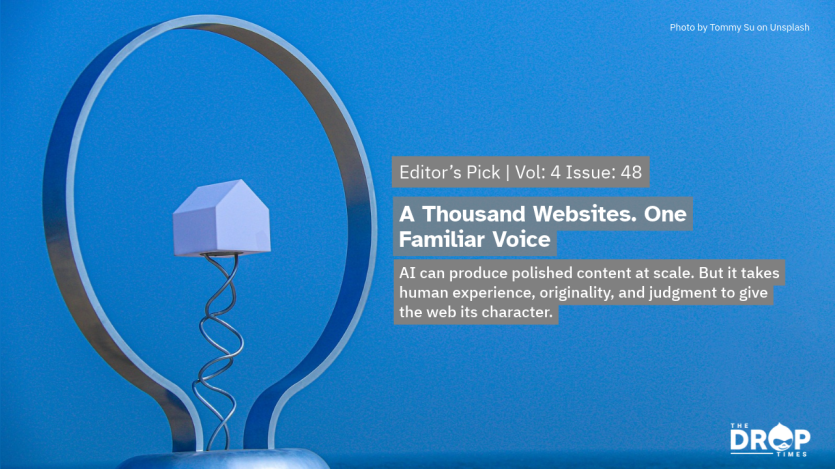
Readers can often recognise a publication before noticing its logo. A local newspaper has its own character, a university speaks with the authority of its researchers, and a community organisation reflects the people and places it represents. Those differences are part of what makes the web interesting. Yet a survey of 1,000 U.S. adults, conducted by Dynata and published by content-quality software company Markup AI in November 2026, found that 73.3% had noticed brands' content and messaging becoming more similar as companies adopted artificial intelligence. The survey measures perceptions, not the causes of that similarity. Still, it raises an interesting question. When everyone has access to tools that produce polished writing, what happens to the distinctive voices that make websites worth visiting?
The concern goes beyond how brands sound. Research published by Pew Research Center in August 2026 found signs of AI writing or substantial editing in more than a third of sampled English-language pages published after ChatGPT's launch. The estimate relies on AI detection, which can misclassify content, and does not represent the entire web. Separately, a Gartner survey found that 57% of surveyed U.S. consumers said AI-generated marketing content had made them less trusting of brand messaging. None of this means AI-assisted writing is necessarily poor. It does suggest that producing more words and earning a reader's trust are two different things. Perhaps the question publishers should be asking is not how much more they can produce, but what makes their work worth reading.
For Drupal and the wider open-source community, that question has practical consequences. Drupal already provides tools for multilingual publishing, revision management and editorial oversight. Its emerging AI ecosystem adds new possibilities, including Context Control Center, which supplies site-specific instructions to AI agents, and AI Content Review, which evaluates content against editorial rules, though its alpha release has important limitations. These tools can support consistency and review, but they cannot decide what an organisation should stand for or which stories deserve attention. That responsibility remains with people. A style guide can help preserve a voice, but it cannot create the perspective behind it. The real opportunity for publishers is to use AI without surrendering the editorial judgment that gives their work meaning.
Perhaps this is what the next chapter of the open web will demand. Not less technology, but a clearer sense of why people publish in the first place. AI can help smaller organisations communicate across languages, make publishing more accessible and give more people the means to participate. Those are possibilities worth protecting. But a community's experiences, a writer's curiosity and an editor's willingness to question what appears on a page cannot be reduced to producing content faster. The value of a website has never rested entirely on the number of words it contains. As those words become easier to generate, a recognisable human perspective may become even more valuable. The question is no longer whether everyone can have a voice on the web. It is whether we will still recognise those voices when we hear them.
Follow The DropTimes on LinkedIn and Bluesky, or join #thedroptimes on Drupal Slack.
Kazima Abbas wrote and curated this issue of Editor’s Pick.