



EverLMS Offers a Self-Hosted Enterprise LMS Built on Drupal

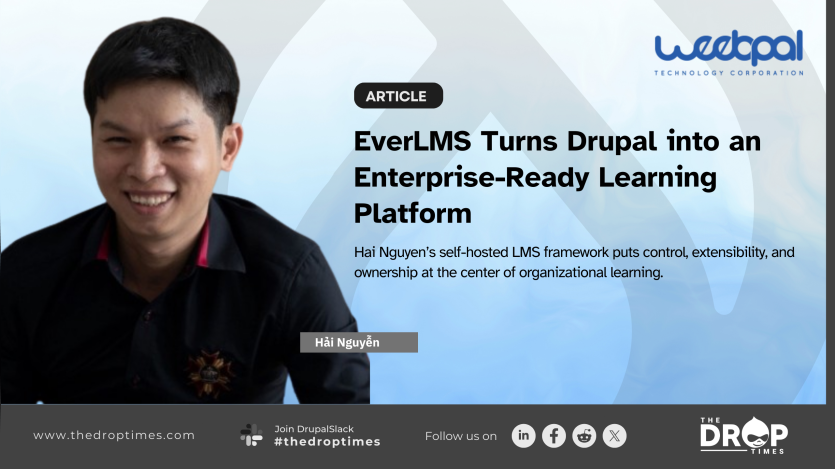
When Hai Nguyen began building EverLMS, the intention was not to release another learning management add-on for Drupal. Instead, he set out to develop a Drupal-native, open-source learning platform that organizations could self-host, extend, and integrate into their existing digital infrastructure.
In a recent conversation and live demonstration with The DropTimes, Nguyen outlined the platform’s capabilities and architectural direction. Beyond feature depth, the project reflects an emphasis on control, extensibility, and long-term maintainability. EverLMS is positioned for agencies and enterprises that treat learning as an operational function rather than a peripheral website feature.
From Plugin to Platform
Many organizations begin with straightforward training needs—publishing video lessons, tracking learner progress, or issuing certificates. SaaS-based LMS tools often serve as a starting point. As training expands across departments or partner ecosystems, constraints may surface around customization, branding, integration, and data governance.
EverLMS approaches this differently. Built on Drupal 10 and released as open-source software, it operates as a full learning framework rather than a feature layer. Learning content is structured within Drupal’s content architecture, leveraging granular permissions, multilingual capabilities, and modular extensibility.
According to its documentation and FAQ, EverLMS is designed for self-hosted deployment, allowing organizations to retain infrastructure-level control over data and configuration. Unlike SaaS-based platforms such as Teachable or TalentLMS, the platform does not operate on a shared multi-tenant model. Its primary maintainer, WeebPal, maintains related implementation profiles and repositories used for deployment and customization.
For Drupal agencies, this alignment keeps learning workflows within familiar tooling. Functionality can be extended using standard Drupal modules, and integrations with CRM, ERP, HR, or authentication systems can be implemented within the same ecosystem. For organizations already invested in Drupal, this reduces architectural fragmentation.
AI as Acceleration
During the live demonstration, Nguyen showcased AI-assisted tools embedded in the course-creation workflow. Rather than positioning AI as a standalone feature, EverLMS integrates it to address content production efficiency.
Course creators can generate structured outlines, draft lesson scaffolds, and build quiz components with AI assistance. The goal is to reduce repetitive setup time while maintaining human oversight of instructional quality.
In practice, this may shorten development cycles for organizations managing frequently updated or large-scale training programs.
Supporting Modern Learning Formats
EverLMS supports text-based lessons, uploaded video, embedded media from platforms such as YouTube and Vimeo, live sessions via Zoom, SCORM packages, and interactive H5P activities. Each format integrates into a unified course hierarchy with consistent tracking and assessment logic.
This flexibility allows consolidation of legacy training materials alongside newer interactive modules. For enterprises managing compliance programs, onboarding tracks, or partner certification portals, interoperability across formats becomes operationally important.
Operational Controls and Reporting
Beyond delivery, the platform includes assessment tools, certification workflows, structured reporting, and configurable access controls. Administrators can monitor completion data, quiz performance, and learner engagement across cohorts.
Role-based permissions support subscription tiers, departmental segmentation, and restricted certification pathways. For regulated environments, such controls form part of the compliance infrastructure.
Agency Licensing Model
EverLMS introduces white-label and OEM licensing options aimed at Drupal agencies. Agencies can deploy customized LMS implementations under their own branding while relying on EverLMS as a foundational framework.
This model may reduce repeated infrastructure development across projects while preserving flexibility for client-specific requirements.
Ownership as Architecture
A defining characteristic of EverLMS is its self-hosted, single-tenant architecture. Organizations are not sharing infrastructure or constrained by multi-tenant SaaS limitations. Deployment, integrations, and data governance remain internally managed.
For companies prioritizing interoperability and autonomy, this approach situates learning infrastructure alongside other core enterprise systems rather than as an external subscription platform.
Looking Ahead
Nguyen’s roadmap includes further refinement of analytics, AI tooling, SCORM compatibility, and expanded integration capabilities. The platform is currently in production use, with ongoing development aligned to agency and enterprise deployments.
The EverLMS codebase is publicly accessible via its Drupal.org Git repository, with related deployment resources and profiles available through WeebPal’s GitHub, including the everlms-profile repository.
Within the Drupal ecosystem, EverLMS illustrates how Drupal can underpin application-layer systems beyond traditional publishing use cases. For organizations evaluating alternatives to SaaS LMS products, it presents a Drupal-based model centered on extensibility and infrastructure ownership.
Reference: EverLMS official website; EverLMS Drupal.org project repository; WeebPal GitHub profile; everlms-profile repository.
 Alka ElizabethMy puns are intended.

ASK: Drupal Community Needs Your Support
View all →
Note: The vision of this web portal is to help promote news and stories around the Drupal community and promote and celebrate the people and organizations in the community. We strive to create and distribute our content based on these content policy. If you see any omission/variation on this please reach out to us at #thedroptimes channel on Drupal Slack and we will try to address the issue as best we can.

Related Organizations

Related People


You may also like