



For Community, By Community: Stanford WebCamp 2026 Opens Today

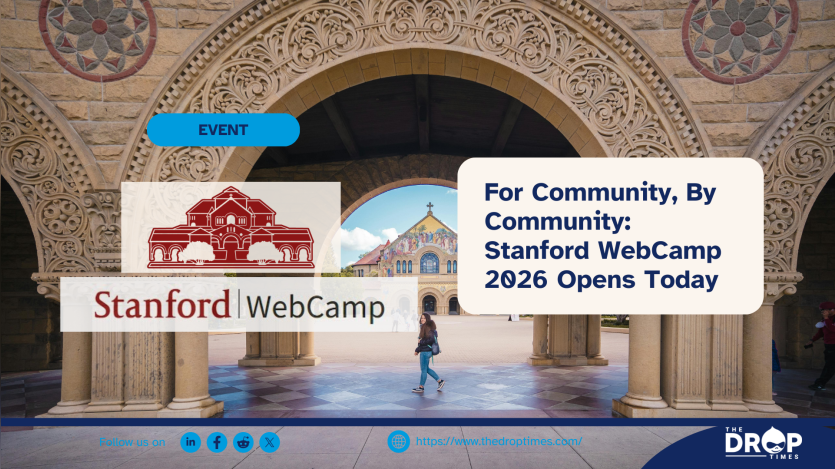
Stanford WebCamp 2026 begins today. No ticket required. No registration gate. No fee of any kind. Just an open invitation, extended as it has been every year since 2010, to anyone working on the web who wants to learn, share, and contribute alongside peers.
The event runs April 30 to May 1, with today's sessions held fully online and tomorrow's programme running in hybrid format at 459 Serra Mall on Stanford's main campus in California. A community celebration is also planned for May 9th, location to be announced. It is the 16th edition of an event that began as Stanford DrupalCamp before broadening its scope and changing its name in 2019 to welcome the full spectrum of web technology.
Eric Wheeler, one of the event's core organisers and a 19-year Stanford veteran, is candid about what has kept WebCamp alive when comparable events have either disappeared or drifted toward commercialisation.
"Our sponsors are very generous. Oftentimes they reach out to us before we have a chance to reach out to them. I think because there is a lot of value in Stanford WebCamp for companies. As companies sprout up and either go under or get acquired, universities will always be around, and they will always need web services. Our overhead is also much lower since we are employees, we get the venue for cheaper. I have also made a couple friends here and there in my 19 years working for Stanford." - Eric Wheeler, Organiser
This year's core sponsors include Acquia, Aten Design Group, Four Kitchens, and Jakala. The DropTimes serves as media partner, and the event is a member of the Midwest Open Source Alliance, a registered 501(c)3.
The session proposal process, open to anyone, functions as an informal gauge of what the community is actually thinking about. This year, Eric noticed something conspicuous by its absence.
"At this point, working for so many years at a university, not much surprises me anymore. I have gotten to watch technologies rise and fail and rise again. One thing that does surprise me is that there are not many sessions getting proposed about community health. I'm hoping as AI stabilizes that these sessions will start to come back."- Eric Wheeler, Organiser
It is a telling observation. The urgency around artificial intelligence has, at least for now, crowded out some of the connective tissue topics like mentorship, contributor well-being, and sustainable open source participation that have historically given communities their staying power. And yet AI itself is woven through this year's programme in ways that feel less speculative and more operational than in previous years.
This year's keynote is delivered by Joshua Barnett, and its subject reflects exactly where higher education IT finds itself in 2026. Joshua's talk addresses AI not as an experimental feature or a novelty layered onto existing systems, but as infrastructure, something becoming embedded in the core architecture of how universities deliver content, services, and decision-making tools. For Joshua, this represents a turning point in how institutions think about the web. AI is no longer a side project. It is becoming part of the foundation, and with that shift come serious questions of governance, scalability, and what it means to build responsibly at institutional scale.
Alongside Joshua, speaker AmyJune Hineline brings a different but equally necessary perspective. Where Joshua focuses on systems, AmyJune focuses on people. Her work, shaped by years in the open source community, centres on accessibility, mentorship, and the often-invisible pathways through which new contributors find their way into technical ecosystems. Her presence at WebCamp underscores the event's roots and its commitment to the idea that open source communities sustain themselves through shared knowledge and inclusive practice. Irina frames the contrast between the two as the defining tension of the current moment.
"Together, their stories illustrate the state of mind today. On one side, AI is reshaping the technical and strategic landscape at scale. On the other hand, open source communities continue to define how people learn, contribute, and belong within that landscape. The future of the web depends on both: robust infrastructure and resilient, human-centered communities to build and guide it."- Irina Zaks, Organiser
Sessions at WebCamp span web design and development, UX, DevOps, content strategy, project management, accessibility, CMS technologies, and API integration. Introductory content is highlighted on the first day; more advanced technical sessions run through the second. The structure is intentional: the camp has always positioned itself as equally useful to someone attending their first conference as to a seasoned practitioner.
For first-timers trying to understand what WebCamp actually feels like, Irina returns to a phrase that has become the event's quiet motto.
"When I explain what Stanford WebCamp is about, the core message is 'For Community, By Community'. There's no sense of hierarchy — no 'speaker vs. audience,' no polished conference distance. Just peers solving real problems in real time. That's the moment people keep describing. At many conferences, the value is on stage. At WebCamp, the value extends in conversations, in spontaneous collaboration, into the realization that you're allowed to participate, not just listen. And for first-timers, that's usually the turning point: when they stop feeling like attendees and start acting like contributors."- Irina Zaks, Organiser
That ethos has survived sixteen years, a name change, a pandemic, the return to in-person gatherings, and now an AI-saturated moment that is reshaping every conversation in the field. Stanford WebCamp 2026 begins today. It is free. It is open. And it is still, fundamentally, yours to shape.
Stanford WebCamp 2026 runs April 30 to May 1, 2026. Online sessions are live today. The hybrid programme continues tomorrow at 459 Serra Mall, Stanford, CA. A community celebration follows on May 9th. Visit webcamp.stanford.edu for details.
 Alka ElizabethMy puns are intended.

ASK: Drupal Community Needs Your Support
View all →
Note: The vision of this web portal is to help promote news and stories around the Drupal community and promote and celebrate the people and organizations in the community. We strive to create and distribute our content based on these content policy. If you see any omission/variation on this please reach out to us at #thedroptimes channel on Drupal Slack and we will try to address the issue as best we can.

Related Events


Related Organizations

Related People


You may also like