



Drupal AI Summit NYC Opens Today With Focus on Enterprise AI and Open Source Governance

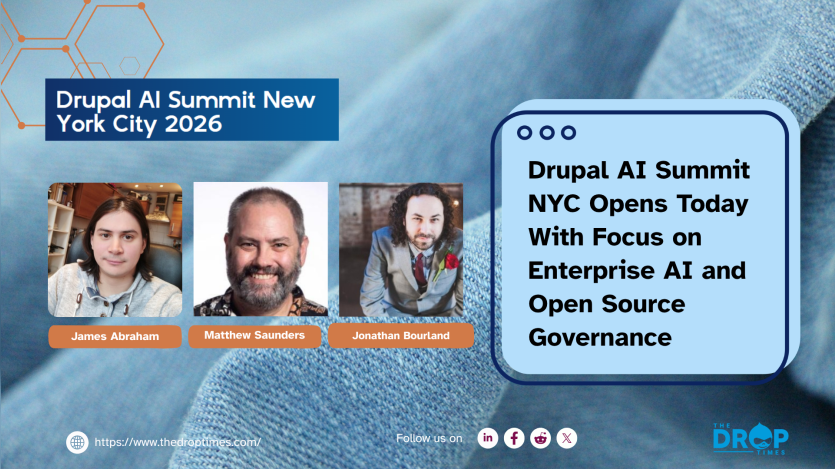
Gathering in New York City today, the Drupal AI Summit will bring together Drupal contributors, enterprise teams, and artificial intelligence practitioners for a full day of discussions focused on the practical use of AI within Drupal platforms and digital operations. The event is scheduled to run from 10:00 to 18:45 EDT on 14 May 2026 at Convene, 360 Madison Avenue. Organisers have positioned the summit around implementation experience, governance concerns and production-level use cases rather than speculative discussion about AI adoption.
The programme includes sessions from Matthew Saunders, Josh Koenig, Jeroen Spitaels, Martin Anderson-Clutz, James Abrahams, Rob Loach, Kristen Pol, Jonathan Bourland, John Tran, Kristof Van Tomme, John Doyle, Scott Delea and Christoph Breidert. Topics scheduled throughout the day include AI governance, structured content systems, migration tooling, digital sovereignty, workflow integration and operational oversight in enterprise environments.
The summit arrives at a point when many organisations are moving beyond experimental AI deployments and assessing how artificial intelligence can operate reliably inside long-term digital infrastructure. Several sessions are expected to focus on how Drupal’s structured content model, extensibility and open-source architecture affect AI implementation decisions in regulated or large-scale environments. Discussions will also examine how governance, transparency and human oversight can remain part of AI-supported publishing and operational workflows.
Unlike many AI-focused events that centre primarily on product demonstrations or speculative forecasts, the Drupal AI Summit has placed stronger emphasis on production environments and organisational constraints. Speakers are expected to discuss systems already operating inside enterprise and public-sector settings, including the operational difficulties involved in integrating AI into content management, migration planning and workflow automation.
James Abrahams, director at FreelyGive Ltd, said in a statement shared with The DropTimes that the earlier Paris edition of the summit attracted a broader mix of attendees than many traditional Drupal gatherings. According to James, organisations brought together operational staff and content teams to better understand how AI could assist with publishing and workflow processes within Drupal systems.
"Paris AI Summit was a sell-out. We had a packed room, and it had a bunch of people who were just end-users. I don't mean business owners, but some organisations just bought some of their team who use Drupal day to day to get content out, and they wanted to learn how AI could make things better."
James also noted that the summit's co-location with a broader AI event created opportunities to introduce Drupal to participants outside its established community. He said conversations around Drupal AI sessions drew interest from attendees who had either not used Drupal for years or had limited familiarity with the platform.
The New York edition is co-located with apidays New York, a format intended to place Drupal discussions within a wider AI and enterprise technology environment. Organisers expect that structure to increase interaction between Drupal contributors and teams working across adjacent open-source and AI ecosystems.
Matthew Saunders, AI ambassador at amazee.io, is scheduled to open the event with a session titled “The Open Source AI Harness, An Introduction”. His presentation will examine how organisations are moving away from isolated AI tools toward systems that combine governance structures, workflows, human oversight and structured content management.
"These are not theoretical conversations. The speakers are working directly with organizations deploying AI in production environments and dealing with the practical realities that come with that."
Matthew is also expected to address digital sovereignty and concerns around infrastructure control, transparency and vendor lock-in. Those themes have become increasingly prominent across open-source communities as enterprise organisations accelerate AI adoption while attempting to maintain operational independence.
Migration tooling and structured content transformation will also form part of the programme. Jonathan Bourland, associate director of Drupal at CivicActions, and Mike Gifford are scheduled to present a session titled “Beyond Extract-and-Dump: High-Fidelity Migrations with Drupal AI”. Their session will discuss a tool called Simply AI Migration, which is designed to assist organisations in handling unstructured or difficult-to-migrate content.
In comments shared with The DropTimes, Jonathan said migration work often becomes expensive and operationally difficult when organisations attempt to move inconsistent content into structured Drupal systems. He said the project aims to reduce manual effort while improving how migrated material is organised inside Drupal environments.
"It's a flexible tool for migrating messy or unstructured content and developing structured data in your Drupal site."
Several sessions across the summit are expected to reflect a broader shift within the Drupal ecosystem, where discussion of AI is moving from experimentation toward operational governance and infrastructure planning. Rather than treating AI as a separate interface layer, many speakers are expected to frame Drupal as the environment in which organisational content, workflows, and governance policies already exist.
The event also highlights how open-source platforms are positioning themselves within wider AI discussions increasingly dominated by proprietary systems and infrastructure concerns. Within that context, Drupal contributors and platform teams are expected to examine how transparency, extensibility and control can remain central as AI tooling becomes more deeply integrated into publishing and digital operations.
 Kazima AbbasKazima Abbas is a sub-editor at The Drop Times
ASK: Drupal Community Needs Your Support
View all →
Disclosure: This content is produced with the assistance of AI.
Note: The vision of this web portal is to help promote news and stories around the Drupal community and promote and celebrate the people and organizations in the community. We strive to create and distribute our content based on these content policy. If you see any omission/variation on this please reach out to us at #thedroptimes channel on Drupal Slack and we will try to address the issue as best we can.

Related Events


Related People


You may also like