



Drupal Association Plans Website Reunification as GitLab Migration Advances

The Drupal Association has committed to bringing Drupal.org back together as one website. Tiffany Farriss, interim CEO of the Association, outlined the direction in the 24 November 2026 edition of In the Open. The announcement identifies funding constraints and technical debt among the challenges facing Drupal.org.
Farriss said the Association had stopped a separate proof-of-concept product marketing website and folded that work into Drupal.org modernisation. Under the revised plan, the main www.drupal.org address will point to the platform previously served at new.drupal.org. This is a commitment to a staged transition, not an announcement that the entire site has already moved.
The Association plans to place sections that have not yet migrated on a temporary host while keeping existing URLs functional, including bookmarks and references embedded in Drupal core. Farriss warned that temporarily moving roughly 80% of search-driven pages could cause a short-term decline in search traffic. The team intends to monitor search performance weekly and report on the changes.
Project pages are due to move first, followed by documentation. Farriss said rebuilt sections would return to the main address with improved metadata, structured data and Markdown outputs intended to make Drupal guidance easier for developers and automated tools to retrieve. A separate archiving strategy is intended to keep older community material, security advisories and change records available, with notices directing readers towards current guidance. The Association has not supplied a completion date for the wider reunification.
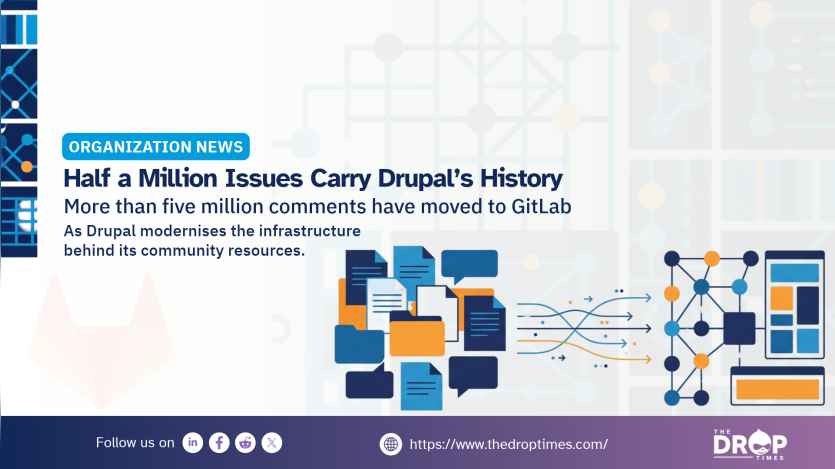
The announcement follows another infrastructure milestone disclosed at DrupalCamp Spain 2026. Approximately 500,000 issues and more than five million comments have been migrated from Drupal.org to GitLab across around 12,000 projects, according to figures presented by Fran García-Linares, senior Drupal developer at the Association. Although website reunification and issue migration are separate technical undertakings, both involve preserving resources accumulated through years of community activity.
An examination of historical release notes, migrated issues and public engineering records by The DropTimes illustrates the importance of preserving the relationships between these resources. Drupal's development history extends across interconnected records, including documentation, issue discussions, source code and contribution records. Moving an individual record may leave it dependent on resources hosted on other platforms.
The Association's website modernisation predates the latest announcement. Its partnership with Palantir.net began in early 2024, when Drupal.org was still running on Drupal 7. According to the agency's case study, the website then encompassed approximately 12,000 documentation pages and 50,000 modules. The modernisation plan called for an incremental migration that accommodated both product marketing and existing community services.
The redesigned homepage was presented at DrupalCon Barcelona in September 2024 before replacing the existing homepage in December. The Association's August 2026 engineering update subsequently reported that the Drupal 11 upgrade of the modern Drupal.org platform was underway. Its 25 September announcement ahead of DrupalCon Rotterdam identified plans for a new marketing website alongside progress in migrating project issue queues.
The Association's August 2026 engineering update reported more than 90,000 migrated issues across over 7,200 projects. By 25 September 2026, the Association reported that nearly 10,000 projects had migrated. Fran's 20 November 2026 presentation at DrupalCamp Spain places the number at approximately 12,000 projects, with around 500,000 migrated issues.
The presentation also identifies around 200 projects that had more than 1,000 issues before the migration began, while Drupal core alone had more than 115,000. Fran indicated that the most difficult projects would be migrated towards the end of the process. The available figures are approximate, and the underlying project populations have not been independently reconciled. They do not establish why the reported volume of migrated issues has increased more substantially than the reported number of migrated projects.
The importance of preserving historical references becomes apparent in the Drupal AI 1.0.1 release notes, published on 13 January 2025. The release notes contain four references to development issues using their original Drupal.org addresses. These concern assistant links, developer documentation, routing and configurable AI provider timeouts.
During its examination of indexed records, The DropTimes retrieved corresponding GitLab work items for three of those references: #3497916, #3498650 and #3479159. The retrieved records retain their original issue identifiers and references to their original reporters. The fourth reference, #3499126, could not be independently verified. The examination relied on retrieved page snapshots rather than live HTTP testing and does not establish the current availability of every referenced issue.
Historical attachments introduce another dependency. Retrieved records for two migrated Drupal Canvas issues, #3582550 and #3590029, contain references to patch files hosted on Drupal.org in March and May 2026. The DropTimes could not independently retrieve the files themselves. Their presence as references illustrates how migrated GitLab records can continue to depend on resources hosted elsewhere.
Preserving these relationships has required engineering work throughout the migration. Fran's public contribution records identify tasks involving missing relationships between migrated issues, historical files omitted from issue posts and files associated with anonymous ownership. Other recorded work concerns contributor dashboards and the handling of contributor activity during migration. These records document areas that required engineering attention but do not establish whether the problems remain unresolved or how many historical records were affected.
Website reunification presents a related challenge. Drupal.org page snapshots examined by The DropTimes show product information, project pages, documentation and development records distributed across the modern website, the legacy website and GitLab. Consolidating the website does not necessarily mean bringing every development service onto the same platform.
Historical documentation also needs to communicate whether its guidance remains applicable. The existing Drupal 7 documentation directory, for example, retains technical resources while displaying an end-of-life notice. Preserving this distinction during website modernisation can help readers consult historical material without mistaking it for guidance applicable to supported Drupal versions.
The Association's GitLab migration documentation already describes mechanisms for retaining historical issue identifiers and redirecting existing references. These provide an established approach to preserving access across changes in infrastructure. The website reunification presents a comparable requirement: maintaining the connections between project pages, documentation and the development records on which Drupal contributors rely.
References
-
-
ai 1.0.1 | Drupal.org (13 January 2025)
-
La gran migración de issues de Drupal.org a GitLab, Drupal Association


ASK: Drupal Community Needs Your Support
View all →
Disclosure: This content is produced with the assistance of AI.
Note: The vision of this web portal is to help promote news and stories around the Drupal community and promote and celebrate the people and organizations in the community. We strive to create and distribute our content based on these content policy. If you see any omission/variation on this please reach out to us at #thedroptimes channel on Drupal Slack and we will try to address the issue as best we can.

Related Events


Related Organizations


Related People


You may also like