After two years of building artificial intelligence features for Drupal projects, the team at 1xINTERNET encountered a problem that faster content generation could not solve. Organisations operating across multiple brands and markets struggled to keep pace with growing content and localisation demands. AI could accelerate production, but brand and legal reviews remained bottlenecks. Adding another generation button was unlikely to resolve the problem.
That experience shapes one of the discussions scheduled for Drupal AI Summit Paris 2026, taking place on 1 December 2026 at CNIT Forest in Paris, France. The summit opens the three-day Future of Software Technologies (FOST) conference.
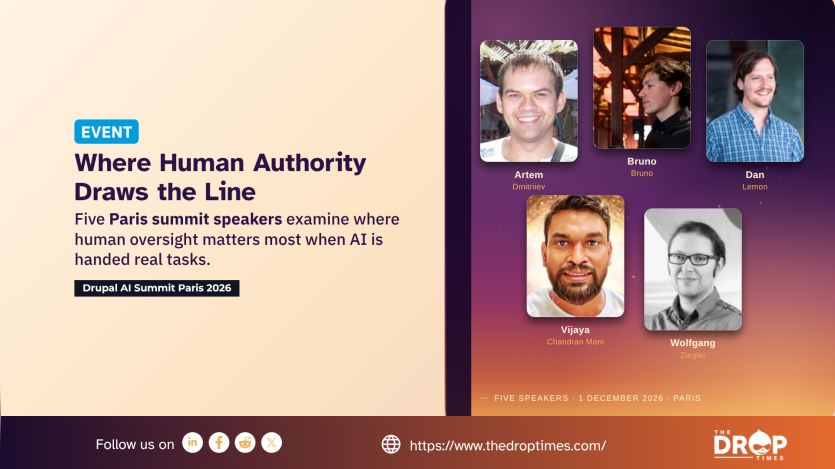
Ahead of the event, five speakers shared their perspectives with The DropTimes on the problems that prompted their sessions and the practices they believe organisations should reconsider. Their experiences reveal a set of connected challenges that extend beyond Drupal: how organisations prepare their systems for AI, maintain standards, protect information and determine which responsibilities remain with people.
For developers, business leaders and content teams planning their next AI investment, the summit's programme offers an opportunity to examine those decisions through architectural discussions, technical demonstrations and production case studies.
When AI Becomes a CMS User
Much of the early adoption of AI in content management has focused on assisting editors with individual tasks. The morning programme challenges that relationship by examining how websites serve AI-driven audiences and how agents could participate more directly in managing content.
At 11:00–11:25 CET (UTC+1), Artem Dmitriiev, senior Drupal AI developer at 1xINTERNET, explores the architectural changes required when AI takes on responsibilities traditionally assigned to human CMS users.
Artem Dmitriiev
Artem Dmitriiev
Stop treating AI as a feature you add to the editor screen, and start treating it as a user of your system with its own permissions, rules and audit trail.
–Artem Dmitriiev, senior Drupal AI developer, 1xINTERNET
Artem advocates structuring content independently of page templates and incorporating governance checks directly into generation workflows. External agents could then interact with content through application programming interfaces (APIs), subject to the permissions and validation rules configured by the organisation.
These considerations are particularly relevant to businesses planning website redesigns or managing digital platforms across multiple markets. Architectural decisions made today can influence how readily a platform accommodates automation later. Developers attending the session can examine whether existing content models, permissions and publishing workflows are suitable for agent-driven operations.
However, Artem also raises an unresolved question that technical architecture alone cannot answer: who takes responsibility when an AI agent publishes something it should not? He hopes the summit will address accountability alongside the practical costs of retaining the ability to operate independent AI models.
More Content or Less Editorial Work?
Giving AI greater responsibility does not necessarily mean asking it to produce more. For organisations managing hundreds of pages, improving the consistency of existing content may offer a more immediate application of the technology.
Following Artem's morning session, Bruno Bruno, frontend developer at 1xINTERNET, examines AI as an editorial review tool rather than a replacement for human authors. His session considers how organisations can assess content against their own standards and propose corrections while retaining editorial authority.
Bruno Bruno
Bruno Bruno
Stop using AI to only write more, and start using it as a review tool too.
–Bruno Bruno, frontend developer, 1xINTERNET
For content managers, this suggests a different way of evaluating AI investments. Instead of counting generated articles, organisations could measure the time spent identifying recurring errors, checking brand requirements and reviewing routine submissions. The usefulness of automation would depend partly on whether it reduces repetitive work without introducing additional review obligations.
Bruno hopes the wider discussion will examine precisely this distinction. AI may help organisations accomplish more work, but its value could also come from allowing specialists to spend less time on tasks that do not require their expertise.
A subsequent demonstration of Drupal Workspaces by Fabian Franz of Tag1 Consulting complements this discussion. The session examines how AI-generated changes can be prepared separately from the published site, giving teams an opportunity to inspect and revise them before deployment. Together, the morning sessions present different approaches to controlling what agents can do and when their work becomes public.
The Information Organisations Cannot Freely Share
Consider a communications team working on an unpublished announcement or a customer service department handling confidential support requests. Both could identify opportunities for AI assistance, yet neither can assume that every external AI service is appropriate for the information involved.
At 14:00–14:25 CET, Dan Lemon, software engineer at amazee.io, examines how organisations use Drupal AI in production while addressing requirements around data sovereignty.
Dan identifies a gap between the widespread use of AI and the ability of organisations to explain where their information is processed. His session draws on anonymised client examples involving content classification, accessible-language rewrites and search systems.
Dan Lemon
Dan Lemon
I’d stop treating data sovereignty as a compliance chore. It’s what lets you use AI on the content that matters.
–Dan Lemon, software engineer, amazee.io
Dan recommends documenting where AI services operate, who can access submitted information and what happens to that information after processing. He also advocates retaining the ability to change models or providers. The Drupal AI module provides a common framework for integrating multiple providers, although switching between them still requires consideration of their different capabilities and implementation requirements.
For technology executives and procurement teams, the discussion introduces questions that belong in supplier evaluations rather than being addressed only after deployment. Data residency, infrastructure ownership, retention policies and provider independence are distinct considerations. Hosting information in Europe, for example, does not automatically resolve every question of sovereignty.
Dan hopes the summit will challenge how organisations define sovereignty itself, particularly where infrastructure location, ownership and operational control do not align.
Where Human Judgement Cannot Be Replaced
The afternoon programme provides several opportunities to examine AI within established enterprise and public-sector systems. Among them are sessions covering Shell's developer portal and a multilingual answer engine for the European Personnel Selection Office. Medical research provides another example, with particularly demanding requirements for professional oversight.
CPRD provides anonymised clinical data for research. Applications undergo multiple stages of assessment, including checks related to information governance, research protocols and proposed data usage. Vijaya identifies the challenge as supporting application reviews without overburdening specialist reviewers or weakening existing oversight.
Vijaya Chandran Mani
Vijaya Chandran Mani
Embrace Human-in-the-Loop by design: Build the UX so AI augments rather than sidelines the human review hierarchy
The implementation connects a Drupal application portal to a separate AI review service built with Node.js. According to the session description, the service evaluates application information against domain-specific requirements and assists reviewers within the established process. The case study examines the integration architecture, the preparation of application data and the use of specialised knowledge to inform AI assessments.
The relevance extends beyond healthcare. Universities, government departments and enterprises also operate approval workflows that depend on specialist knowledge and established responsibilities. Their teams can examine how AI assistance is introduced without transferring final decision-making authority to an automated system.
The available session material does not quantify the implementation's accuracy or efficiency. Questions about incorrect recommendations, reviewer intervention and the evaluation of AI outputs therefore provide useful starting points for discussions with the speaker.
What Happens When AI Learns From Outdated Knowledge?
Even a carefully designed AI workflow depends on the information available to it. An automated assistant drawing on an obsolete policy or an inaccurate internal document can reproduce that error across multiple tasks. Improving the model alone cannot resolve deficiencies in the underlying knowledge.
At 16:30–16:55 CET, Wolfgang Ziegler, managing partner and chief technology officer at drunomics, examines knowledge management for organisations in which people and AI agents increasingly collaborate.
Wolfgang Ziegler
Wolfgang Ziegler
Stop treating knowledge management as a productivity tool on the side. It is shifting to strategic AI infrastructure.
–Wolfgang Ziegler, managing partner and chief technology officer, drunomics
Wolfgang's team developed OpenKnowledgebase using Drupal, Drupal AI and other open-source technologies. The project, currently in beta, combines Markdown-based content, collaborative editing and a built-in Model Context Protocol (MCP) server that allows external AI agents to interact with the knowledge base.
Its design supports review policies, records of content authorship and approval, and references connecting AI answers to source material. These capabilities address different aspects of information reliability, although their effectiveness depends on configuration and the quality of the review process.
For organisations developing internal AI assistants, Wolfgang's session raises questions that precede the selection of a language model. Who maintains internal documentation? How are outdated instructions identified? What happens when an agent proposes a change to an established organisational procedure?
Wolfgang hopes the summit will explore how much autonomy agents should receive and whether the Drupal community can translate its existing governance capabilities into shared practices for AI-assisted work.
What Organisations Can Take Back From Paris
The five speakers approach AI from different professional contexts, but their responses converge on the importance of retaining control over automated work. Artem examines the responsibilities assigned to agents, Bruno considers editorial quality, Dan addresses infrastructure independence, Vijaya explores professional oversight, and Wolfgang questions the reliability of organisational knowledge.
These perspectives also suggest a practical way for prospective attendees to prepare for the summit. Technical architects could examine an existing content model and identify where agents would require restricted access. Editorial managers could document a recurring review problem. Procurement teams could compare the data-handling conditions of their AI providers, while organisations introducing internal assistants could identify information that lacks a clear owner or review process.
Bringing an existing operational problem to the event may make its demonstrations and case studies more useful. It provides a basis for comparing approaches, questioning implementation decisions and assessing whether a particular solution is appropriate for an organisation's own requirements.
The wider FOST conference runs from 1–3 December 2026. According to the official event page, the organisers offer a discounted €149 pass covering the broader conference programme.
For organisations planning AI adoption in 2027, the questions raised by the Paris summit will remain relevant after the event concludes. Before assigning another task to an AI system, teams need to establish what information it can access, what it can change, how its work will be evaluated and who remains accountable for the result. Those decisions are as much a part of introducing AI into production as the technology itself.
Image Attribution Disclaimer: At The Drop Times (TDT), we are committed to properly crediting photographers whose images appear in our content. Many of the images we use come from event organizers, interviewees, or publicly shared galleries under CC BY-SA licenses. However, some images may come from personal collections where metadata is lost, making proper attribution challenging.
Our purpose in using these images is to highlight Drupal, its events, and its contributors—not for commercial gain. If you recognize an image on our platform that is uncredited or incorrectly attributed, we encourage you to reach out to us at #thedroptimes channel on Drupal Slack.
We value the work of visual storytellers and appreciate your help in ensuring fair attribution. Thank you for supporting open-source collaboration!
Disclosure: This content is produced with the assistance of AI.
Note: The vision of this web portal is to help promote news and stories around the Drupal community and promote and celebrate the people and organizations in the community. We strive to create and distribute our content based on these content policy. If you see any omission/variation on this please reach out to us at #thedroptimes channel on Drupal Slack and we will try to address the issue as best we can.
AI integration in Drupal - combining the best features and approaches from AI Interpolator, OpenAI, Augmentor and other modules for a unified framework and solution for AI in Drupal no matter what major model or service you choose to use.











 Kazima AbbasKazima Abbas is a sub-editor at The Drop Times